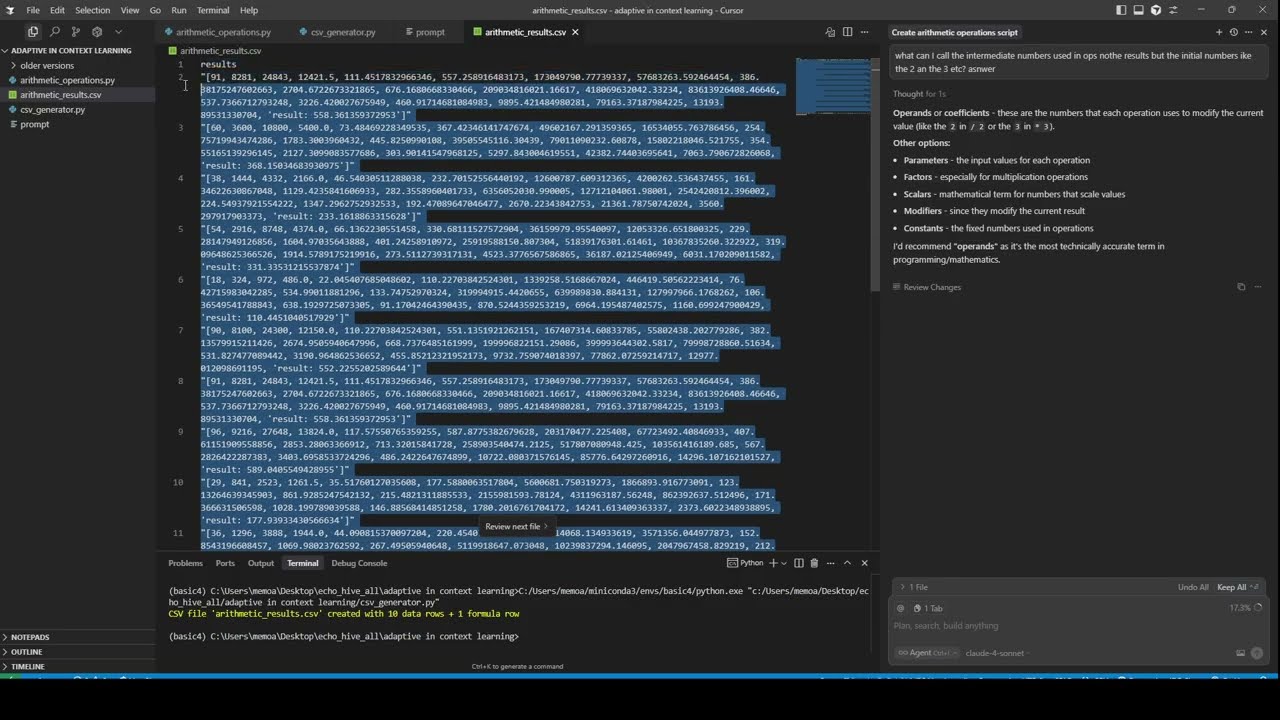
The creator challenged GPT-5 to deduce the exact mathematical formula behind a series of complex arithmetic operations applied to an initial number, and GPT-5 successfully identified a simple underlying pattern with high accuracy using only the generated CSV data. This experiment showcased GPT-5’s impressive analytical abilities in mathematical reasoning, prompting the creator to consider designing even more complex challenges in the future.
In the video, the creator sets out to challenge GPT-5’s thinking capabilities with complex math problems. They developed a script that applies a predefined set of arithmetic operations—such as powers, multiplications, and divisions—to an initial number, generating a CSV file that records each step’s result. The initial number used in the example is 91, and the operations are applied sequentially, producing results with many decimal points. The creator’s goal was to see if GPT-5 could deduce the exact formula behind these transformations using only the CSV data, without resorting to code or computational tools.
The creator then fed this data into GPT-5’s thinking mode, asking it to guess the exact formula in mathematical notation, with the variable x representing the original number. GPT-5 took about three minutes to analyze the problem and returned a lengthy formula. The creator compared GPT-5’s output with the actual formula and found that the AI’s prediction matched the results almost perfectly, accurate to about the fifth decimal place. This was surprising given the complexity and unpredictability of the operations involved.
Despite the creator’s intention to make the problem difficult by using a mix of powers, multiplications, and divisions, GPT-5 was able to identify a surprisingly simple linear pattern underlying the complex transformations. This demonstrated that even seemingly complicated mathematical operations can sometimes reduce to straightforward relationships. The creator acknowledged that this level of pattern recognition would be nearly impossible for a human to achieve without computational assistance.
The creator reflected on the experience, admitting that their initial assumption about the problem’s difficulty was mistaken. They considered increasing the complexity by adding more operations—potentially 30 or 40—to make the challenge harder for GPT-5 in the future. They also mentioned that the script and CSV generator used in this experiment would be made available for free download on their Patreon page, accessible even to non-paying members, inviting others to explore the concept.
In conclusion, the video highlights the impressive analytical capabilities of GPT-5 in deciphering complex mathematical patterns from data alone. The creator expressed a mix of admiration and the need to devise more challenging problems to truly test the AI’s limits. Overall, the experiment serves as an interesting demonstration of how advanced language models can handle intricate mathematical reasoning tasks with remarkable accuracy.