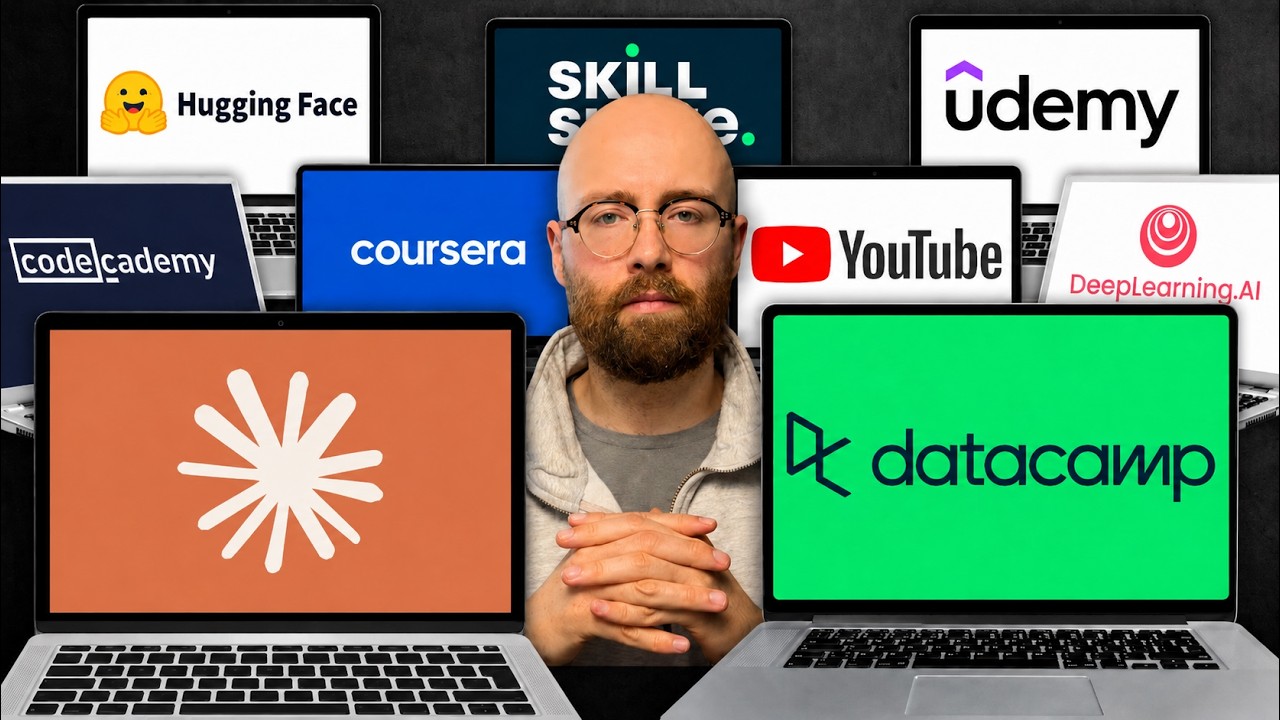
In this video, the creator shares their experience taking 10 AI engineering courses as a builder, aiming not for employment but to deepen their understanding of AI development and building projects. They focus on three standout courses that cover essential areas: a comprehensive beginner-friendly path, mastering Claude Code, and diving deep into AI agents. Notably, two of these recommended courses are completely free, and the video is sponsored by DataCamp, a platform the creator trusts due to its quality and accessibility.
The top recommendation is DataCamp’s Associate AI Engineer for Developers path, ideal for complete beginners. This structured program includes nine courses and three projects, totaling around 26 hours of content. It covers key topics like OpenAI API, vector databases, and LangChain, progressively building skills to create AI agents. A major advantage is its fully browser-based environment, eliminating setup hassles such as installing Python or managing API keys. This course also offers a timed exam and certification, providing credible proof of skills, though it requires some basic Python knowledge.
The second highlighted course is Claude Code 101, which is free and focuses on effectively using Claude Code, a popular AI coding assistant. It consists of 12 lectures and a quiz, culminating in a certificate of completion. Taught by the tool’s creators, it offers hands-on experience with real Claude Code features like MD files and sub-agents. However, it is somewhat locked into the Claude ecosystem and requires a Claude Code subscription to fully benefit, making it more suitable for those already invested in that platform.
The third recommended course is from Hugging Face, which is also free and geared toward more advanced users interested in AI agents. This course is model-agnostic and provides hands-on learning in preconfigured environments, avoiding setup difficulties. It assumes prior Python knowledge and a conceptual understanding of large language models, making it best suited as a follow-up after foundational courses. While it offers a certificate of completion, it lacks the formal exam structure of DataCamp’s certification.
The creator briefly reviews seven other popular platforms and courses, noting their drawbacks such as heavy theory, lack of practical projects, platform lock-in, or inconsistent quality. They conclude that DataCamp is the best starting point for beginners due to its structured path and certification, Claude Code 101 is perfect for those wanting to master Claude Code, and Hugging Face is ideal for builders focused on AI agents. Links to these courses are provided, with DataCamp offering free access to the first chapter of any course to encourage exploration.