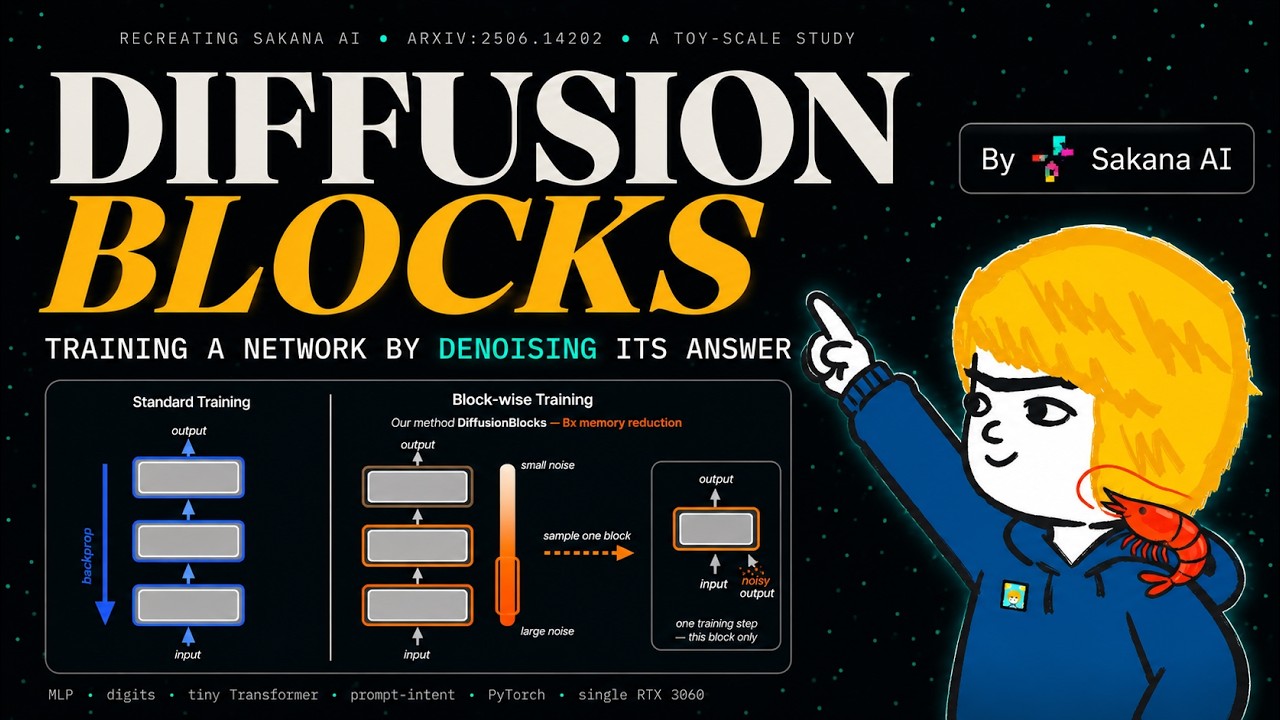
In this video, the creator explores a novel training method called diffusion blocks, introduced by Sakana AI, which aims to significantly reduce memory usage during neural network training. The core challenge addressed is the high memory demand of traditional backpropagation, which requires storing all intermediate activations simultaneously, causing memory usage to scale with model depth. Diffusion blocks propose training neural networks in independent blocks, each responsible for denoising a specific noise level band, allowing only one block’s activations to be held in memory at a time. This decoupling breaks the usual gradient chain and promises substantial memory savings.
The key insight behind diffusion blocks is the similarity between residual blocks in networks and diffusion model denoising steps. Both operate by taking an input state and adding a small correction or nudge towards cleaner data. By interpreting each residual block as a denoiser working on a specific noise level, the training can be split into separate blocks, each trained independently on its noise band. This approach enables training blocks in isolation, with no gradient flow between them, drastically reducing memory requirements and allowing potential parallel training across multiple devices.
The creator initially attempted to reproduce the diffusion blocks experiment but encountered issues due to insufficient block numbers and unsuitable model choices, such as classifiers instead of generative models. After refining the approach, they focused on generative denoisers with the same architecture and compute budget for both baseline and blockwise training. The experiment tested generation quality, peak memory usage, and training time across tasks of varying difficulty, including simple shapes and more complex patterns, to ensure a robust evaluation of the method’s effectiveness.
Results showed that diffusion blocks could achieve up to 2-3 times memory savings during training without sacrificing generation quality when using around four blocks, aligning with the original paper’s claims. However, pushing the number of blocks too high (e.g., 8 or 16) led to a significant drop in output quality, indicating a trade-off between memory savings and model performance. Additionally, while memory usage decreased, training time increased due to more frequent optimizer steps, highlighting a balance between resource savings and computational cost.
In conclusion, diffusion blocks present a promising approach to reducing memory consumption in training deep generative models by splitting the network into independently trained denoising blocks. The method works well up to a certain block depth, beyond which quality deteriorates. The creator emphasizes that this technique is part of ongoing efforts to optimize training efficiency and invites viewers to suggest other training optimizations for future exploration. Overall, diffusion blocks offer a valuable tool for training larger models on limited hardware by trading off some training speed for substantial memory savings.