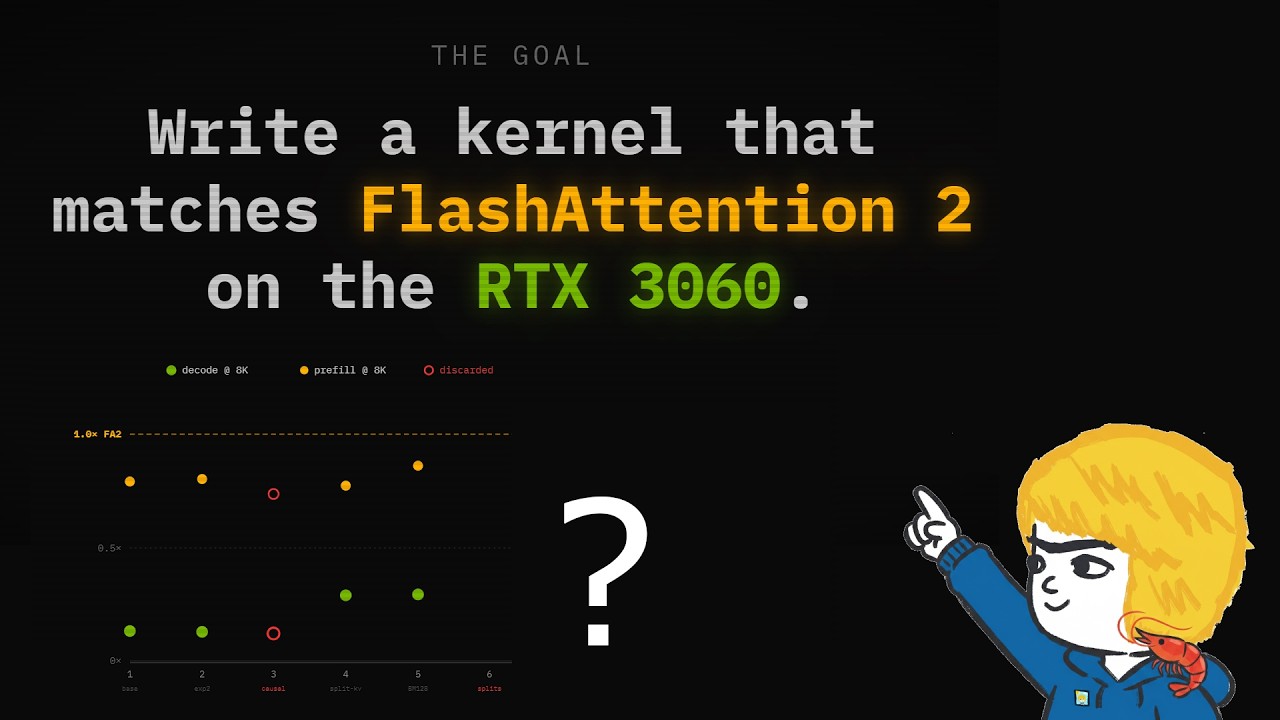
In this video, the creator explores optimizing GPU kernels specifically for the Nvidia RTX 3060, a consumer-grade graphics card, to improve the performance of local large language models (LLMs). Noticing that most existing kernels, like Flash Attention 2, are designed for data center GPUs rather than consumer hardware, the creator aims to write a custom kernel tailored to the 3060. Using Andre Karpathy’s auto research method—an approach where an AI agent iteratively tests and optimizes parameters—the goal is to surpass the performance of Flash Attention 2 on this specific GPU. The project leverages Triton, a Python-based language for writing GPU kernels, which allows faster iteration compared to traditional CUDA programming.
The video explains the importance of the attention mechanism in language models, which is computationally intensive and where most of the model’s time is spent. Flash Attention 2 is the current gold standard kernel used widely across AI frameworks but is optimized for high-end data center GPUs like the Nvidia A100. The RTX 3060, being a consumer card, has different hardware characteristics, so the creator’s approach is to customize and optimize the kernel to better fit this hardware. The process involves running a series of experiments suggested by the auto research agent to incrementally improve kernel performance.
Initial experiments focused on rewriting parts of the kernel to use faster GPU math operations, skipping unnecessary computations, and splitting workloads across all GPU processors to avoid idle time. While some experiments yielded significant speed improvements—especially in decoding workloads—others failed or had to be discarded due to software pipeline issues or correctness checks. Over time, the kernel’s performance improved dramatically, closing the gap with Flash Attention 2, particularly in decoding speed, which is crucial for generating tokens in language models.
Further tuning involved adjusting tile sizes, block configurations, and optimizing memory access patterns to reduce redundant data loading. These refinements brought the custom kernel’s performance on par with Flash Attention 2 across various workloads, with some metrics even surpassing it. The creator highlights that while Flash Attention 2 is highly optimized after years of development, the custom Triton kernel offers a competitive alternative that is easier to install and use on consumer GPUs, as Triton integrates seamlessly with PyTorch without requiring complex CUDA setups.
The project concludes as a modest but meaningful success, demonstrating that auto research can effectively guide kernel optimization for specific hardware. The creator has open-sourced the Triton GQA Flash Attention kernel for the RTX 3060 on GitHub, inviting others to experiment and improve upon it. Looking ahead, the creator plans to explore writing custom kernels optimized for AI agents, potentially enhancing performance for local models used in agent-based applications. The video encourages viewers to subscribe and stay tuned for future developments in this area.