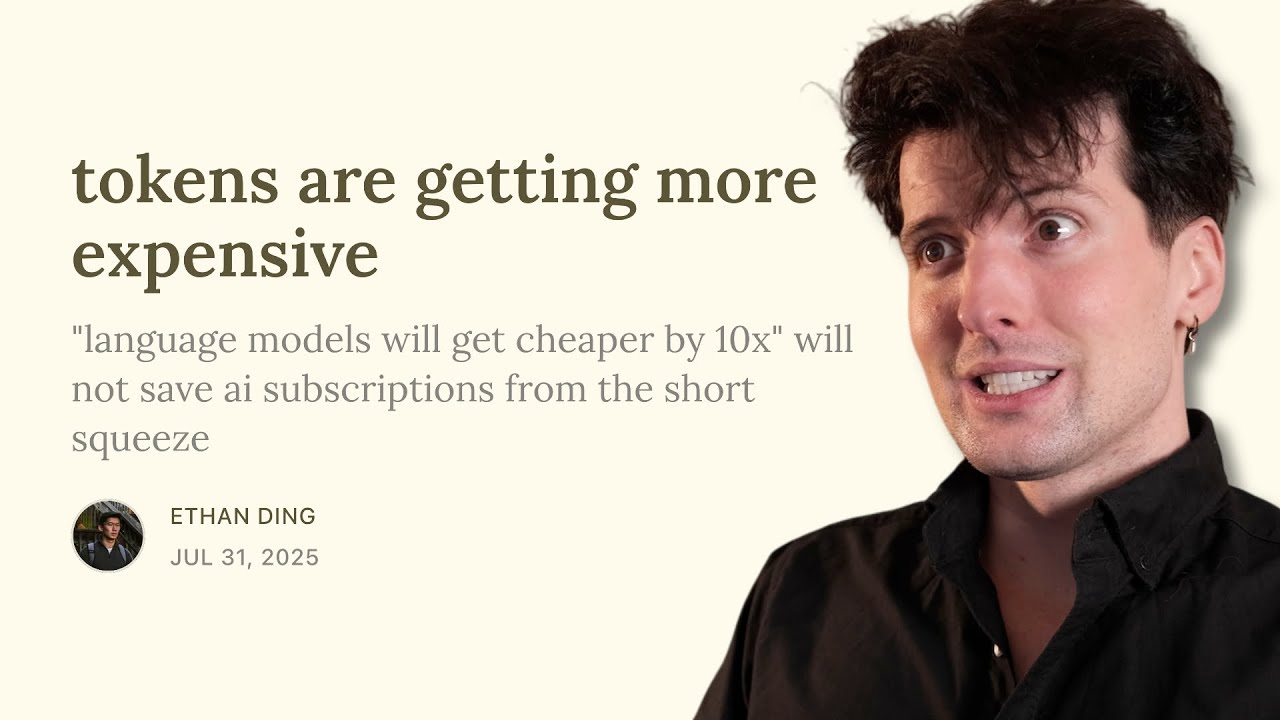
The video reveals that despite lower per-token prices, the overall costs of using advanced AI models like Grok 4 are rising due to the exponential increase in output tokens generated during complex reasoning tasks, making traditional cost metrics misleading. It also highlights the challenges AI companies face in balancing sustainable pricing models amid soaring token consumption, suggesting that enterprise-focused strategies may be necessary to maintain financial viability.
The video begins by revisiting the creator’s earlier optimism about AI model costs decreasing over time, which initially seemed promising for broader AI adoption. However, after conducting extensive benchmarks, the creator discovered that while token prices might appear cheaper on paper, the actual costs of running advanced models like Grok 4 are significantly higher due to the increased number of tokens generated during reasoning processes. This discrepancy arises because reasoning-heavy models produce far more output tokens, which are more expensive than input tokens, leading to unexpectedly high costs despite lower per-token prices.
A key insight shared is the distinction between input and output tokens, with output tokens costing substantially more. The video demonstrates how reasoning models, which generate detailed explanations and thought processes, consume exponentially more tokens than simpler models. For example, Grok 4’s reasoning output can be hundreds of tokens for a simple answer, inflating costs dramatically. This token explosion is a major factor driving up AI usage expenses, making the cost per token metric less relevant than the total tokens generated during complex tasks.
The creator also discusses the broader industry implications, highlighting that while AI models have become cheaper per token, the demand for higher-quality, reasoning-capable models keeps prices stable or even rising for the most sought-after models. This dynamic creates a “short squeeze” on token consumption, where users naturally gravitate toward the best-performing models and push them to their limits, resulting in skyrocketing operational costs. Subscription models offering unlimited usage are becoming unsustainable, as demonstrated by companies like Claude Code rolling back unlimited plans due to massive token consumption and financial losses.
The video further explores the challenges AI companies face in balancing pricing strategies. Usage-based pricing would reflect true costs but is unpopular with consumers who prefer flat-rate subscriptions, leading to a “prisoner’s dilemma” where companies subsidize heavy users to stay competitive but risk financial instability. The creator emphasizes that sustainable AI business models may require vertical integration, targeting enterprise clients with high switching costs, or bundling AI services with other infrastructure offerings to offset inference costs. This approach contrasts with consumer-focused, flat-rate models that are increasingly untenable.
In conclusion, the video underscores the complexity of AI economics today, where improvements in model capabilities drive up token consumption and costs despite cheaper per-token prices. The creator acknowledges the financial strain of benchmarking these models but stresses the importance of understanding these cost dynamics for building viable AI products. The video ends with a nod to ongoing discussions in the AI community about sustainable business models and a recommendation to follow related thought leadership for deeper insights into navigating this evolving landscape.