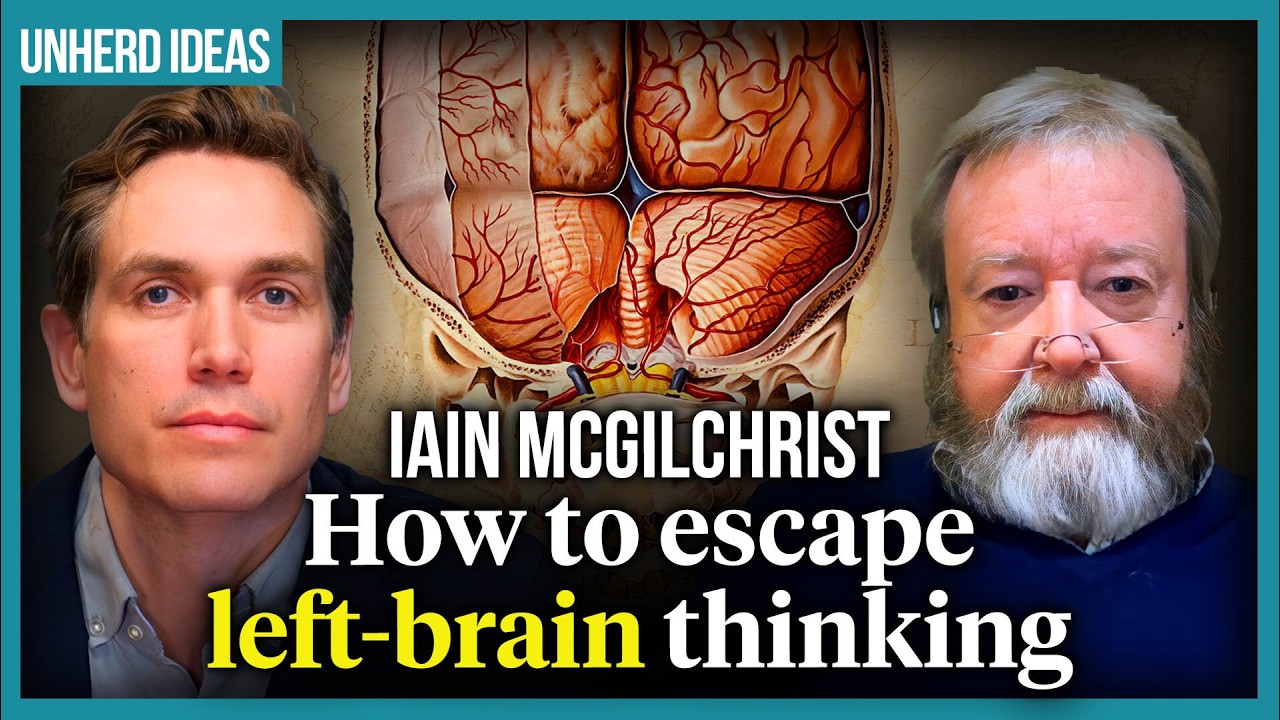
In this insightful conversation, neuroscientist and philosopher Iain McGilchrist explores the fundamental differences between the brain’s two hemispheres and their distinct ways of perceiving truth and reality. He challenges the simplistic notion that the left hemisphere is solely responsible for language and reason while the right handles emotion and imagery. Instead, McGilchrist explains that both hemispheres engage in all functions but differ primarily in their modes of attention: the left hemisphere focuses narrowly and analytically on details, while the right hemisphere maintains a broad, open, and integrative awareness of the world. This dual attention shapes two contrasting experiential worlds—one fragmented and abstract, the other interconnected and alive—highlighting the limitations of relying solely on left-brain thinking.
McGilchrist delves into the ancient Greek distinction between mythos and logos as two complementary forms of truth. Mythos, often dismissed today as mere myth or falsehood, actually conveys profound, holistic truths that cannot be fully captured by the analytical, dissecting approach of logos. He illustrates this with examples from art, poetry, and mythology, such as the story of Orpheus and Eurydice, emphasizing that some truths are relational, paradoxical, and accessible only through a right-hemisphere mode of understanding. This perspective challenges modern reductionist views, including those of prominent figures like Richard Dawkins and Steven Pinker, who prioritize empirical facts and rationality but often overlook the deeper, non-literal truths embedded in myth and religious narratives.
Addressing the tension between science and spirituality, McGilchrist argues that reason and scientific inquiry are vital but insufficient on their own. He advocates for a balanced approach that also values intuition, imagination, and a sense of the sacred—qualities nurtured by the right hemisphere. He critiques the modern Enlightenment’s overemphasis on rationality and explicit knowledge, suggesting that this has led to a diminished appreciation for mystery, faith, and relational truth. Rather than rejecting the Enlightenment, he calls for its supplementation with a renewed recognition of the right hemisphere’s capacities, which can foster wisdom and a more profound engagement with life’s complexities.
Turning to Christianity, McGilchrist describes it as the greatest of all myths—not in the sense of being untrue, but as a narrative rich with deep spiritual and existential truths that transcend literal historicity. He shares his personal journey of faith, emphasizing allegiance and ongoing dialogue with the Christian story rather than dogmatic certainty. He also highlights the historical role of Christianity in shaping Western civilization’s values, such as compassion and humility, and warns against the dangers of losing these foundations. While acknowledging the risks of politicizing religion, he advocates for a gentle, lived revival of Christian practices and values in daily life and education as a means to restore balance and meaning in contemporary society.
Finally, McGilchrist reflects on the broader cultural and political challenges of re-integrating right-hemisphere wisdom into a predominantly left-brain dominated world. He cautions against simplistic or forceful solutions, instead promoting awareness, openness, and small-scale community efforts akin to monastic centers that nurture spiritual growth and social cohesion. Drawing on Eastern philosophical concepts like non-doing and unknowing, he envisions a gradual, organic renewal grounded in personal responsibility and relationality. Despite his pessimism about current trends, he remains hopeful that even a small shift in collective consciousness could lead to significant positive change within a decade, fostering a richer, more balanced understanding of truth, meaning, and human flourishing.