In this video, the creator continues exploring the frontier of running advanced AI models locally at home, focusing on benchmarking various versions of the GLM52 model and other alternatives. He emphasizes that while he uses a high-end machine with four RTX Pro 6000 GPUs, such powerful hardware is not strictly necessary for most coding tasks. Models like the Quen 35B A3B and Dense 27B Quinn can handle about half of coding workloads efficiently, and for heavier tasks, one can still rely on APIs. He also notes the rising cost of RTX Pro 6000 GPUs, likening them to the new Bitcoin due to their price increases, but stresses that local AI compute remains a viable option for those who want consistent, quota-free access without relying on external APIs.
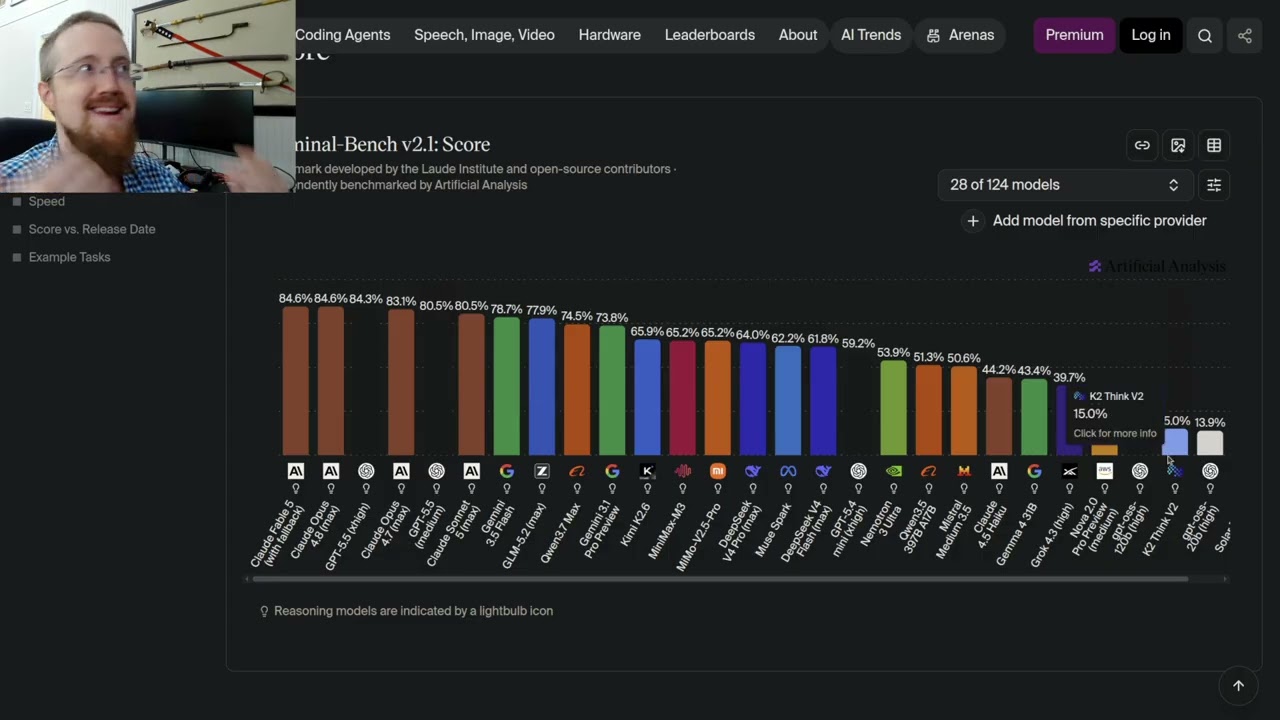
The main challenge in running local AI models, according to the creator, is not just the expense but the complexity of understanding various technical aspects such as quantization formats (e.g., GGUF, MXFP4, NVFP4), llama CPP, tensor parallelism, and pipeline parallelism. These factors significantly impact model performance and usability. He shares his experience benchmarking models using Terminal Bench v2.1, a software engineering-focused benchmark, and highlights that the DeepSeek V4 Flash model, a relatively small 160GB model, outperformed others in terms of speed and reliability, making it his preferred choice for local AI work.
The creator compares different quantization levels of GLM52, noting that 2-bit and 4-bit versions perform similarly on benchmarks, but 8-bit quantization significantly reduces performance. He also discusses the trade-offs between model size, precision, and speed, emphasizing that DeepSeek V4 Flash runs exceptionally fast—up to 1,200 tokens per second with tensor parallelism—making it more efficient than cloud-based models for his use case. Despite some skepticism about newer quantization methods like NVFP4 and the “reap” technique, he remains focused on practical performance and usability, favoring models that balance speed, accuracy, and reliability.
The video also touches on the importance of human involvement in the AI loop, as fully autonomous models sometimes fail on complex tasks that a human could easily correct. The creator prefers models that allow him to stay engaged in the engineering process rather than fully hands-off solutions. He warns about the risks of running AI models with high permissions and stresses the need for caution, even with trustworthy models like DeepSeek V4 Flash. Additionally, he discusses concurrency and token efficiency, noting that while increasing concurrency generally boosts throughput, some anomalies occur at specific concurrency levels, which he is still investigating.
Finally, the creator plans to continue benchmarking more models, including the High3 and Neotron 3 Ultra, to find the best balance of performance and resource requirements for different hardware setups. He invites viewers to suggest benchmarks related to long-horizon, agentic software engineering tasks and expresses interest in expanding beyond Terminal Bench v2.1. Overall, he encourages the community to explore local AI compute seriously, highlighting that with the right models and hardware, it is possible to achieve high performance without relying on cloud APIs, making local AI a practical and exciting frontier.