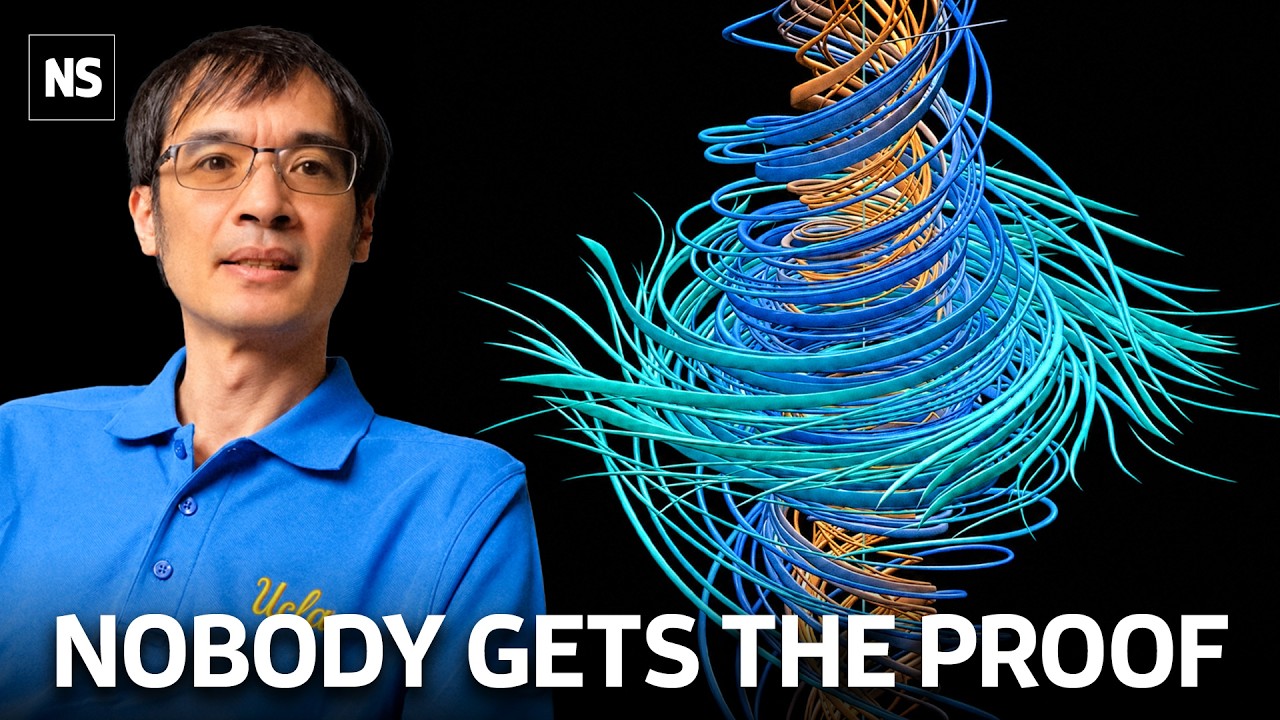
Terence Tao discusses the growing role of AI in mathematics, highlighting its strength in producing formal proofs like the AI-assisted Navier-Stokes solution but cautioning that AI currently lacks the ability to foster deep understanding and meaningful insights essential for mathematical progress. He emphasizes the need for responsible integration of AI, continued interdisciplinary collaboration, and a balanced approach that values both rigorous problem-solving and abstract thinking to ensure the healthy evolution of mathematics.
The video features a conversation with Terence Tao, a renowned mathematician, discussing the intersection of AI and mathematics in today’s rapidly evolving landscape. Tao highlights that while AI has become exceptionally proficient at solving mathematical problems, it primarily excels at producing answers rather than fostering deeper understanding or generating new mathematical insights. He emphasizes that mathematics is not just about finding solutions but about uncovering connections and building comprehensive theories, a dimension where AI has yet to make significant contributions. Tao also points out the challenges posed by the rapid development of AI technologies, which have outpaced efforts in AI safety, alignment, and interpretability, raising concerns about potential risks.
A significant portion of the discussion centers on the recent AI-assisted solution to the Navier-Stokes problem, one of the famous Millennium Prize problems. Tao explains that although AI managed to produce a formal proof verified by the Lean proof assistant, the mathematical community struggles to fully comprehend or derive meaningful insights from it. Unlike traditional human-generated proofs that advance understanding and inspire further research, this AI-generated proof is seen as a “strip mining” approach that risks damaging the collaborative and cumulative nature of mathematical progress. Tao calls for responsible integration of AI in mathematics to ensure the field’s healthy development.
Tao elaborates on the nature of mathematics as a discipline that balances rigorous problem-solving with abstract thinking and modeling of the real world. He discusses the importance of abstraction as a safe playground for exploring ideas without real-world consequences, using examples from everyday life and physics. Tao also stresses the necessity of understanding the limitations of mathematical models, citing the 2008 financial crisis as a cautionary tale where overreliance on flawed models led to catastrophic outcomes. This nuanced view underscores the importance of both precision and humility in mathematical applications.
The conversation also touches on the evolving role of AI as both a tool for solving mathematical problems and a subject of mathematical inquiry itself. Tao notes that while AI technologies like machine learning have achieved remarkable practical success, the theoretical understanding of why and how they work remains incomplete. He highlights areas such as optimization theory, topological data analysis, and information theory as crucial for developing a rigorous mathematical foundation for AI. Tao envisions a future where mathematicians collaborate across disciplines—including cognitive science, neuroscience, and philosophy—to address the challenges and opportunities presented by AI.
Finally, Tao reflects on enduring open problems in mathematics, such as the twin prime conjecture, emphasizing their intrinsic appeal due to their simplicity in statement but complexity in solution. He shares his hope that future breakthroughs will not only solve these problems but also provide clear insights accessible to the mathematical community. Tao concludes with a philosophical note on the infinite nature of mathematics, reassuring that despite AI’s advances, there will always be new frontiers to explore, ensuring the field’s vitality for generations to come.
Useful Links