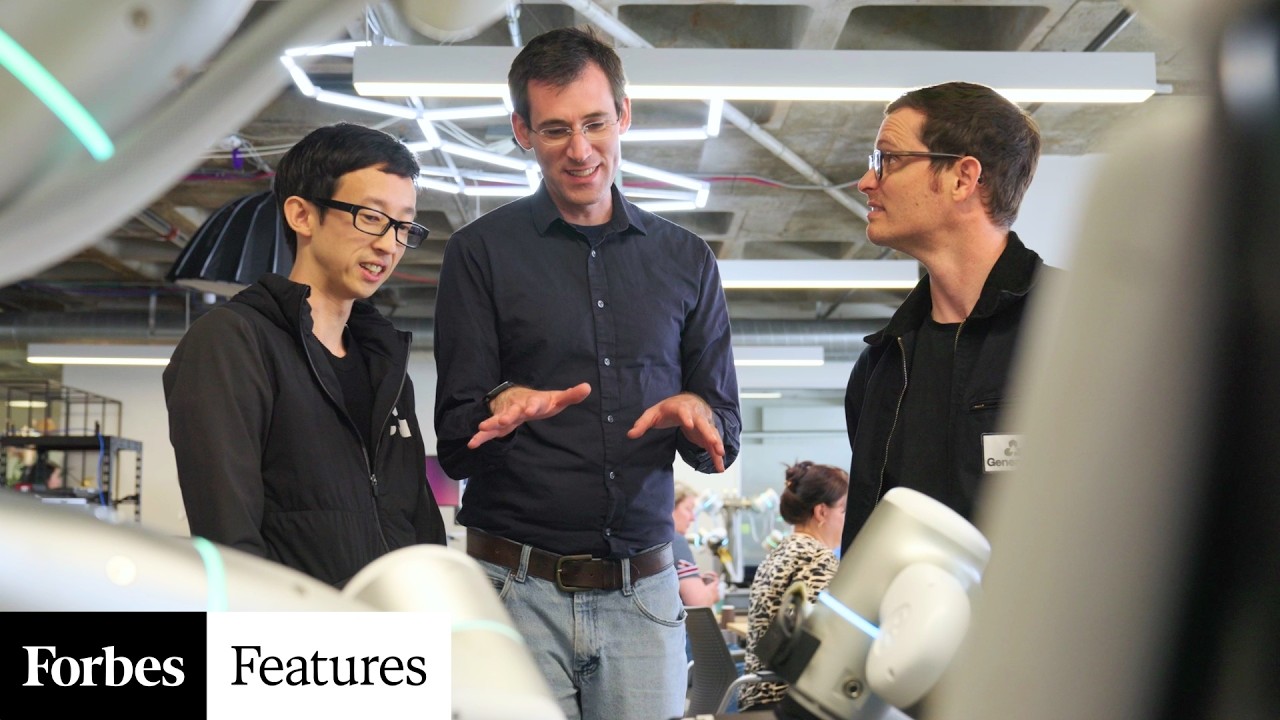
The video explores the groundbreaking work of Generalist, a startup valued at $440 million, which is pioneering the development of advanced AI “brains” for physical robots. While artificial intelligence has made significant strides in digital realms, enabling tasks like writing code, the physical world remains a challenging frontier. Tasks that require delicate manipulation, such as folding clothes or packing boxes with precise force, have proven difficult for robots due to limitations in traditional programming methods. Generalist’s founders, with backgrounds in applied physics, robotics, and autonomous drones, recognized the need for a new approach that leverages large-scale data to enable robots to interact with the physical world as intuitively as AI models handle text.
Generalist is at the forefront of bringing robotics into the “pre-training era,” similar to the revolution seen with large language models. Unlike text data, robotics data is scarce and not readily available on the internet, so the company has built its own proprietary data collection system. This includes specialized hardware called Data Hands, designed to capture human dexterity in a scalable way. With half a million hours of dexterous robotics data, Generalist is uniquely positioned to train foundational robotics models that can perform complex, delicate tasks by drawing on extensive pre-training, enabling robots to handle real-world physical challenges with unprecedented skill.
One of the key breakthroughs highlighted is the robot’s ability to perform intricate tasks, such as servicing a robot vacuum, by applying the right amount of force and coordinating both hands dynamically. This level of physical common sense and reactive intelligence allows robots to recover from unexpected disruptions, like being hit or having objects knocked from their grasp, showcasing a form of improvisational intelligence that has long eluded robotics. The company’s models demonstrate adaptability and micro-corrections in real-time, pushing the frontier of AI research into physical interaction and manipulation.
Generalist’s strategy emphasizes simplicity and scalability in hardware design to overcome traditional barriers like complex machinery and supply chain issues. By focusing on first principles and creating hardware that captures the essential 80% of capabilities, they aim to make robotics accessible and usable by a broad audience without requiring specialized expertise. This approach supports the vision of widespread adoption, where Generalist’s AI models could power a diverse ecosystem of robots across industries, rather than building all the robots themselves.
Looking ahead, Generalist envisions their robotics foundation models becoming the universal “brains” for millions or even billions of robots worldwide. Much like how language models revolutionized digital interaction, these physical AI models will enable a new wave of innovation, allowing developers and entrepreneurs to build creative robotic applications. The future promises a physical AI boom powered by adaptable, intelligent systems capable of performing infinite tasks, fundamentally transforming how humans interact with machines in everyday life.