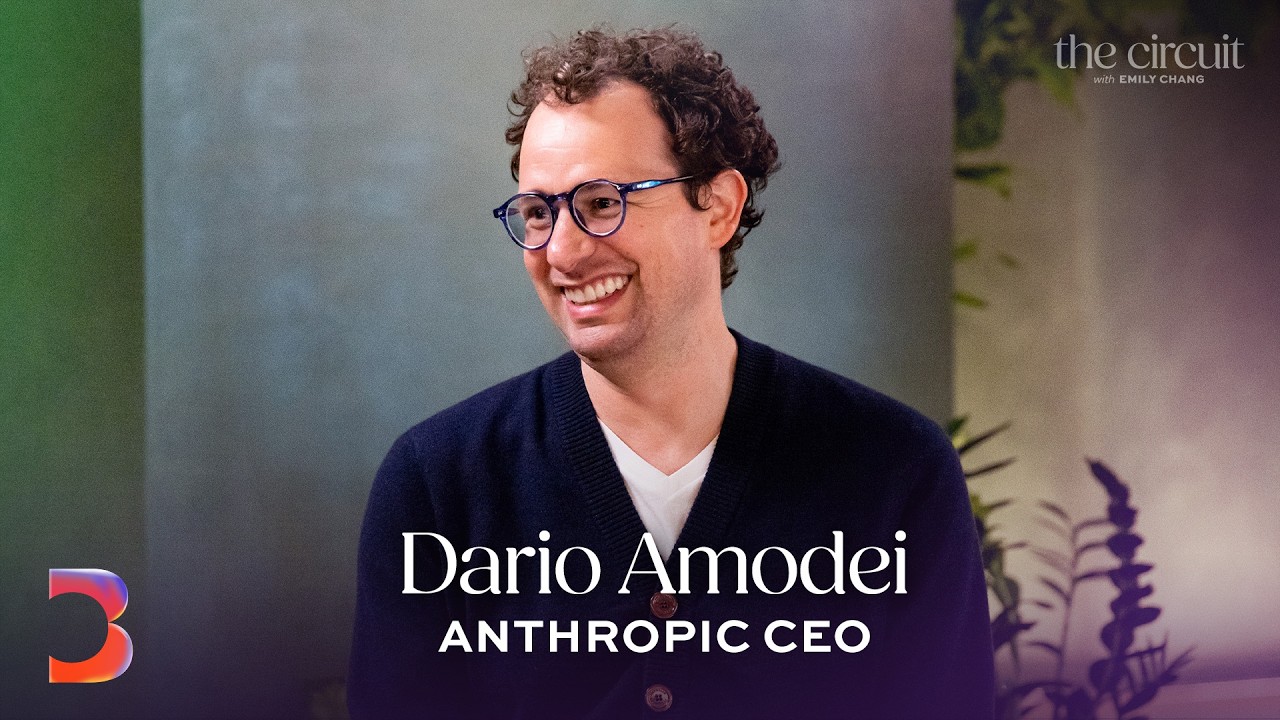
Anthropic CEO Dario Amodei shares insights into the rapid and exponential growth of AI technology, likening the experience to relativistic time dilation where developments accelerate beyond normal perception. Despite the intense pressure and fast pace, Amodei emphasizes the importance of maintaining rational decision-making and calm, avoiding paranoia or panic. He reflects on his upbringing in San Francisco, highlighting how the city’s spirit of nonconformism and individualism influenced his worldview and approach to innovation. Amodei also discusses his departure from OpenAI, attributing it to fundamental disagreements over trust and values rather than just technical or safety concerns.
Amodei explains Anthropic’s strategic focus on enterprise and coding applications rather than consumer-facing products, aligning their business model with their values to avoid conflicts that could compromise their mission. He stresses that model quality is paramount in maintaining a competitive edge, acknowledging the ease with which developers can switch platforms but confident in Anthropic’s technological lead. Regarding the broader software industry, he predicts significant disruption as AI automates many tasks, urging companies to identify and leverage their unique moats to survive and thrive in the evolving landscape.
On the topic of AI’s societal impact, Amodei candidly addresses concerns about job displacement, estimating that AI could eliminate up to half of entry-level white-collar jobs within five years. He advocates for proactive planning and policy responses to manage this disruption, emphasizing the need to expand economic opportunities and create new roles that complement AI capabilities. Amodei also touches on the ethical complexities of AI’s military applications, explaining Anthropic’s cautious engagement with the Department of Defense and their firm stance against fully autonomous weapons and mass surveillance, underscoring the necessity of human oversight in AI-assisted military decisions.
Amodei reveals Anthropic’s development of Mythos, a powerful AI model capable of autonomously identifying and exploiting cybersecurity vulnerabilities. Due to its potential risks, the company has chosen a measured release strategy, prioritizing defensive uses and collaborating with government agencies to mitigate counterintelligence threats. He rebuffs claims that Mythos’s capabilities can be easily replicated by open-source models, highlighting the significant commercial and security advantages it provides. This cautious approach exemplifies Anthropic’s broader commitment to balancing innovation with safety and responsibility in AI deployment.
Finally, Amodei reflects on the broader governance challenges posed by AI, advocating for checks and balances involving both private companies and governments to ensure responsible development and use. He acknowledges the unprecedented nature of AI as a powerful technology emerging primarily from the private sector and stresses the importance of transparency, regulation, and public accountability. Despite the risks, including a non-negligible chance of civilizational collapse, Amodei remains optimistic about AI’s potential to drive a century of scientific progress and improve human life, provided that society navigates the exponential growth thoughtfully and collaboratively.