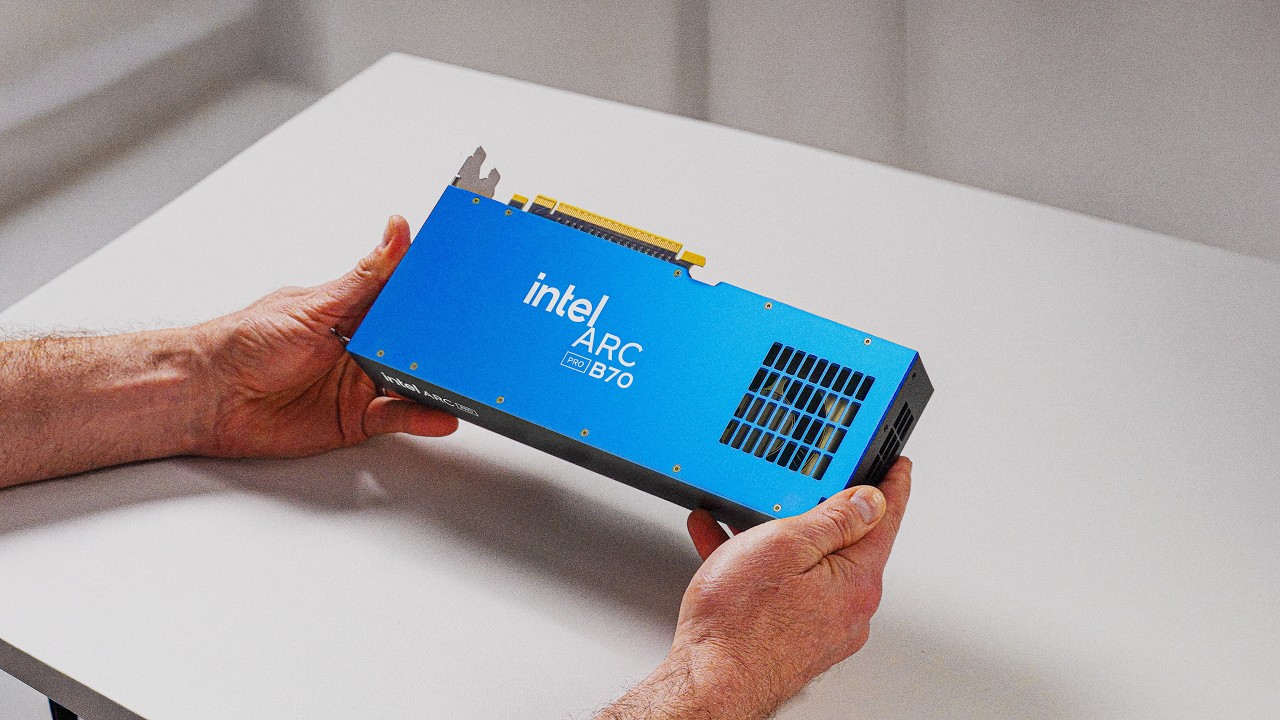
The video introduces Intel’s new Arc Pro B70 GPU, a successor to the B50, highlighting its impressive 32 GB VRAM and sub-$1,000 price point, which is significantly cheaper than Nvidia’s RTX 5090 priced near $4,000. The presenter compares the B70 with Nvidia’s RTX Pro 4000 and AMD’s Radeon AI R9700, both also featuring 32 GB VRAM but at higher prices and with different memory bandwidths. Despite the B70 having the lowest memory bandwidth, it offers competitive performance for local AI workloads, making it a cost-effective option for professionals needing substantial VRAM.
Performance testing focuses on local AI model benchmarks using various software stacks like Llama CPP, Vulcan, and VLM. The B70 shows strong results, often outperforming Nvidia’s RTX 4000 in prompt processing and token generation, especially under higher concurrency workloads. However, Nvidia’s card benefits more from certain quantization methods like AWQ, which improve speed and efficiency. AMD’s R9700, while having good hardware specs, lags behind in performance due to less mature software support, highlighting the critical role of optimized software stacks in GPU performance.
The video also explores practical applications such as image and video generation, where the B70 and R9700 perform similarly despite differences in software versions and hardware specs. The Intel GPU benefits from Intel-specific patches and custom nodes integrated into Comfy UI, whereas AMD relies on the Rockom stack, which is still catching up in terms of optimization. The presenter notes that Nvidia’s advanced software ecosystem justifies its higher prices, but Intel’s offering provides a compelling balance of price and capability for local AI tasks.
Scaling tests with four B70 GPUs demonstrate good prompt processing improvements but reveal some limitations in token generation speed due to PCIe bandwidth constraints. The presenter runs larger AI models, such as the Quen 3 coder 30B, showing that the combined 128 GB VRAM across four B70s can handle substantial workloads, although software support for the latest models remains a bottleneck. Real-world coding assistant tests indicate that while the hardware is capable, software maturity and model compatibility are crucial for optimal performance.
In conclusion, Intel’s Arc Pro B70 offers a highly competitive price-to-performance ratio for local AI workloads, challenging Nvidia and AMD’s more expensive GPUs. While Intel and AMD still need to improve their software stacks to fully leverage their hardware, the B70’s affordability and solid performance make it an attractive choice for professionals working with large AI models and demanding applications. The video encourages viewers to consider software compatibility alongside hardware specs when choosing GPUs for AI tasks and points to ongoing developments that may further enhance Intel’s position in this space.