In his talk, Prof. David Krakauer explores the intertwined concepts of complexity, life, and intelligence, suggesting that these terms may not be as distinct as traditionally thought. He contrasts the famous slogan “More is different,” associated with emergence, with his own idea that intelligence is better captured by “Less is more.” Krakauer argues that intelligence involves finding simpler, more compact patterns or rules within the complexity of the world, much like how Newton’s inverse square law simplified the understanding of planetary motion compared to earlier models. He emphasizes that science, like poetry, is a humanistic endeavor aimed at making the universe intelligible and meaningful rather than merely controlling or predicting it.
Krakauer delves into the nature of intelligence by discussing various perspectives, including behaviorist views and evolutionary definitions. He highlights that intelligence is not equivalent to knowledge; rather, it is the capacity to acquire new abilities and adapt intentionally to achieve goals. He critiques large language models (LLMs) for being “more is more” systems—vast repositories of knowledge without true intelligence, which he defines as “less is more.” Intelligence, in his view, involves creativity, imagination, and the ability to solve problems without relying solely on accumulated information.
A key insight Krakauer offers is the relationship between life, intelligence, and evolution framed in terms of physics concepts: life as an intensive property of adaptive matter and intelligence as its extensive counterpart. He explains that intelligence corresponds to the accumulation of information—bits stored in genomes or brains—that records history and enables adaptation. This framework implies that all living systems are inherently intelligent to some degree because they store and use information to adapt to selective pressures. He uses this to distinguish between different levels of intelligence across species, such as the difference between an elephant and a worm.
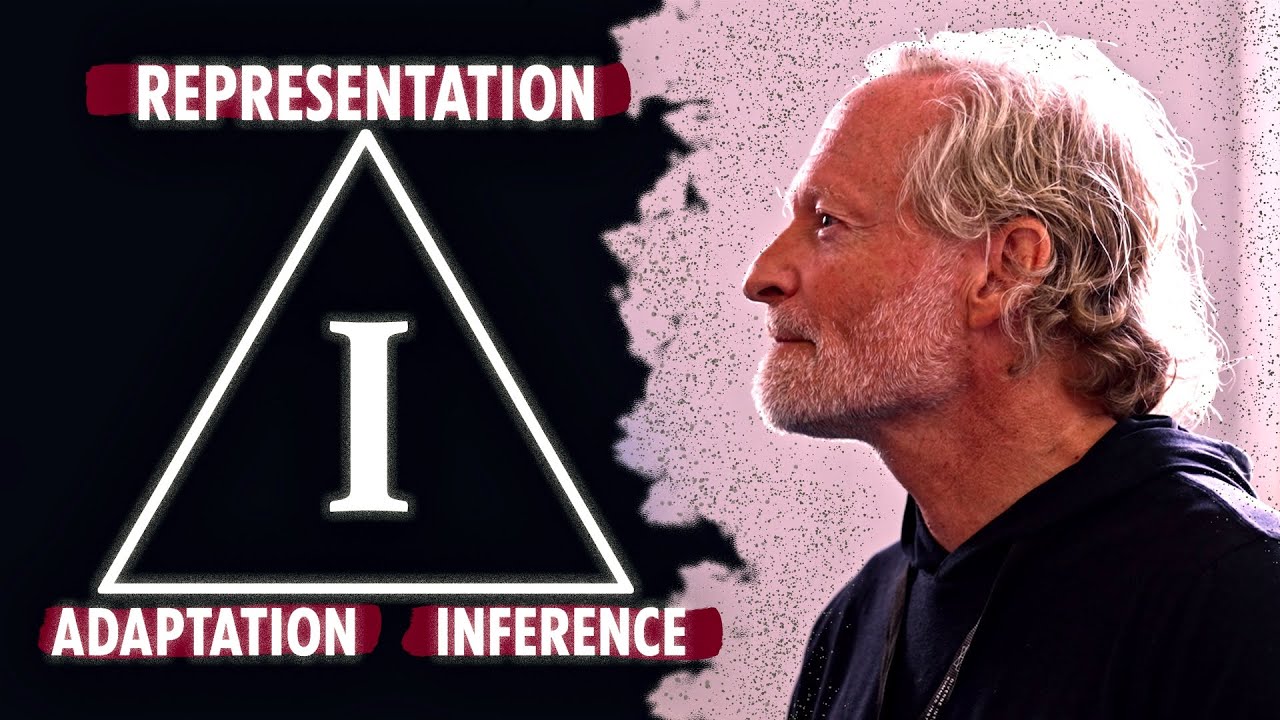
Krakauer further conceptualizes intelligence as existing in a three-dimensional space comprising strategic intelligence (adaptability), inferential intelligence (reasoning and calculation), and representational intelligence (encoding and symbolic representation). He notes that viruses excel in strategic intelligence, humans have developed inferential intelligence supported by tools like calculators, and representational intelligence involves sophisticated symbolic systems like mathematics. He contrasts the evolutionary paths of biological intelligence and artificial intelligence, suggesting AI started as inferential and is moving toward agentic and representational forms.
Finally, Krakauer discusses the principle of materiality, illustrating how physical artifacts and embodied representations can simplify complex problems by constraining search spaces through physical laws like exclusion and binding. He argues that intelligence fundamentally involves transforming hard problems into easier ones using strategy, inference, and representation, while stupidity does the opposite by making easy problems hard. This broad, physics-informed view of intelligence applies across species and systems, emphasizing the adaptive and problem-solving nature of intelligence beyond just human cognition.