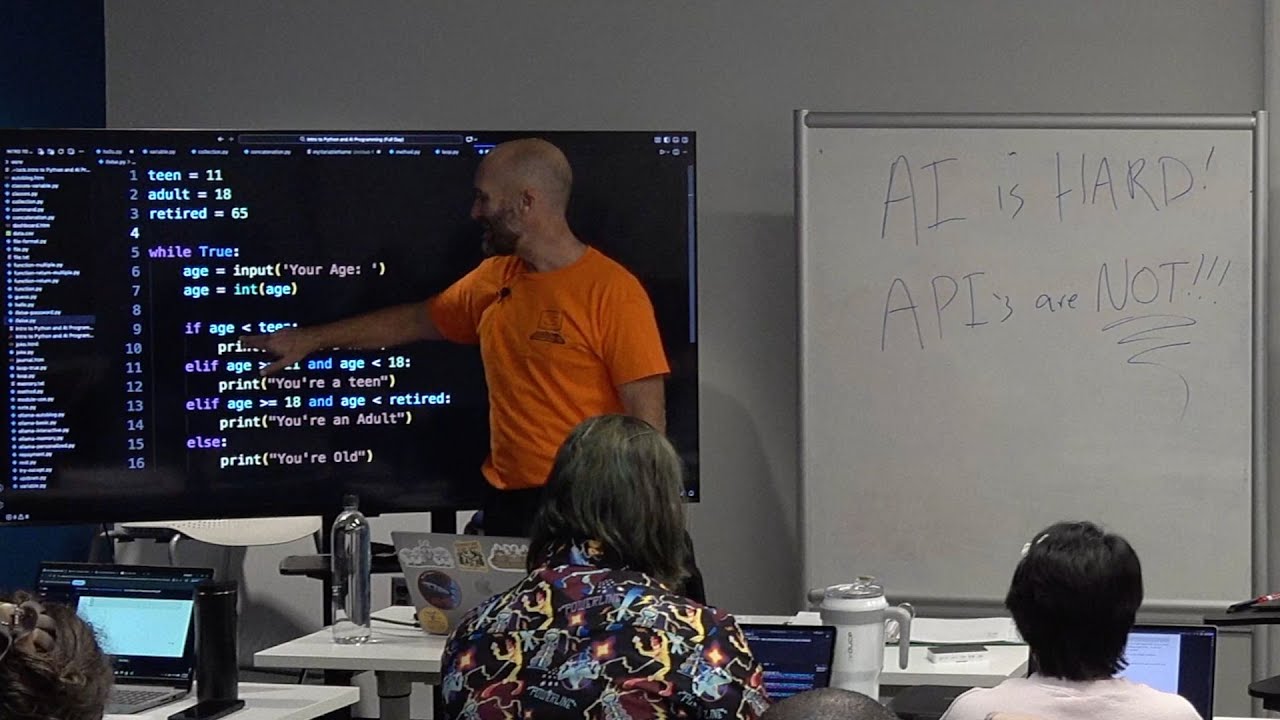
The video is a comprehensive, full-day introductory class on Python and AI programming, led by an experienced instructor with a background in technology education. The session begins with an overview of the class structure, emphasizing a collaborative learning environment where students are encouraged to help each other. The instructor shares his journey in tech, the philosophy behind Silicon Dojo, and the importance of hands-on, authority-free education. He also discusses the logistics of class attendance, the value of networking, and the rationale for using Python as the primary teaching language due to its versatility and accessibility.
The class covers the basics of Python, starting with installation instructions for different operating systems (Windows, Mac, Linux), the use of VS Code as an Integrated Development Environment (IDE), and the importance of installing the Python extension for code highlighting and error detection. The instructor explains Python’s interpreted nature, the significance of using the correct version (Python 3), and the role of modules and frameworks in extending Python’s functionality. He also introduces the concept of virtual environments (venv) for managing dependencies and preventing conflicts between projects.
Core programming concepts are thoroughly explained, including variables, data types (int, float, string), collections (lists, tuples, sets, dictionaries), and methods for manipulating these data structures. The instructor demonstrates how to use comments, naming conventions (snake_case vs. camelCase), and string concatenation (with f-strings) for readable and maintainable code. Control structures such as loops (while, for) and conditionals (if, elif, else) are illustrated with practical examples, and students are guided through hands-on labs like a guessing game and a loan repayment calculator to reinforce these concepts.
The session transitions into more advanced topics, such as interacting with REST APIs using the requests module, parsing JSON data, and handling errors with try-except statements. The instructor explains the importance of service-oriented architecture, the use of API keys, and best practices for error handling and code reusability through functions and classes. File operations (reading, writing, formatting), operating system interactions, and the basics of web scraping with BeautifulSoup are also covered, culminating in practical labs like building an up/down dashboard and an auto-blog generator.
In the final segment, the focus shifts to AI programming using the open-source Olama framework, which allows students to run large language models (LLMs) locally. The instructor walks through installing Olama, downloading models, and integrating AI capabilities into Python scripts. Students learn to build interactive AI applications, personalize responses using geolocation data, implement memory for conversational context, and automate content creation by scraping and summarizing web articles. Throughout, the instructor emphasizes the importance of practical experience, architectural thinking, and adapting to the rapidly evolving landscape of AI and software development.