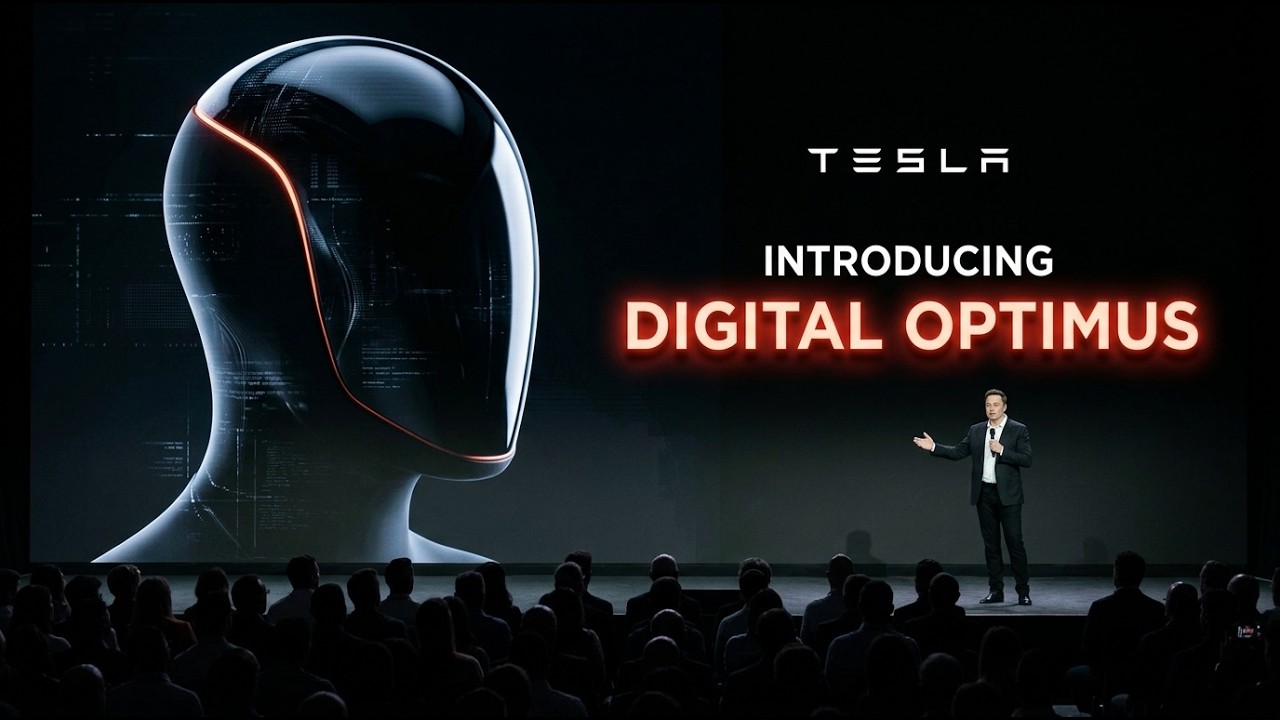
Elon Musk recently unveiled an ambitious new vision for artificial general intelligence (AGI) called “Digital Optimus,” alongside a project humorously named “Macro Hard”—a deliberate play on Microsoft’s name. The core idea is to create an AI agent that can operate a computer like a human office worker, using a keyboard and mouse to perform tasks such as data entry, emails, and customer service. Musk’s approach draws inspiration from the dual-system model of human cognition, with a fast, reactive “system one” (Digital Optimus) handling real-time interactions, and a slower, more thoughtful “system two” (Grok, XAI’s chatbot) providing context and higher-level reasoning.
Unlike current AI agents from companies like Anthropic, OpenAI, or Google, which rely on static screenshots to interact with computers, Digital Optimus is designed to process continuous, real-time video feeds of the screen. This method mirrors Tesla’s self-driving technology, which processes live video from car cameras to make driving decisions. The fast, reactive component runs on Tesla’s affordable AI4 chip, while the more computationally expensive reasoning is handled in the cloud, making the system both efficient and scalable.
Musk’s broader AGI vision involves both a physical and digital Optimus. The physical Optimus is a humanoid robot designed to perform real-world tasks, while Digital Optimus handles all computer-based work. Both use the same AI hardware and learning methods, with reinforcement learning enabling them to adapt to their respective environments. This dual approach aims to cover nearly all types of human labor, positioning Tesla and XAI as leaders in embodied AGI—intelligence that operates seamlessly in both digital and physical realms.
However, the project has faced significant internal turmoil. A recent Business Insider report revealed that the Macro Hard initiative at XAI had stalled, with leadership turnover, team departures, and halted data collection. Key engineers left or were reassigned, and the project’s direction shifted multiple times. In response to these setbacks, Musk reframed the effort as a joint Tesla-XAI project, moving much of the work to Tesla’s autopilot team and rebranding it as Digital Optimus, suggesting a strategic pivot rather than a planned evolution.
Despite the technical promise—especially Tesla’s unique advantage in real-time video processing and distributed computing via its fleet of vehicles—the gap between Musk’s grand vision and current reality is substantial. Competing companies are already shipping working AI agents, while Macro Hard/Digital Optimus has struggled with execution and leadership. Whether Musk’s latest AGI initiative will deliver on its bold promises or become another unfulfilled ambition remains to be seen.