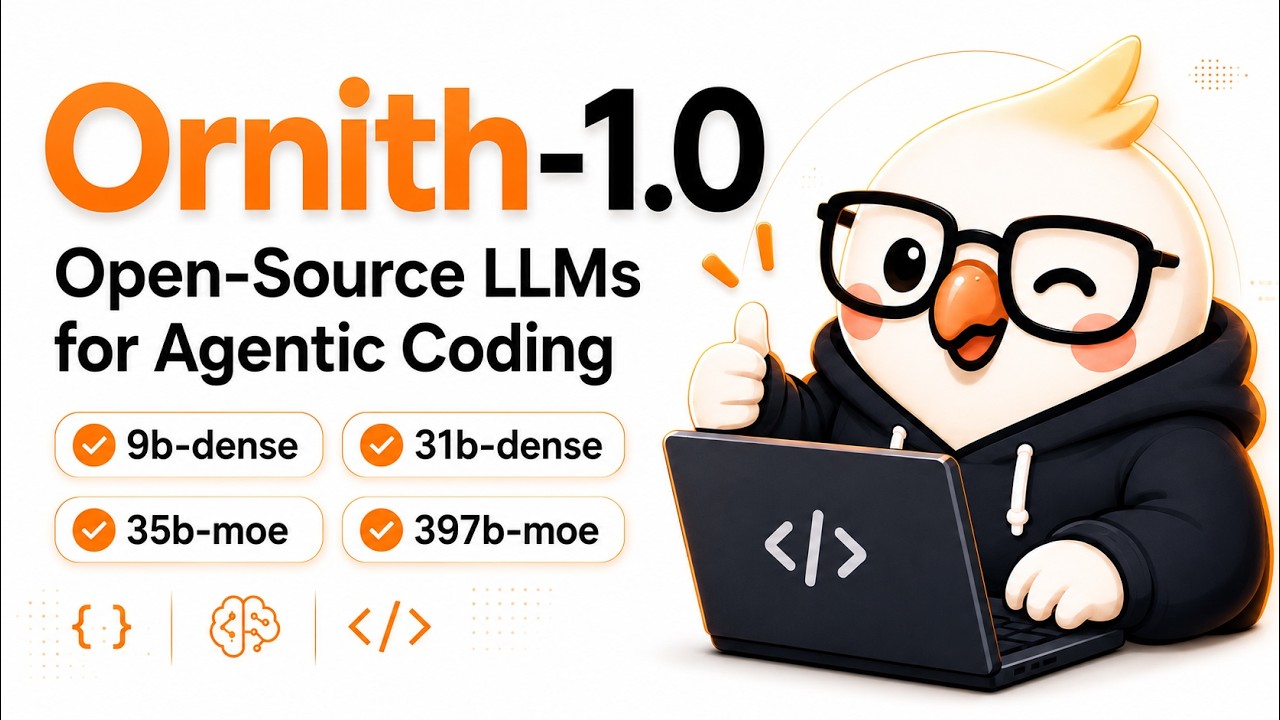
The video introduces Ornith 1.0, a family of models developed by Deep Reinforce that focus on agentic coding by enabling models to write their own harnesses or scaffolds dynamically. Unlike traditional approaches where humans design these harnesses, Ornith models learn to generate both the solution rollouts and the task-specific harnesses that guide these rollouts. This self-scaffolding capability aims to optimize both the scaffold and the solution, improving the overall performance of the model in coding tasks. The Ornith family includes four fine-tuned models based on the Quen 3.5 and Gemma 4 families, ranging from a 9B parameter model to a large 397B parameter model, all of which are publicly available for experimentation.
The key innovation in Ornith 1.0 lies in its two-stage reinforcement learning process. First, the model proposes a refined harness based on a given task, then it generates the rollout conditioned on this harness. Multiple rollouts are evaluated using a reward signal derived from GRPO (Generalized Policy Optimization), which updates the model to improve both harness creation and solution generation. This approach addresses the challenge of reward hacking—where models might exploit shortcuts to maximize rewards—by implementing three layers of defense: an immutable environment sandbox, a deterministic monitor that penalizes unauthorized actions, and an LM-based judge that can veto inappropriate outcomes.
Benchmarks show that Ornith’s largest model outperforms several other prominent models, including Quen 3.7 Max and Miniax, and competes closely with Claude Opus models. Even the smaller 9B model performs impressively compared to larger models, making it a viable option for local coding tasks on limited hardware. The video demonstrates Ornith’s capabilities through various examples, such as generating SVG images, answering reasoning questions, and creating harnesses for tasks like fetching weather forecasts or retrieving AI news from Twitter, adapting dynamically to constraints like the absence of API keys.
The video highlights the practical utility of Ornith’s self-scaffolding approach by showing how the model designs complex harnesses on the fly, including handling API requirements and generating code that meets specific user constraints. The model’s chain-of-thought reasoning is evident in its detailed token outputs, reflecting a deep understanding of the task and constraints. The presenter also showcases the model’s ability to build user interfaces, such as a radio app, based on previously generated harnesses, illustrating the model’s flexibility and efficiency in iterative coding tasks.
In conclusion, Ornith 1.0 represents a significant step forward in agentic coding by automating the creation of task-specific harnesses, reducing the need for human intervention in prompt engineering. While it may not yet replace daily coding workhorses, it offers a promising solution for local coding environments and specialized tasks. The video encourages viewers to experiment with different Ornith models and share their experiences, emphasizing the potential of this approach to shape the future of AI-assisted coding. The presenter also acknowledges Dell for sponsoring the compute resources used in the demonstrations.