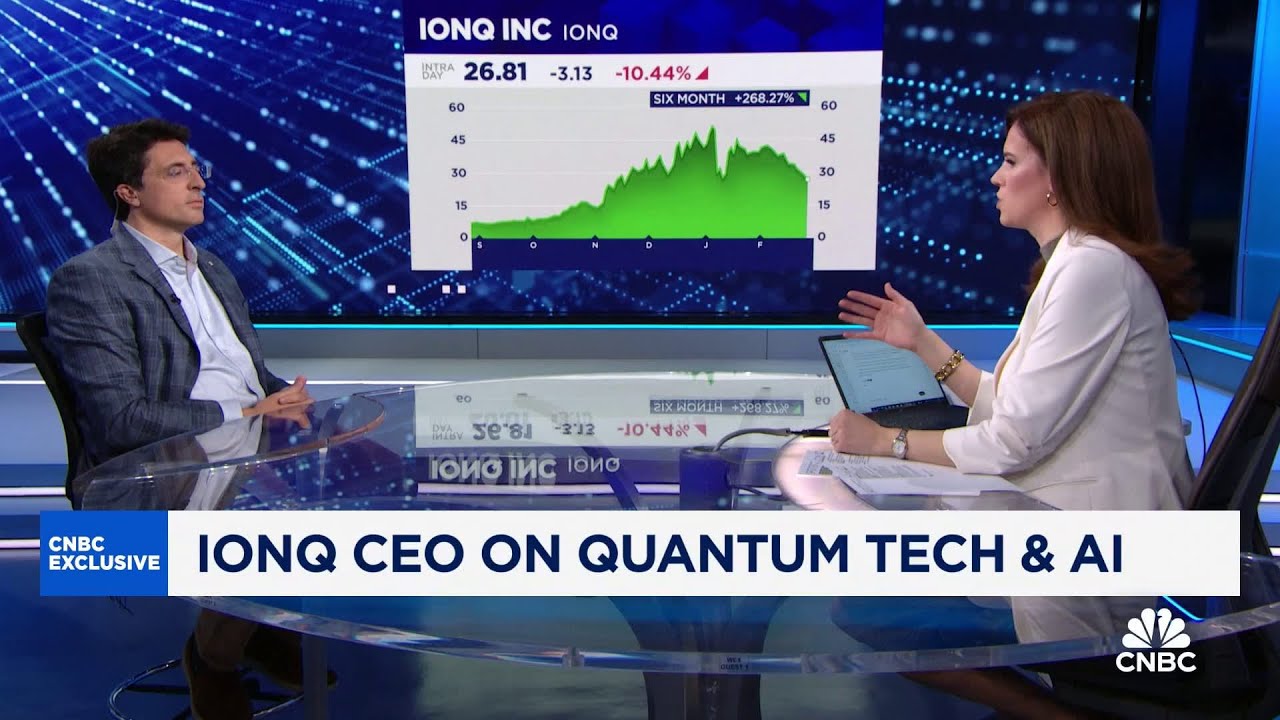
In an interview, IonQ CEO Nicholas Demasi discusses the company’s leadership in quantum computing and its potential to enhance artificial intelligence through unique processing capabilities. He emphasizes IonQ’s practical applications in various industries and its plans to scale up qubit count, positioning the company as a key player in the future of computing technology.
In an exclusive interview, Nicholas Demasi, the CEO and president of IonQ, discusses the company’s role in the quantum computing landscape and its potential impact on artificial intelligence (AI). Demasi has a long history with IonQ, having followed its technology for 25 years and played a significant role in its IPO in 2020. He emphasizes that IonQ is a leading player in the quantum computing market, distinguished by its revenue, market capitalization, and expertise in real-world applications.
Demasi explains the concept of quantum computing, describing it as the third leg of the computing ecosystem, alongside traditional CPUs and GPUs. He highlights the unique capabilities of quantum processors (Qpus), which can perform numerous calculations simultaneously on complex problems with vast data sets. This ability positions quantum computing as a powerful tool for solving challenges that classical computing cannot address effectively.
The CEO outlines IonQ’s partnerships with various organizations, including AstraZeneca for drug design and General Dynamics for fraud detection. These collaborations illustrate the practical applications of quantum computing in fields such as computational chemistry and engineering. Demasi believes that quantum computing will eventually complement AI, enhancing its capabilities rather than replacing it.
When comparing quantum computing to AI, Demasi acknowledges that while AI has made significant strides, quantum computing represents the next evolution in computational power. He likens the advancement of quantum technology to the rise of GPUs in relation to CPUs, suggesting that quantum computing will provide exponential increases in processing power as more qubits are added to the systems.
Finally, Demasi asserts that IonQ is ahead of its competitors in the quantum computing space, with many of them lagging in their research and development efforts. He notes that IonQ is already generating revenue and making strides toward practical applications, with plans to scale up its qubit count significantly in the near future. This positions IonQ as a key player in the ongoing evolution of computing technology, with the potential to disrupt various industries through its advancements in quantum mechanics.