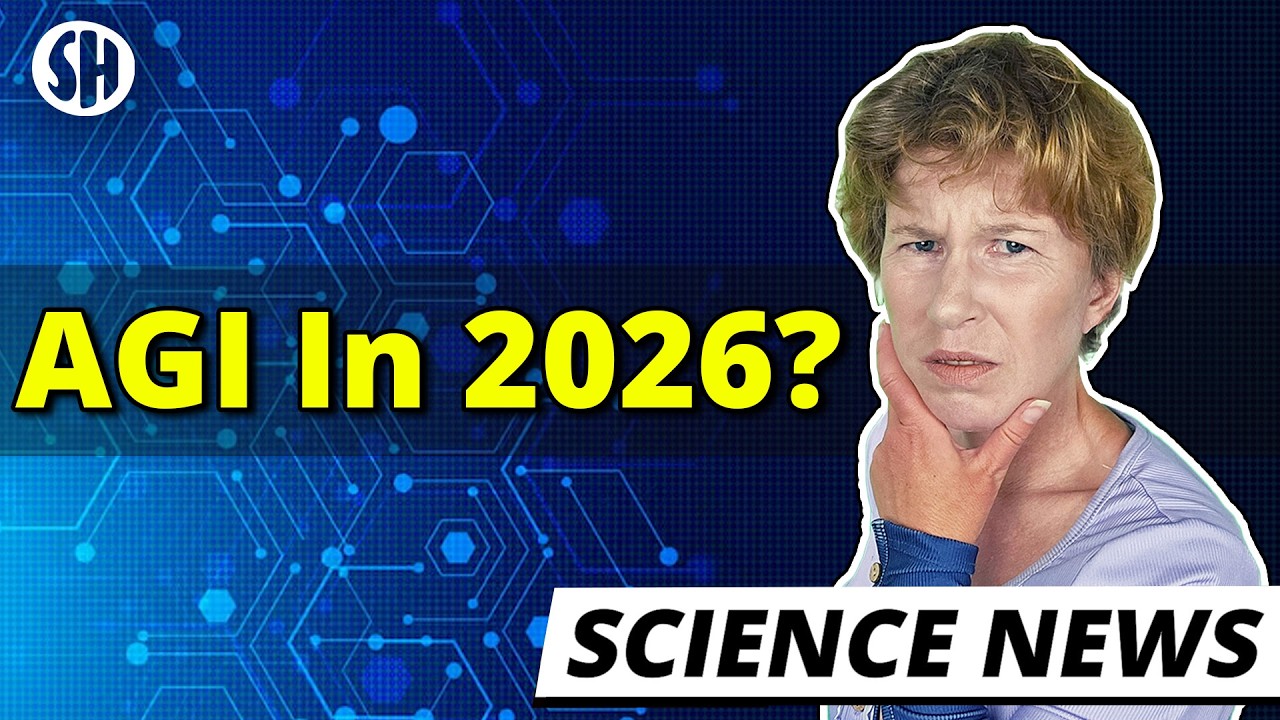
Certainly! Here’s a five-paragraph summary of the video, with spelling and grammar corrected:
The video explores current predictions and speculations about when artificial general intelligence (AGI) might be achieved. Recent advancements in AI, such as the release of ChatGPT 5.1, Grok 4.1, and Gemini 3, have fueled renewed debate. Demis Hassabis, head of DeepMind, maintains his earlier forecast that AGI could arrive within five to ten years, noting that a few more significant breakthroughs are still needed. On the more optimistic end, Elon Musk predicts AI could surpass any single human’s intelligence by the end of 2025, and possibly all humans by 2027 or 2028, though he expresses some skepticism about this timeline.
Dario Amodei, CEO of Anthropic, also offers an optimistic outlook, suggesting that by 2026 or 2027—and almost certainly by 2030—AI systems will reach a level comparable to a “country of geniuses in a data center.” He clarifies that AGI is not a well-defined term for him, viewing it more as a marketing phrase, but envisions AI soon outperforming nearly all humans at almost all tasks. OpenAI CEO Sam Altman places his AGI prediction within the next U.S. presidential term, specifically targeting March 2028 for the development of a true automated AI researcher, though not necessarily full AGI.
Other tech leaders share similar timelines. Nvidia CEO Jensen Huang and former Google CEO Eric Schmidt both estimate AGI could emerge in three to five years. Jean LeCun, who recently left Meta, aligns more with Hassabis, suggesting AGI is still five to ten years away due to the need for further technological breakthroughs. However, a recent survey of over 300 AI experts found that most expect slower progress than these industry leaders, indicating a broader range of opinions within the field.
Forecasting platforms and research institutes provide additional perspectives. The online forecasting platform Metaculus has seen its community shift AGI expectations from the 2050s to a median of late 2027. The research institute EpochAI predicts that scaling large language models will continue to drive progress through 2030, at which point AI may be able to solve complex problems in math, biology, and software independently and with high accuracy. The video notes that part of the discrepancy in predictions stems from differing definitions of AGI, with some leaders quietly redefining it to mean independent research capability rather than true human-level intelligence.
In conclusion, the video emphasizes that while predictions for AGI range from as soon as next year to a decade away, the field is advancing rapidly and definitions remain fluid. OpenAI has even updated its contract with Microsoft to replace vague AGI references with an independent expert panel to determine when AGI is achieved. The presenter suggests that, regardless of the exact timeline, today’s AI agents are already highly useful for a variety of tasks, and encourages viewers to explore current AI tools to enhance productivity.