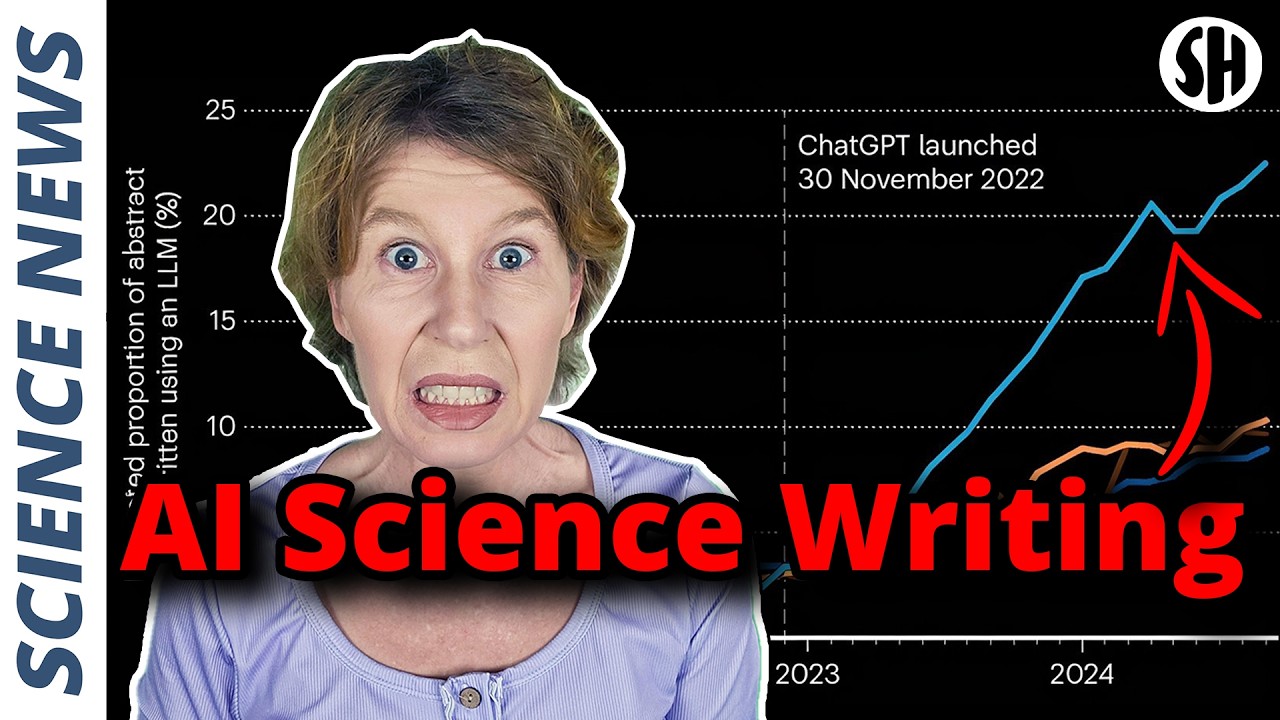
The video discusses the growing impact of artificial intelligence (AI) on the scientific community, particularly highlighting concerns about the rapid increase in scientific publications. According to Mark Hner from Digital Science, the rate of scientific paper production has nearly doubled recently, rising from about 8% to 17% annually. This surge is largely attributed to AI tools that simplify writing and submitting papers. However, this growth threatens to overwhelm the peer review system, as there are not enough scientists available to thoroughly review the increasing number of submissions, pushing many reviewers to work under stressful and inconvenient conditions.
AI is also influencing the peer review process itself, with some scientists using AI to generate peer reviews. Studies show that AI-generated reviews are difficult to distinguish from human ones, with detection rates below 20%. This has led to questionable practices, such as embedding hidden commands in papers to coax AI into providing favorable reviews. These developments raise concerns about the integrity and reliability of the peer review system, which is a cornerstone of scientific quality control.
Another alarming issue highlighted is the rise of organized scientific fraud, particularly through “paper mills”—networks that produce fake research papers and sell authorships or citations. Research indicates that these fraudulent papers often cluster around a small number of complicit journal editors, and when one journal cracks down, paper mills simply move to others. Although currently representing a small fraction of total publications, the number of fraudulent papers is growing rapidly, fueled by AI’s ability to facilitate the creation of fake data and manuscripts.
The problem of paper mills has been especially prevalent in countries like China and India, where surveys reveal a significant percentage of medical professionals admitting to unethical publishing practices. However, this issue is spreading westward, targeting major scientific publishers. Paper mills are becoming increasingly sophisticated, even manipulating platforms like Wikipedia to boost the visibility of fake research, which can mislead journalists and the public. This trend poses a serious threat to the credibility of scientific literature and public trust in science.
Beyond outright fraud, the video also touches on systemic issues in academia, such as publishing low-quality incremental research (“salami slicing”), reciprocal citation practices, and unethical grant applications involving “shadow” principal investigators. These practices contribute to a culture where quantity often trumps quality, undermining the scientific enterprise. The presenter argues that academia is deeply flawed and warns that AI, while a powerful tool, is currently exacerbating these problems rather than solving them. The video ends on a somewhat ironic note, mentioning that even AI like ChatGPT reassures that everything is fine, despite the evident challenges.