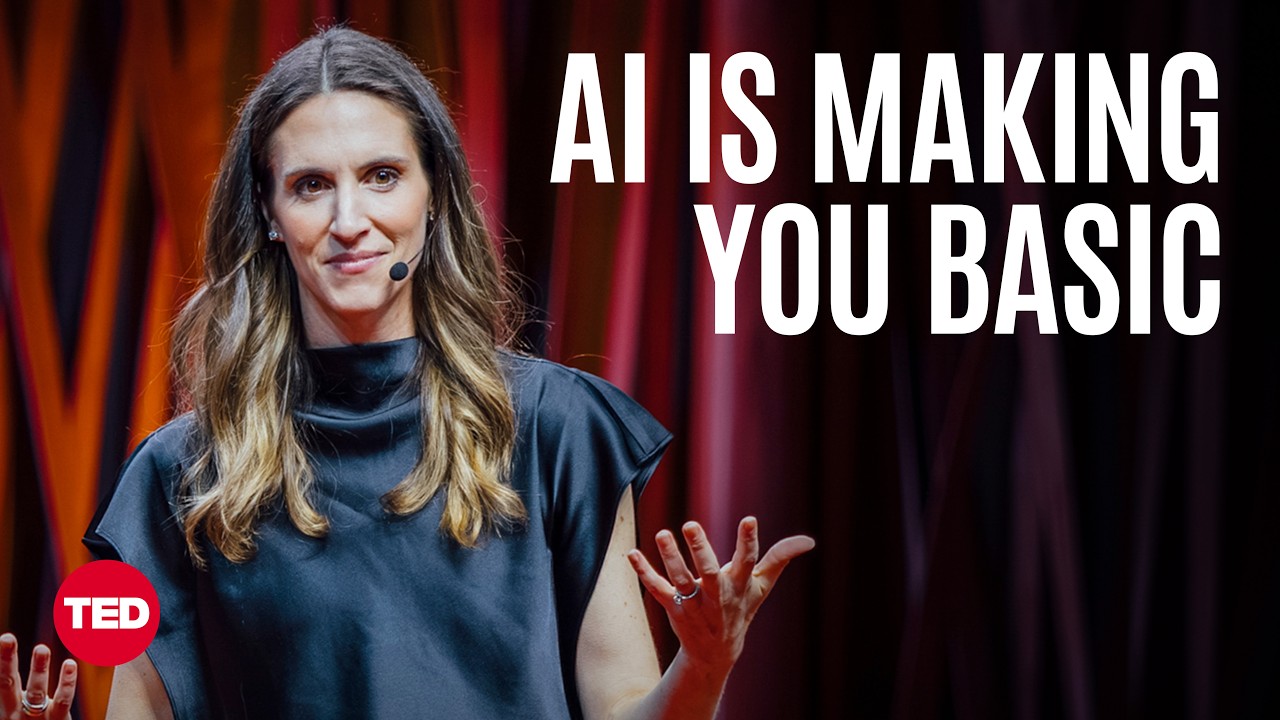
In her TED talk, Sandra Matz expresses a unique concern about AI: rather than fearing job loss or misinformation, she worries that AI will make us boring by diminishing our human capacity for exploration and risk-taking. She explains that humans constantly face a trade-off between exploiting familiar choices and exploring new possibilities—a balance that has been crucial for our growth as individuals and as a species. However, AI systems, designed primarily to optimize for short-term engagement and satisfaction, tend to favor exploitation, recommending what is safe and popular rather than encouraging discovery and novelty.
Matz illustrates this with the example of Baskin-Robbins’ 31 ice cream flavors. When she asked ChatGPT to recommend flavors multiple times, it overwhelmingly suggested only the two most popular ones, ignoring the rest. This tendency toward safe recommendations could lead to a homogenization of choices, not just in ice cream but across all areas of life. Studies she and her collaborators conducted show that AI guidance narrows people’s preferences, reduces creativity, and makes cultural choices more uniform, effectively flattening the rich diversity of human experience into statistical sameness.
The problem deepens when AI learns individual preferences and then consistently recommends only the most favored options, eliminating the occasional adventurous choice. Matz’s experiment with ChatGPT, where it repeatedly chose her favorite ice cream flavor and ignored others, exemplifies how AI can scrub away the quirks and complexities that make us interesting and dynamic. This subtle narrowing happens gradually, with each AI-driven decision reinforcing a narrower version of ourselves, leading to a loss of uniqueness and complexity over time.
Despite these concerns, Matz acknowledges the immense value of AI in helping us navigate the overwhelming choices of modern life. The solution, she argues, is not to reject AI but to recalibrate how we use it. By incentivizing AI to balance exploitation with exploration, we can harness its ability to detect patterns and help us take smart, curated risks. She proposes a conceptual “dial” that users could adjust to control how far AI recommendations stray from their usual preferences, allowing for both comfort and adventure in decision-making.
Ultimately, Matz emphasizes that preserving human complexity—the quirks, contradictions, and passions that define us—is essential. As AI increasingly acts on our behalf rather than merely suggesting, the stakes become existential. She calls for action to ensure AI supports exploration and creativity, encouraging us to occasionally say no to the safe choice and embrace the wild and reckless. This, she concludes, is vital to maintaining the richness and uniqueness of the human experience in an AI-driven world.
Useful Links