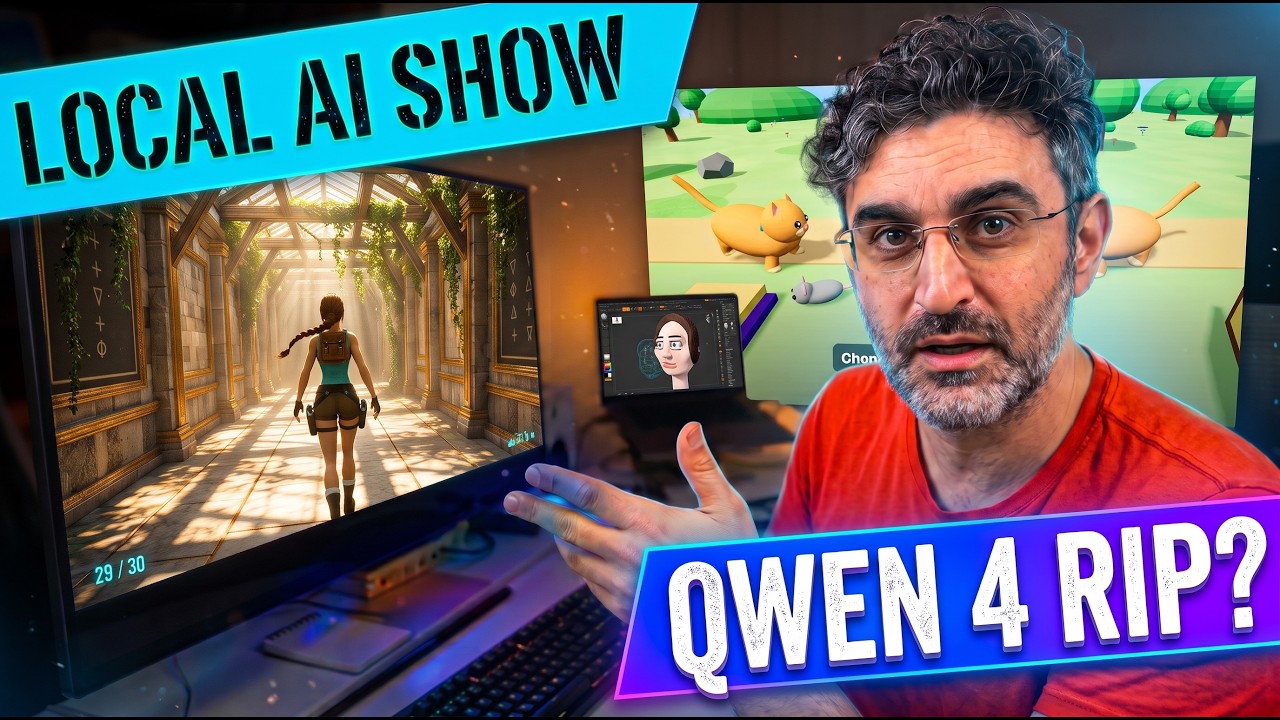
The video presents an in-depth review and comparison of Hi4 Flash, a new AI model developed by Tencent, China’s largest revenue-generating company, against the well-known Quen Flash Next model. The reviewer highlights that Hi4 Flash is competitive in performance, especially considering its efficient quantization techniques that reduce memory requirements to around 85 GB, making it suitable for devices like the M1 Max MacBook Pro. Various tests demonstrate that Hi4 Flash can generate impressive outputs, such as a Tomb Raider game scene with detailed characters and environments, often matching or even surpassing Quen Flash Next in quality and token generation.
The reviewer explores different quantization levels of Hi4 Flash, from basic Q4 to more advanced Q5 and Q9 quantizations, showing how intelligent quantization significantly improves output quality. For example, a poorly quantized Q4 model produces basic and error-prone results, while a well-quantized Q4S model generates photorealistic images and complex websites with smooth transitions and detailed graphics. The Q5 quantization pushes memory usage higher but allows for longer token generation and more stable outputs, with fewer runtime errors compared to other models.
Hi4 Flash’s versatility is showcased through its multimodal capabilities, including image recognition, Python coding, and 3D game generation. The model successfully creates various interactive games such as a cat-and-mouse chase, racing games, and even a GTA 5 clone, with minimal runtime errors and smooth gameplay mechanics. The reviewer notes that while some games have minor bugs or basic graphics, the overall performance is impressive for a model of this size and complexity, especially given the stability and lack of frequent crashes.
The video also delves into Hi4 Flash’s reasoning and logic abilities, testing it with puzzles, math problems, and coding challenges. The model demonstrates a good understanding of context, often ignoring irrelevant distractions and providing correct answers, especially when “thinking” mode is enabled. Although some complex riddles and logic puzzles still pose challenges, the model’s ability to handle programming tasks and mathematical queries with minimal errors is highlighted as a strong point, making it a practical tool for developers and researchers.
In conclusion, the reviewer expresses enthusiasm about Hi4 Flash as a strong competitor to Quen Flash Next, praising its efficient memory usage, high-quality output, and stability across various tasks. The model’s Apache 2-style license with minimal restrictions further adds to its appeal. While the future of Quen 4 remains uncertain, Hi4 Flash’s performance and versatility make it a promising option in the AI model landscape, especially for users seeking powerful local inference on consumer hardware. The video encourages viewers to explore Hi4 Flash and consider it a viable alternative in the rapidly evolving AI space.