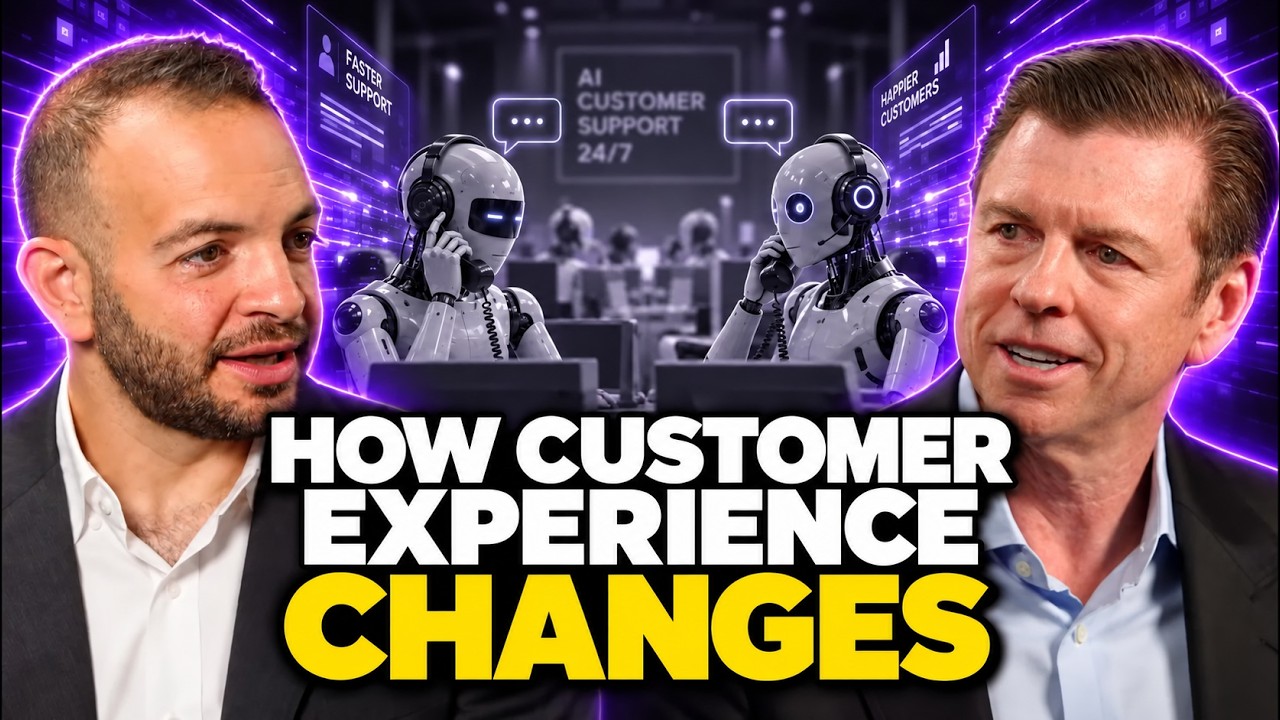
In this conversation with Tony Bates, Chairman and CEO of Genesis, the discussion centers on the transformative impact of AI on customer experience. Genesis is a leading customer experience platform that orchestrates over 33 billion conversations annually, helping companies like ESPN, Ferrari, and HSBC deliver seamless interactions across sales, marketing, and customer service divisions. Bates emphasizes that customer experience has become a key differentiator for businesses, with Gartner noting that 89% of differentiation now comes from how customers feel about a company rather than just product or price. The advent of generative AI is accelerating this shift by enabling contextual intelligence, allowing AI to remember customer preferences and provide personalized, coherent experiences across multiple touchpoints.
Bates outlines the evolution of customer experience technology from simple predefined processes and IVRs to more autonomous AI-driven orchestration. He introduces a framework of experience orchestration levels, culminating in “universal orchestration,” where AI agents can interact not only with humans but also with other AI agents. This future envisions AI-to-AI communication as a natural extension of current human-to-human and human-to-AI interactions. However, Bates stresses that successful implementation depends on robust governance, guardrails, and hybrid workforce models that integrate AI as a digital teammate rather than a replacement for human workers.
The conversation also explores how AI agents acting on behalf of consumers will change business interactions. Bates notes that while AI can dramatically increase the volume and efficiency of inquiries—such as sending multiple agents to contact car dealerships—the fundamental business models and regulatory constraints will remain intact. Companies will continue to enforce guardrails to ensure compliance and appropriate behavior, whether interacting with humans or AI agents. The user interface for these interactions is still in its infancy, likened to an “MS-DOS moment,” and will need to evolve into more fluid, frictionless experiences embedded across various applications.
Personalization emerges as a central theme, with Bates distinguishing it from mere targeting or segmentation. True personalization involves understanding individual customer needs and delivering the right experience at the right moment, supported by seamless handoffs between AI and human agents. He highlights that not all interactions should be automated; some, especially those requiring empathy or complex judgment—such as crisis intervention or sensitive financial matters—will always need human involvement. The goal is a hybrid approach that automates routine tasks while reserving humans for high-value, nuanced conversations that build loyalty and drive revenue.
Finally, Bates addresses concerns about a so-called “SaaS apocalypse,” where AI might replace traditional software and lead to massive job losses. He dismisses this as an oversimplification, emphasizing the complexity of enterprise operations, the importance of data governance, and the need for ongoing software maintenance and customization. Rather than a wholesale replacement, AI is viewed as a powerful tailwind that enhances existing platforms and workflows. Bates argues that the future of customer experience lies in combining AI capabilities with human creativity and oversight, creating a winners-market dynamic where companies that effectively integrate AI will thrive without displacing the essential human element.
Useful Links