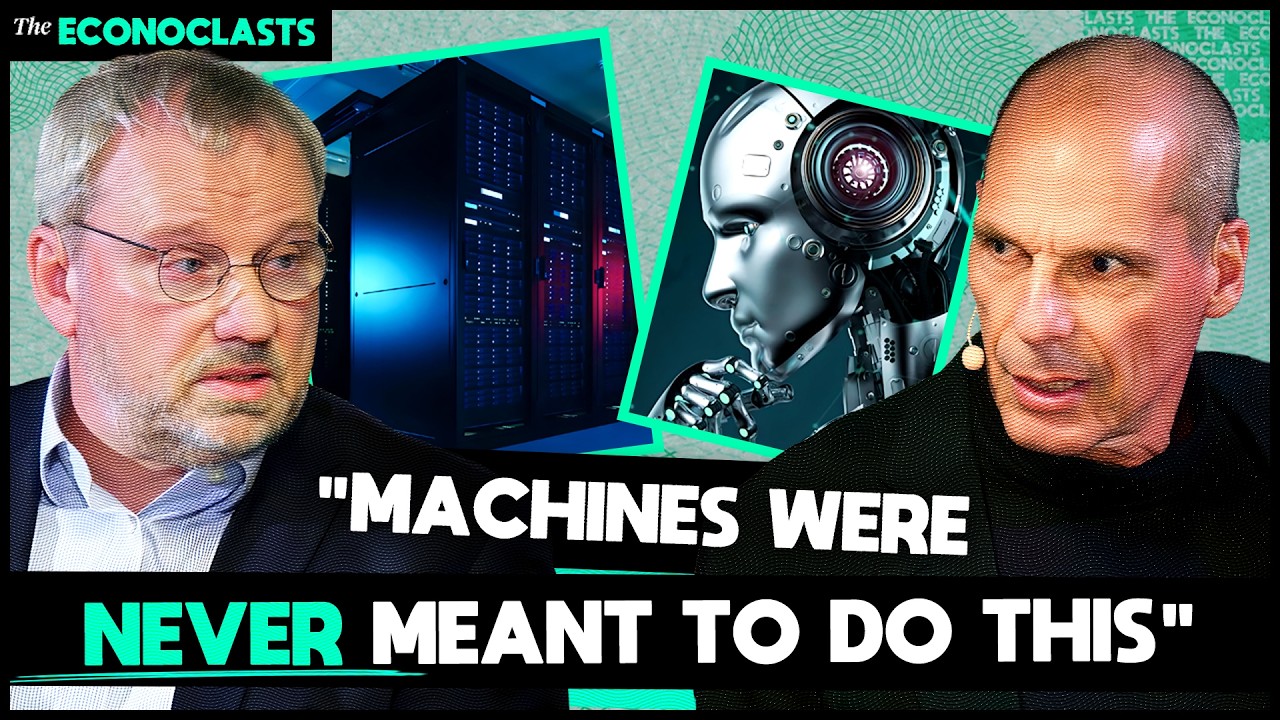
In this episode of The Econoclasts, Yanis Varoufakis and Wolfgang Munchau explore AI’s unprecedented ability to solve complex problems and its potential to disrupt labor markets, emphasizing the need for political and economic strategies to manage its societal impact. They warn against the concentration of power among tech elites promoting transhumanist ideologies and call for democratic oversight, regulation, and equitable distribution of AI’s benefits to safeguard social equality and democratic institutions.
In this episode of The Econoclasts, Yanis Varoufakis and Wolfgang Munchau discuss the groundbreaking recent achievements of artificial intelligence (AI), highlighting its ability to solve complex mathematical problems previously thought unsolvable by machines. This development signals AI’s potential to disrupt numerous job sectors, as it can perform tasks traditionally requiring human creativity and logic, such as legal work and programming. They emphasize that AI is fundamentally a pattern recognition system, capable of innovative problem-solving, which challenges previous assumptions about the nature of intelligence and the future of labor markets.
The conversation then shifts to the broader societal and political implications of AI’s rise. Varoufakis introduces the concept of “tech lordism,” a new ideology embraced by powerful tech elites who envision a transhumanist future where humans merge with technology to transcend biological limitations. This ideology, he argues, is not a harmless fantasy but a dangerous framework that justifies the concentration of power and wealth in the hands of a few tech magnates, undermining democratic institutions and exacerbating social inequalities. The discussion critiques figures like Elon Musk and Peter Thiel for promoting visions that prioritize technological dominance over human values.
Munchau adds a nuanced perspective by distinguishing between types of problems AI can solve—closed, provable problems versus open-ended social and political challenges that require human judgment and creativity. He stresses that while AI can enhance productivity and replace many jobs, it cannot replicate the human capacity to ask meaningful questions or engage in democratic decision-making. This limitation underscores the need for careful political and economic responses to manage AI’s disruptive impact, including revisiting competition policies and taxation to prevent monopolistic control by tech giants.
Both hosts agree that the traditional labor market model, based on time and effort, is becoming obsolete as AI-driven automation changes the nature of work. Supervisory roles over AI systems may replace many conventional jobs, but these roles will demand new forms of remuneration and social arrangements. They warn of significant social upheaval if the benefits of AI are not equitably shared, highlighting the urgency for political systems to develop strategies that address unemployment, income distribution, and the ethical use of AI technologies.
Finally, the episode calls for a sober and proactive political engagement with AI, moving beyond hype and fear to address normative questions about what AI should do for society. The hosts criticize current political complacency and emphasize the importance of regulation, competition policy, and democratic oversight to ensure AI serves the public good rather than entrenched corporate interests. They conclude that while AI cannot be uninvented, society must thoughtfully shape its development to avoid deepening inequalities and preserve democratic values in the face of transformative technological change.