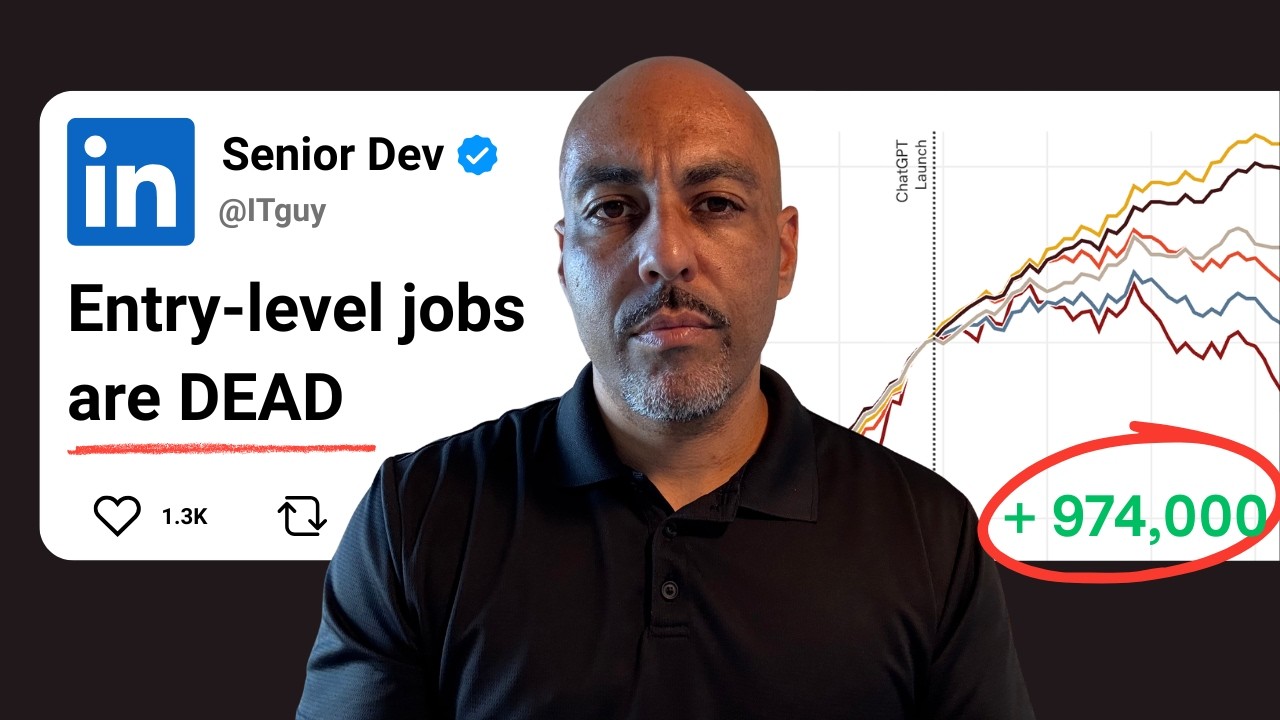
The speaker shares his journey from starting coding at 32 to becoming a senior software engineer, emphasizing that while entry-level tech jobs are declining, mid-career opportunities—especially in AI and applied machine learning—are growing, and that junior developers should focus on gaining practical skills through startups, side projects, and real-world problem-solving. He challenges the notion that AI will replace junior roles entirely, encourages avoiding the “junior” label, and promotes resources like Parsity.io to help learners adapt to the evolving job market.
In this video, the speaker shares his personal journey of starting coding at age 32 and progressing to a senior software engineer role, emphasizing that while entry-level tech jobs appear to be declining, the situation is more nuanced than the common narrative suggests. He highlights that although overall programmer employment in the U.S. has dropped significantly, software developer roles have remained relatively stable, reflecting a distinction between simple coding tasks and more complex software engineering responsibilities that involve end-to-end product development and collaboration across teams.
The speaker points out that early-career developers are the most affected by the current job market downturn, with a sharp decline in entry-level hiring across many white-collar professions, not just tech. However, mid-career professionals are seeing an increase in opportunities, partly because experienced developers can leverage AI tools effectively. He challenges the idea that AI can fully replace teams of junior developers, noting that companies have made decisions based on this assumption, but the data does not fully support it.
A significant growth area is in AI and machine learning roles, particularly positions like forward deployed engineers who combine coding skills with consulting to help companies implement AI strategies. These roles often require practical AI integration skills rather than deep theoretical knowledge, and the speaker encourages learners to focus on acquiring these high-demand, applied skills rather than purely academic ones. He promotes Parsity.io as a resource for gaining such expertise through mentorship and practical training.
For junior developers struggling to find entry-level positions at large tech companies, the speaker advises shifting focus to startups and small businesses, which are actively hiring and offer more symmetrical risk for both parties. Small businesses, which employ a large portion of the U.S. workforce, are increasingly seeking developers who can modernize their operations with AI and automation, presenting valuable opportunities for those willing to work in less traditional tech environments.
Finally, the speaker urges aspiring developers to avoid labeling themselves as “junior” and instead build substantial experience through side projects and volunteering to demonstrate their capabilities. He recommends creating AI-powered tools and agents that solve real problems rather than simple chatbots, to showcase practical skills. Overall, he encourages viewers not to succumb to doom-and-gloom narratives but to understand the real market dynamics and proactively develop relevant skills to succeed.