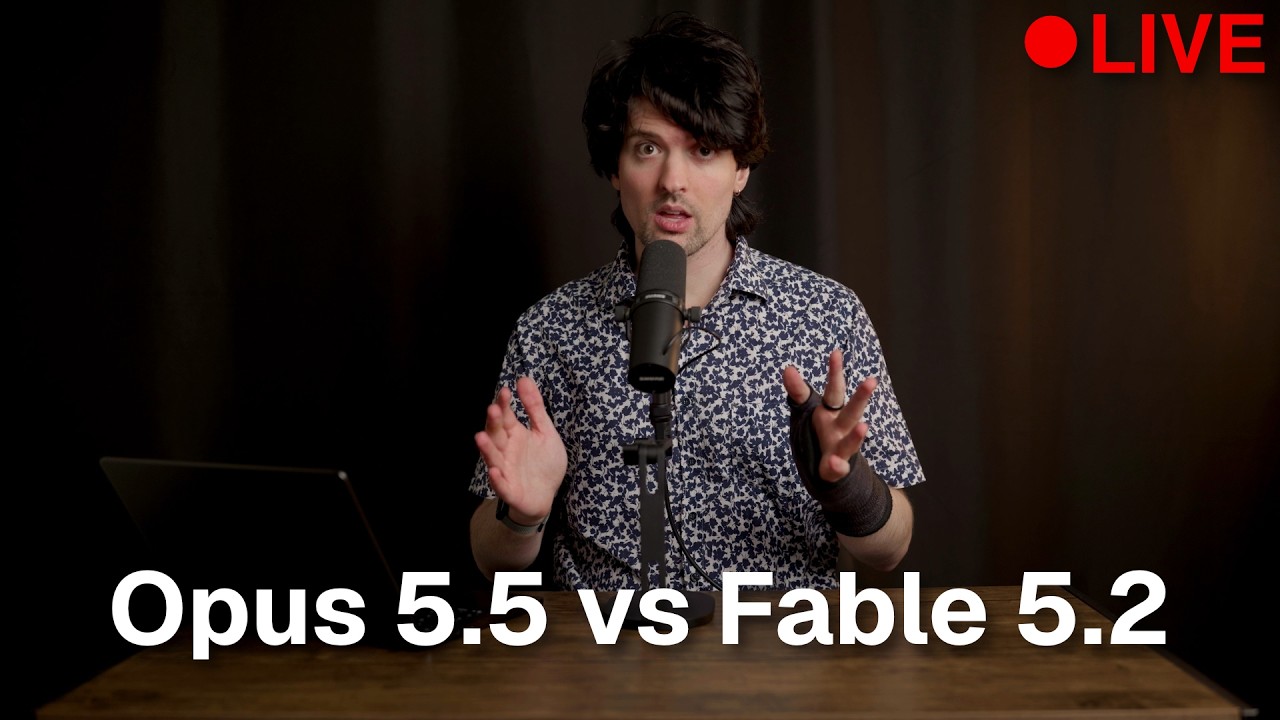
The video discusses the challenges of managing the T3 Code project amid overwhelming contributions, compares leading AI coding models highlighting the strengths of Opus 55 and Fable 52 while critiquing Google’s Gemini 4 Carbon for poor performance, and emphasizes the growing dominance of closed-weight AI models over open-weight ones due to infrastructure and scalability issues. It concludes with reflections on the evolving role of AI in software development, encouraging adaptability, meaningful contributions, and embracing new creative opportunities in the AI-driven landscape.
The video begins with the host addressing the challenges of managing the T3 Code project, emphasizing the overwhelming volume of feature requests, bug reports, and pull requests, many of which relate to existing features that users have yet to discover. He discusses the policy on contributions, discouraging non-employees from submitting pull requests to prevent further slowing down the project. The host also highlights the impressive usage statistics of T3 Code, including nearly 700,000 installs and significant daily token spending, underscoring the project’s scale and the importance of focusing contributions on meaningful bug reports and triaging existing issues.
A significant portion of the video is dedicated to a detailed comparison between two leading AI models for coding tasks: Opus 55 and Fable 52. The host explains that while Opus 55 is reliable, thorough, and excels at tasks requiring meticulous attention to detail, Fable 52 is smarter, more creative, and better suited for complex or ambiguous problems where exploration and intuition are valuable. He uses analogies of engineers with different working styles to illustrate the strengths and weaknesses of each model, recommending Opus 55 for most tasks and Fable 52 for the hardest technical challenges or when a project needs to be pushed forward decisively.
The host then critiques the Gemini 4 Carbon model from Google, describing it as significantly slower and less practical for real-world use compared to Anthropic’s models. He provides evidence of severe latency issues and poor infrastructure support, expressing disappointment with Google’s handling of the model and its deployment. This section serves as a cautionary tale about the importance of not only model quality but also the surrounding infrastructure and support in delivering usable AI tools.
A major theme of the video is the decline in viability of open-weight (open-source) AI models compared to closed-weight models like those from Anthropic and OpenAI. The host explains that despite early promise and rapid improvements, open-weight models are falling behind due to several factors: limited access to powerful GPUs (power scaling), difficulties in effective model distillation, and challenges in recursive self-improvement. He presents data showing that open-weight models constitute a tiny fraction of real-world usage and often rely on benchmark manipulations to appear more capable than they are. The host expresses concern that the gap between closed and open models will continue to widen unless significant changes occur.
Finally, the host reflects on the broader implications of AI advancements for software development, sharing personal anecdotes and philosophical insights. He discusses the transition from traditional coding to AI-assisted development, acknowledging the loss felt by some developers but emphasizing the new opportunities for creativity and productivity. He praises community members who actively ship code and contribute meaningfully, encourages embracing change, and highlights the importance of curiosity and adaptability in this rapidly evolving landscape. The video concludes with gratitude to supporters and a call to focus on impactful work amid the ongoing AI renaissance.