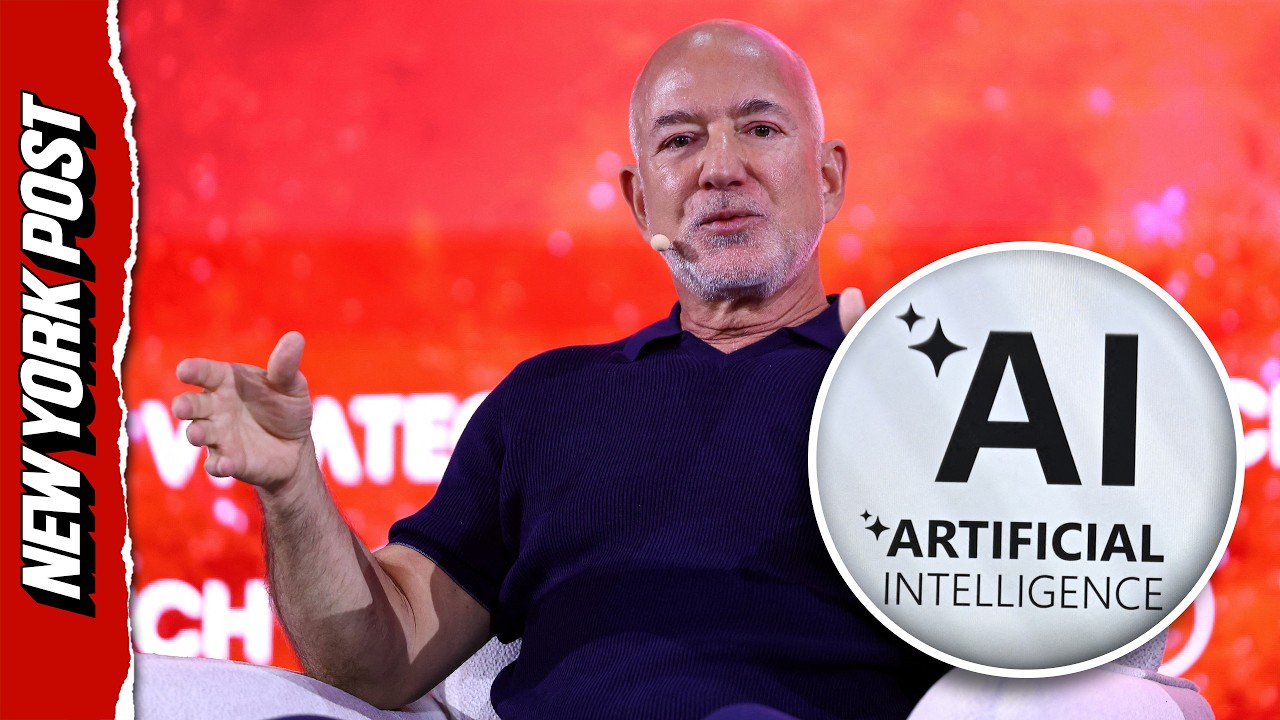
Jeff Bezos envisions a future where space exploration focuses on the Moon and beyond, utilizing space resources to advance technology, support large colonies, and alleviate Earth’s environmental burdens by relocating polluting industries off-planet. He also predicts that AI will accelerate innovation by empowering engineers to rapidly execute ideas, creating a labor shortage rather than redundancy, and unlocking vast new opportunities for invention and economic growth.
In the video, Jeff Bezos reflects on a recent setback experienced by Blue Origin involving their launchpad. Despite the incident being a significant challenge and a “gut punch” for the team, Bezos highlights the fortunate preservation of critical infrastructure components such as the propellant tank farm and the booster, which were largely undamaged. This luck allowed the team to begin rebuilding quickly, demonstrating resilience and determination, symbolized by the team creating “It’s worth it” t-shirts to maintain morale.
Bezos emphasizes the future of space exploration, confirming that the Moon will be the initial focus before moving on to Mars and beyond. He envisions building large colonies in space, inspired by O’Neill-style space habitats, and utilizing near-Earth objects and the Moon for resources. This vision includes advancing space-based computing and solar energy production, with the potential to manufacture computer chips in space and beam data back to Earth, highlighting a future where space becomes a hub for technological innovation.
A key part of Bezos’s vision is the environmental benefit of moving polluting industries off Earth. By making space travel reliable and affordable, and sourcing materials from asteroids and the Moon, humanity could restore Earth to its pre-industrial state, preserving it as a “garden planet.” This long-term goal reflects a commitment to sustainability and the responsible use of space resources to benefit life on Earth.
Bezos also discusses the transformative role of AI in engineering and innovation, particularly through Blue Origin’s Prometheus project. He explains that AI tools are designed to empower engineers to invent and build much faster, accelerating the “dream-build” cycle that historically drives civilizational wealth. Rather than making humans redundant, Bezos argues that AI will create a labor shortage by enabling people to identify and solve more problems, unlocking a vast potential for new inventions and businesses.
Finally, Bezos stresses that the main limitation today is not imagination but the ability to execute ideas. Many people have ideas that never materialize because they are too difficult or costly to realize. By accelerating the innovation cycle with AI and advanced tools, these ideas can become feasible, shifting the constraint from capability to creativity. This optimistic outlook underscores the potential for AI and space technology to drive unprecedented productivity and prosperity in the future.