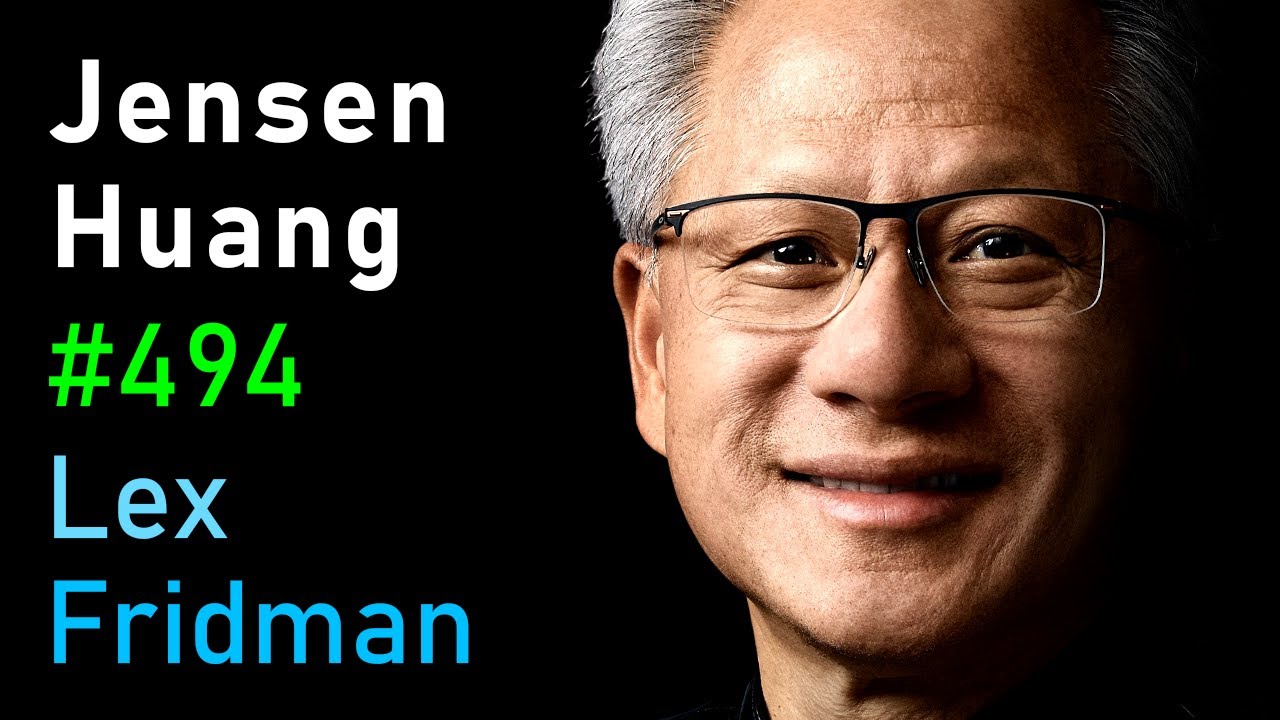
In this in-depth conversation on the Lex Fridman Podcast, Jensen Huang, CEO of NVIDIA, discusses the company’s evolution from a GPU manufacturer to a pioneering force in AI infrastructure through extreme co-design. Huang explains how NVIDIA has expanded its focus from individual chips to entire AI factories, integrating GPUs, CPUs, memory, networking, storage, power, cooling, and software into complex rack-scale systems. This holistic approach addresses the challenges of distributed computing at massive scale, overcoming bottlenecks in computation, networking, and power efficiency to accelerate AI workloads far beyond traditional limits.
Huang reflects on pivotal strategic decisions, such as embedding CUDA programming capabilities into consumer GeForce GPUs despite initial financial risks. This bold move created a vast developer ecosystem that became foundational for AI innovation, enabling NVIDIA to dominate the AI computing landscape. He emphasizes the importance of cultivating belief and alignment within the company and industry over time, shaping a shared vision that allows NVIDIA to anticipate and adapt to rapid technological changes, including emerging AI model architectures and agentic systems that multiply AI capabilities through autonomous sub-agents.
Addressing future challenges, Huang highlights power consumption as a critical bottleneck for scaling AI and advocates for extreme co-design to improve energy efficiency dramatically. He also discusses the intricacies of the semiconductor supply chain, praising partners like TSMC and ASML for their technological excellence and responsiveness. Huang envisions innovative solutions such as dynamic power allocation in data centers and even computing in space to overcome energy and cooling constraints, underscoring NVIDIA’s commitment to pushing the boundaries of engineering and system design.
On the societal impact of AI, Huang is optimistic about the technology’s potential to augment human capabilities rather than replace jobs outright. He draws parallels to radiology, where AI has enhanced productivity and demand for professionals rather than diminished it. Huang encourages individuals across all professions to embrace AI tools to elevate their work and creativity. He also stresses the importance of open source AI models to democratize access and foster innovation across industries and countries, positioning NVIDIA as both a leader in proprietary AI products and a champion of open collaboration.
Finally, Huang shares personal insights on leadership, resilience, and the human aspects of innovation. He discusses managing immense pressure by breaking down problems, sharing burdens, and maintaining curiosity and humility. Reflecting on intelligence versus humanity, he views intelligence as a commodity that AI will democratize, while qualities like compassion and character remain uniquely human. Looking ahead, Huang expresses hope and excitement for humanity’s future, driven by technological breakthroughs that could end disease, reduce pollution, and expand human potential, all while continuing NVIDIA’s mission to invent the future of computing.