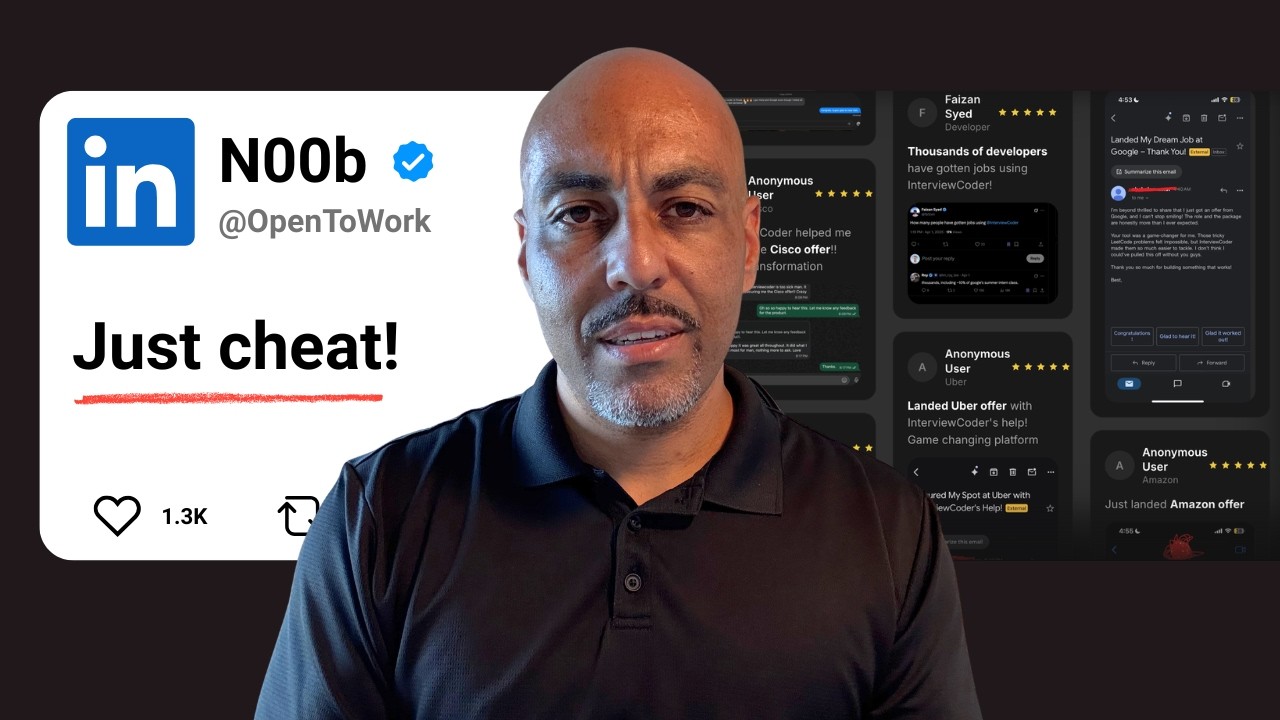
The video recounts the experience of an AI engineering interview where candidates were explicitly encouraged to use AI tools like Claude or Cursor during the process. Despite this openness, nearly half of the candidates still resorted to cheating, which surprised and frustrated the interviewer. The interview was designed to assess candidates’ understanding, reasoning, and critical thinking about AI systems—skills that AI tools cannot genuinely replicate. The interviewer shares detailed observations of candidates who appeared to cheat, highlighting behaviors such as overly generic answers, unnatural pauses, and suspicious cursor movements, which indicated reliance on external help or AI-generated responses.
One candidate, despite an impressive resume, gave textbook answers without nuance and demonstrated suspicious behavior during the coding section, such as memorizing library syntax and quickly correcting code without hesitation. The interviewer noticed odd patterns like repeated phrases and unnatural pauses, suggesting the candidate was receiving real-time assistance. This candidate later deleted their LinkedIn profile, raising further doubts about their authenticity. Another candidate openly used AI tools but failed to demonstrate fundamental knowledge or critical thinking, giving generic corporate-style answers and eventually disconnecting abruptly when pressed for deeper understanding.
The third candidate used AI tools more appropriately but lacked original thought and critical engagement with the AI-generated code. They relied heavily on AI outputs without adding personal insight or understanding, which the interviewer equates to being merely a “prompt engineer”—a role for which there is no real demand. This highlights a common pitfall where candidates misuse AI tools, failing to develop or demonstrate the independent problem-solving skills essential for the job. The interviewer stresses that the issue is not AI tool usage itself but the absence of genuine comprehension and critical thinking.
The video also addresses the consequences of cheating beyond ethics. Even if one disregards morality, cheating is a poor strategy because it leads to inevitable exposure once on the job, causing embarrassment, anxiety, and damage to professional reputation. The interviewer warns that cheating can result in blacklisting across companies and job platforms, severely limiting future employment opportunities. The current interview landscape is criticized as broken, with artificial tests that do not reflect real job requirements, compounded by the confusion AI tools introduce into the evaluation process.
In conclusion, the interviewer calls for a shift toward interviews that genuinely assess relevant skills tailored to the company’s needs, rather than outdated or irrelevant challenges. They acknowledge the frustration candidates feel but firmly advise against cheating, emphasizing that it ultimately harms the individual more than it helps. For those seeking to succeed honestly, the interviewer recommends proper preparation and learning resources. The video ends with an invitation to share cheating stories, underscoring how widespread the problem is, and a final, clear message: don’t cheat.