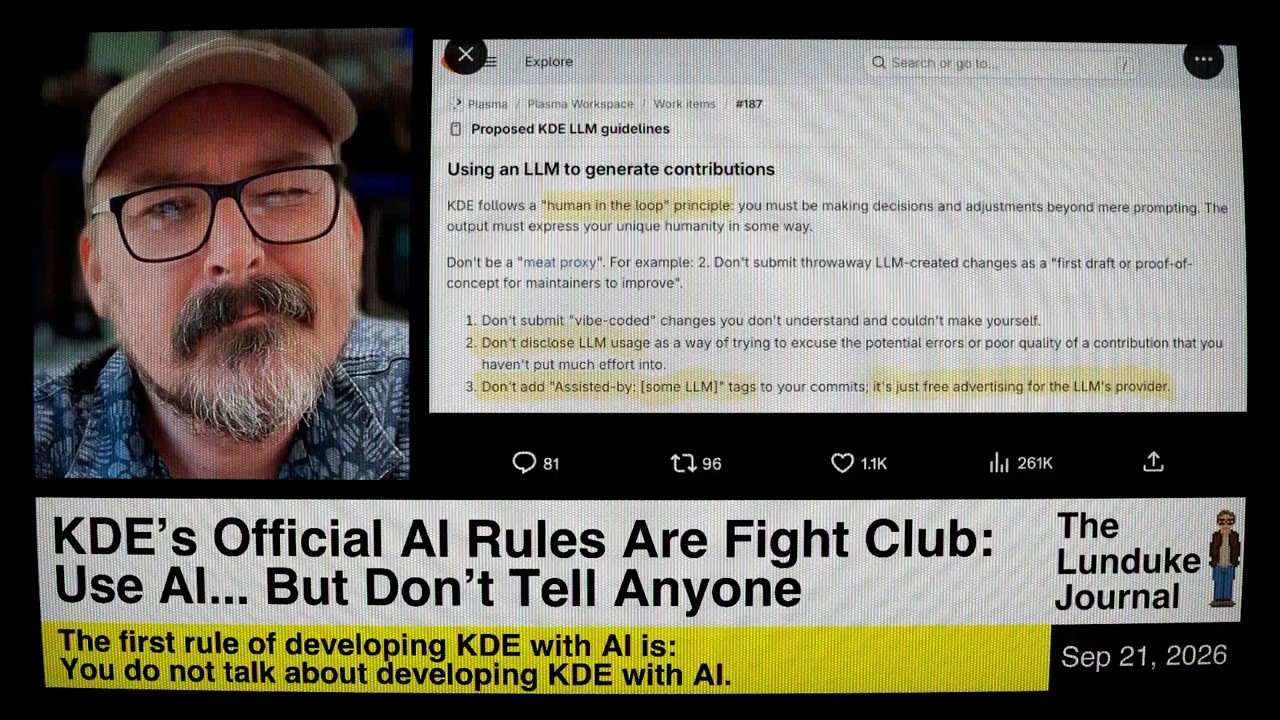
KDE’s official AI policy encourages the use of AI tools in development with strong human oversight and responsibility but strictly prohibits disclosing AI involvement in contributions, likening this secrecy to the “Fight Club” rule of not talking about it. This pragmatic yet controversial approach aims to maintain code quality and human accountability while avoiding political conflicts seen in other open-source communities.
KDE, a popular desktop environment, has introduced official guidelines for using AI and large language models (LLMs) in its projects. Their policy encourages the use of AI tools like Claude and Grok, provided that humans remain in control of the development process and take full responsibility for the code they contribute. This approach is seen as sensible and pragmatic, emphasizing code quality and human oversight rather than outright banning AI usage. Contributors are advised to thoroughly review AI-generated code to ensure they understand and stand behind it.
However, a controversial aspect of KDE’s policy is the strict prohibition on disclosing the use of AI in contributions. Contributors are instructed not to mention AI assistance in commit messages or elsewhere, effectively making AI usage a secret within the community. This “don’t tell anyone” rule has been likened to the “Fight Club” principle, where the first rule is not to talk about it. This secrecy contrasts with other projects like the Linux kernel, which require explicit disclosure of AI involvement to maintain transparency and traceability.
The policy also stresses that contributors should not rely on AI as a crutch or excuse for poor-quality work. They must remain actively engaged in the coding process, understanding and refining AI-generated output rather than blindly submitting it. This “man in the loop” principle aims to preserve the unique human element in software development and prevent the community from becoming mere proxies for AI-generated code. The policy discourages using AI as a scapegoat for mistakes and forbids tagging commits as AI-assisted, partly to avoid free advertising for AI tool developers.
The reaction to KDE’s policy has been mixed, with some praising its focus on responsibility and code quality regardless of AI use, while others find the secrecy aspect strange or problematic. The broader open-source community is grappling with similar issues, as seen in GNOME’s conflicted stance on AI—where leadership publicly opposes AI while developers actively use it, often incentivized by employers like Red Hat. KDE’s approach appears to be a way to embrace AI pragmatically while sidestepping the political controversies that have engulfed other projects.
Overall, KDE’s AI usage policy reflects a cautious but forward-looking attitude toward AI in open-source development. It balances encouragement of AI tools with strong human accountability and a surprising emphasis on confidentiality about AI use. This “Fight Club” style secrecy is unusual and has sparked debate, but it may represent an attempt to navigate the complex social and political dynamics surrounding AI in the software community. The policy highlights ongoing tensions and uncertainties as open-source projects adapt to the growing role of AI in coding.
Useful Links