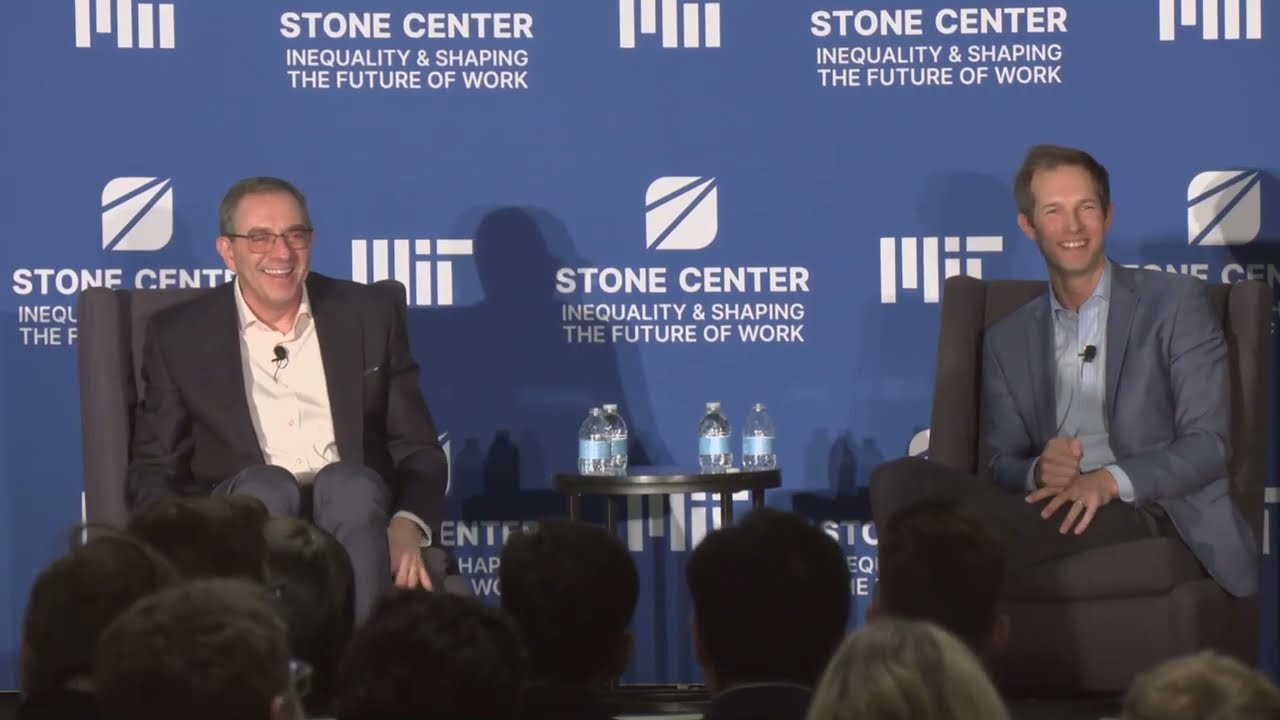
Congressman Jake Auchincloss, representing Massachusetts’ 4th district and serving on the House Committee on Energy and Commerce with oversight on AI policy, delivered a keynote address emphasizing the evolving nature of the U.S. labor market and the challenges posed by emerging technologies like AI. He outlined three critical questions for research and policy: identifying the next phase of labor market evolution beyond farms, factories, and offices; understanding whether AI will displace or augment jobs differently across sectors; and determining effective policy interventions that balance preparation, productivity, and redistribution. Auchincloss highlighted the importance of translating scholarly knowledge into actionable public policy to address these complex issues.
Addressing concerns from his constituents, Auchincloss noted a generational divide regarding AI’s impact on employment. Older generations feel less threatened by AI displacement, while younger people, especially recent college graduates, express significant anxiety about their job prospects. He stressed the need for a vision where people remain “above the API”—using AI as a collaborative tool rather than being controlled by it. Drawing a contrast between platforms like TikTok, where users are often manipulated by algorithms, and Etsy, where users leverage algorithms to create economic opportunities, he advocated for an economy that empowers individuals as producers and entrepreneurs.
On AI regulation, Auchincloss rejected the polarized camps of either no regulation or immediate heavy regulation controlled by tech companies. Instead, he argued for outcome-based, technology-neutral policies that focus on real-world impacts rather than specific AI technologies. He cited examples such as health insurers using AI to deny claims and biotech firms using AI for drug discovery, emphasizing that regulation should target harmful outcomes like privacy violations and misinformation on social media platforms. He called for updating laws like Section 230 to hold platforms accountable for harmful content, especially as AI-generated deepfakes and chatbots pose new risks.
Auchincloss also discussed broader societal challenges, including the corrosive effects of social media on public discourse and democracy. He described social media as an “algorithmic thunderdome” that promotes outrage and tribalism, contributing to loneliness and polarization. Advocating for “touch grass populism,” he emphasized the importance of real-life engagement and intentional public and private actions to reform media ecosystems. He also proposed ambitious ideas like building new cities to address housing shortages, energy needs, and urban design, linking these efforts to economic mobility and technological innovation, including AI-driven construction methods.
In the Q&A session, Auchincloss tackled questions on bipartisan cooperation in housing and infrastructure reform, the challenges of integrating AI into education, and regulating minors’ internet use without sacrificing benefits. He acknowledged the difficulty of adapting educational systems to AI tools and stressed the need for discipline in learning. On regulation, he highlighted the importance of protecting neural autonomy and combating AI-driven bias and misinformation. He expressed cautious optimism about bipartisan efforts to regulate social media and AI, emphasizing the need for courage and collective action to address these transformative challenges effectively.