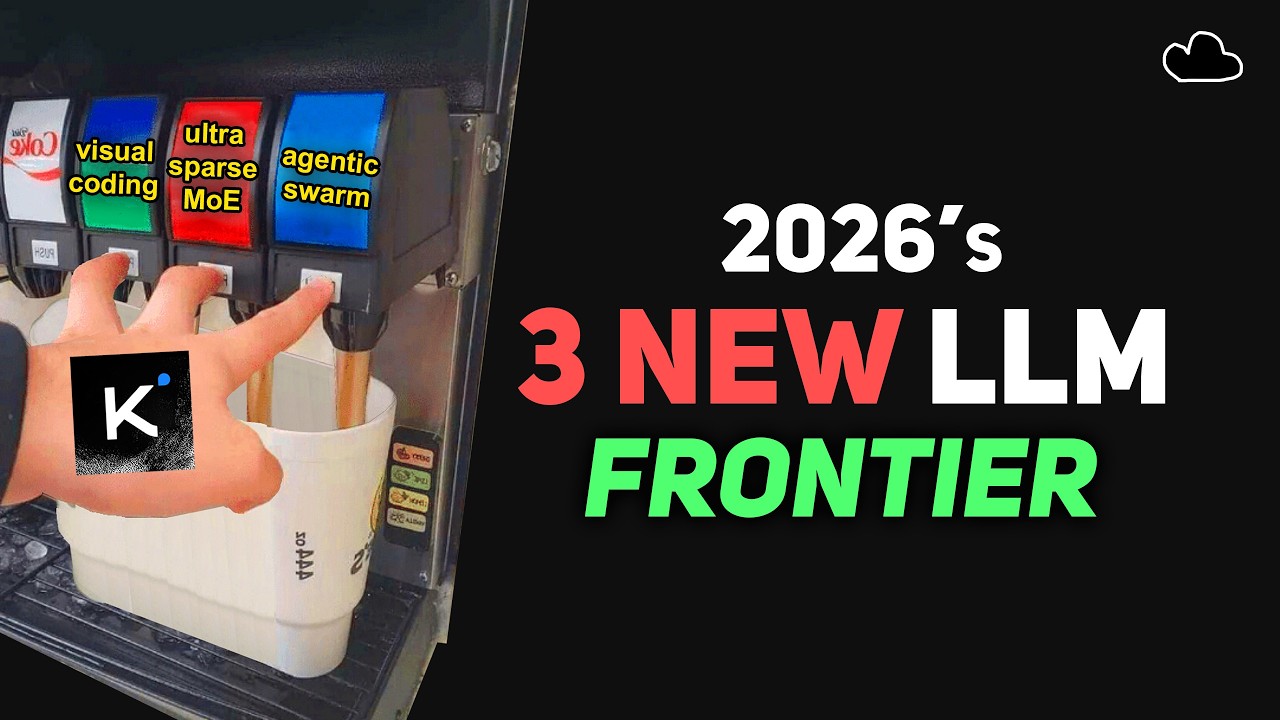
The video discusses the significance of Kimi K2.5, a leading large language model (LLM) developed by Moonshot AI, which has become one of the most popular models on OpenRouter—a platform for accessing and comparing open-source AI models. The presenter highlights how Kimi K2.5’s research paper introduces innovative concepts that set it apart from other AI labs, many of which are not as open with their advancements. Moonshot AI’s history of bold and successful research bets suggests that the breakthroughs in Kimi K2.5 could set new standards for LLMs by 2026.
A key innovation in Kimi K2.5 is its approach to continual training. Unlike typical models that receive only a modest amount of additional training, Kimi K2.5 was continually trained with a budget equal to its original pre-training—15 trillion tokens for both phases, totaling 30 trillion tokens. This training included both text and vision data, transforming the model into a native multimodal system. Instead of simply adding a vision module to a text model, Moonshot AI jointly trained vision and language from the ground up, using a vision encoder (MoonVIT3D), an MLP projector, and the Kimi K2 language model. This architecture allows the model to handle images and videos at native resolution and unify them in the same embedding space.
Another major advancement is the model’s ability to perform vision-based coding. Kimi K2.5 can replicate websites from recordings, demonstrating impressive front-end development capabilities. This is significant because AI has traditionally struggled with the visual aspects of coding and debugging. The model’s training included image-code pairs (such as HTML, React, or SVG with rendered screenshots), enabling it to align abstract code structures with visual layouts. Additionally, Moonshot AI developed a novel post-training process called Zero Vision SFT, which uses only text-supervised fine-tuning data to teach the model visual tool reasoning, overcoming the scarcity of high-quality vision instruction datasets.
The video also introduces the concept of “agent swarm,” a system where the model can decompose complex problems into multiple subtasks and run them concurrently, vastly improving inference speed. Unlike traditional sequential agentic systems, Kimi K2.5’s agent swarm uses a trainable orchestrator that dynamically spawns and manages specialized sub-agents in parallel. The orchestrator is trained using Parallel Agent Reinforcement Learning (PARL), which rewards efficient problem decomposition and penalizes unnecessary agent spawning. This approach not only accelerates execution but also improves context management by isolating subtasks and bounding their local context.
Finally, the video covers Kimi K2.5’s use of ultra-sparsity through a Mixture of Experts (MoE) architecture. The model has 1 trillion total parameters but activates only 32 billion per token, with 384 experts and a 2% sparsity ratio. This design allows for more efficient compute usage and better specialization among experts, as each expert can focus on more granular concepts. The ultra-sparse structure also helps preserve old competencies while learning new distributions, making the model more adaptable and efficient. The presenter concludes by praising Moonshot AI’s openness and the potential impact of their research on the broader AI community, fostering greater competition and innovation.