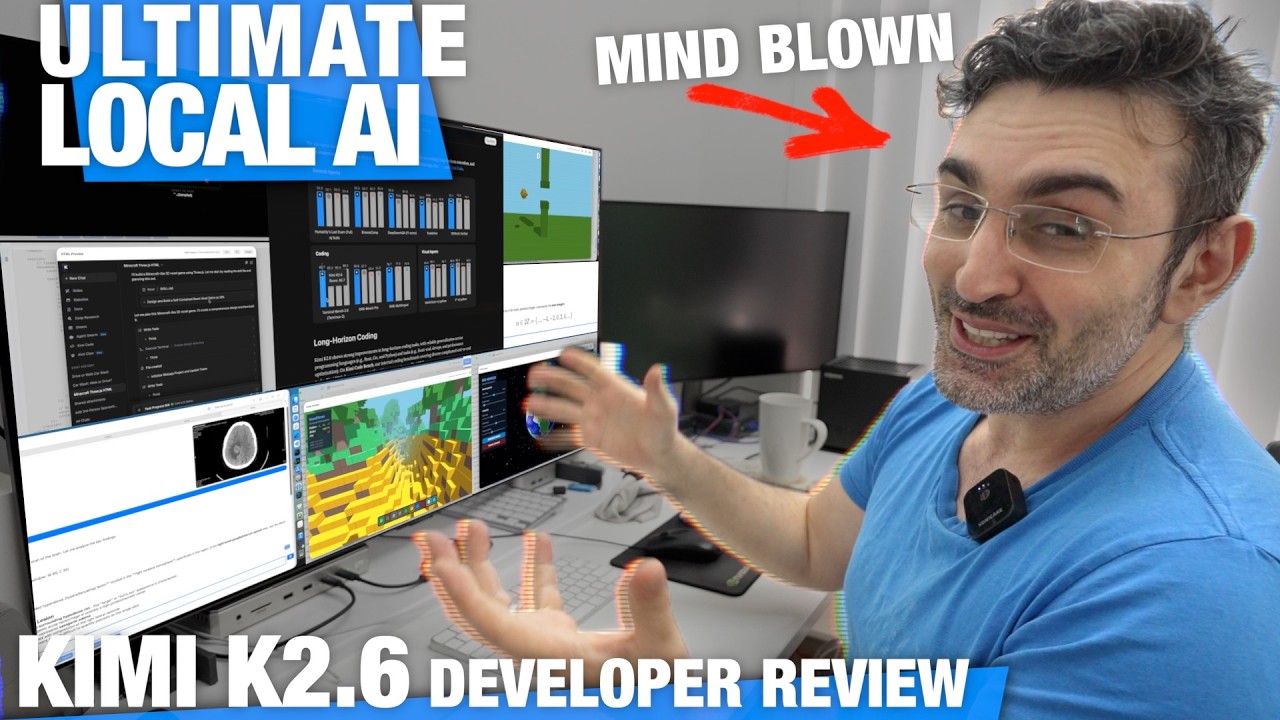
The video presents an in-depth review and testing of Kimmy K2.6, a cutting-edge, multimodal AI model boasting one trillion parameters and excelling in coding, vision, and mathematical reasoning. The host demonstrates the model’s impressive capabilities by running various quantizations locally on a Mac Studio and comparing them with the cloud version. Kimmy K2.6 shows remarkable performance in generating complex code, such as recreating websites from screenshots and building interactive games like Snake and Flappy Birds with CRT-style graphics and sound effects. The model’s ability to run efficiently on systems with large memory (around 400-500 GB) while maintaining high token generation speeds is highlighted as a significant achievement.
Different quantization levels of Kimmy K2.6 are tested, including Q3, Q3.4, Q3.5, and Q3.6, with the INF technique versions generally producing better and more stable results. Lower quantizations like Q3 struggle with complex tasks, often resulting in runtime errors or incomplete outputs, while the 3.5-bit INF quantization consistently delivers high-quality, playable 3D games and procedural planet generators with interactive elements such as collisions and asteroid impacts. The cloud version performs similarly but occasionally encounters errors not seen in local runs, showcasing the robustness of the local quantized models.
The AI’s mathematical reasoning is also tested using problems from the International Mathematics Olympiad 2024, where Kimmy K2.6 successfully solves complex problems even at lower quantizations, demonstrating its advanced reasoning capabilities. The model also excels in image analysis, accurately diagnosing medical CT scans with detailed differential diagnoses, although it lacks explicit disclaimers about medical advice in the local version, unlike the cloud interface. This unrestricted access is seen as both a strength and a potential risk depending on user expertise.
Further tests include logic and decision-making tasks, where Kimmy K2.6 provides sensible answers both in instant and thinking modes, showing its ability to handle nuanced queries. The host also experiments with the model’s agent system to generate Minecraft-like environments and procedural planets, noting some minor control issues but overall impressive results. The model’s vision capabilities are previewed by having it recreate the Kimmy.com website from a screenshot, producing a near-perfect HTML clone with interactive animations, demonstrating the model’s multimodal strengths.
In conclusion, Kimmy K2.6 is praised as a chart-topping, highly intelligent AI model that can be run locally for privacy or in the cloud for extra compute power. Its ability to handle coding, vision, math, and logic tasks at scale with efficient quantization makes it a versatile tool for developers and researchers. The host expresses excitement about upcoming smaller quantizations and continued improvements, while also reflecting humorously on the potential impact of such advanced AI on future professions. Overall, Kimmy K2.6 is positioned as a groundbreaking open-weight model with broad applications and impressive performance.