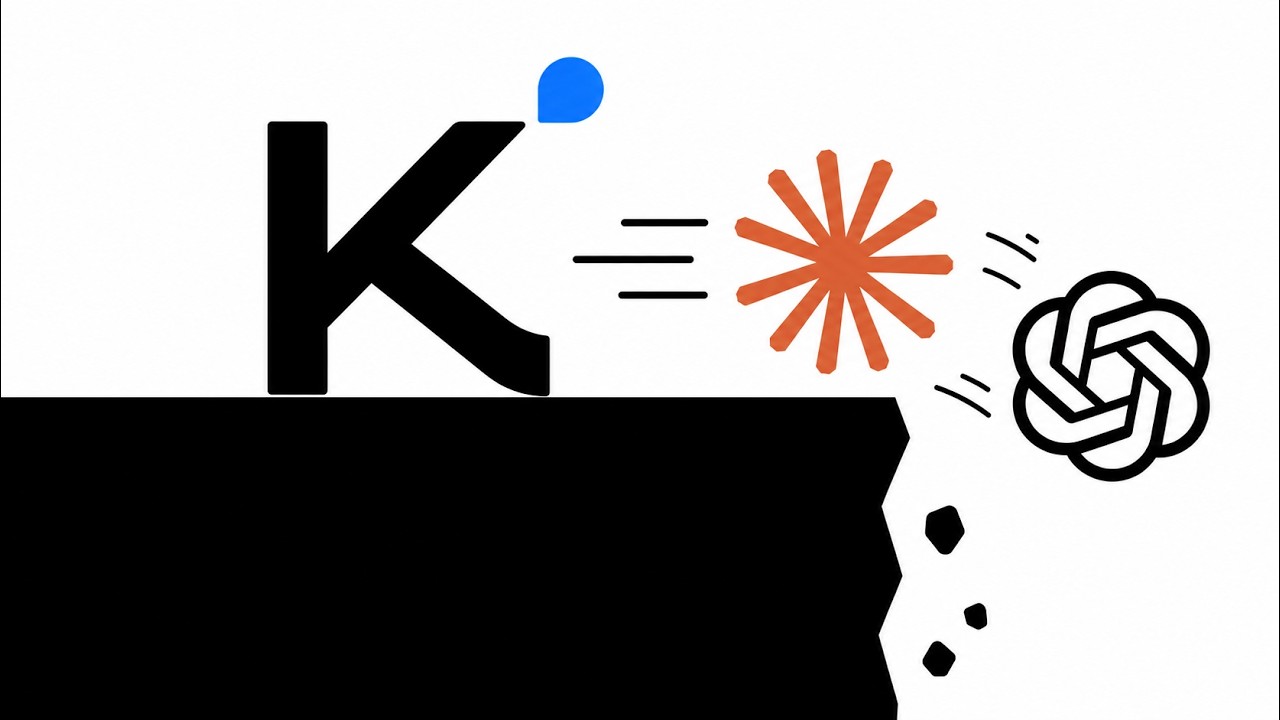
The video showcases Kim K3, an open weights AI model with 2.8 trillion parameters that excels at coding complex software through innovations like Kimmy Delta attention and attention residuals, significantly improving efficiency and scalability. It emphasizes the model’s accessibility to the research community, the role of platforms like Lambda in facilitating AI experimentation, and the broader impact of open science in advancing AI technology for global benefit.
The video introduces Kim K3, a groundbreaking AI system capable of coding complex software such as a nearly complete Mac OS operating system and various games, including an Animal Crossing-style game. What sets Kim K3 apart is that it is an open weights model, meaning anyone can download and own the model weights for free indefinitely. This openness is remarkable, especially given the model’s massive size of 2.8 trillion parameters, which makes running it at home challenging but accessible through web trials or APIs at a lower cost compared to other frontier models.
A key innovation behind Kim K3 is the introduction of “Kimmy Delta attention,” a mechanism that efficiently manages long discussions or sequences by maintaining a carefully updated notebook of relevant information rather than rereading everything repeatedly. This approach allows the AI to focus on the most pertinent and recent data, improving its ability to contribute meaningfully over extended interactions. This method significantly enhances the model’s efficiency in handling complex tasks.
Another breakthrough is the use of “attention residuals,” which provide a version history of information as it passes through multiple layers of the model. Instead of only receiving the latest update, each layer also accesses previous versions, enabling the model to maintain and correct its memory more effectively. This combination of Kimmy Delta attention and attention residuals results in a 2.5 times improvement in scaling efficiency compared to the previous Kimmy K2 model, meaning the AI learns much more from the same amount of training computation.
These advancements not only enable Kim K3 to perform impressive feats but also contribute to the broader AI research community by improving other open models. The open science approach behind Kim K3 fosters collaboration among researchers worldwide, making powerful AI tools accessible to everyone. Although running the full model is still resource-intensive, distilled versions are expected to become easier to run, further democratizing access to advanced AI technology.
The video also highlights Lambda, a platform that provides powerful Nvidia GPUs for running AI experiments, reproducing research papers, fine-tuning models, and running inference tasks quickly and reliably. Lambda supports the AI research community by enabling users to test ideas and achieve results efficiently. The presenter encourages viewers to try Lambda at lambda.ai/papers, emphasizing the exciting era of open science and the transformative potential of AI systems like Kim K3 for education, healthcare, and scientific research worldwide.