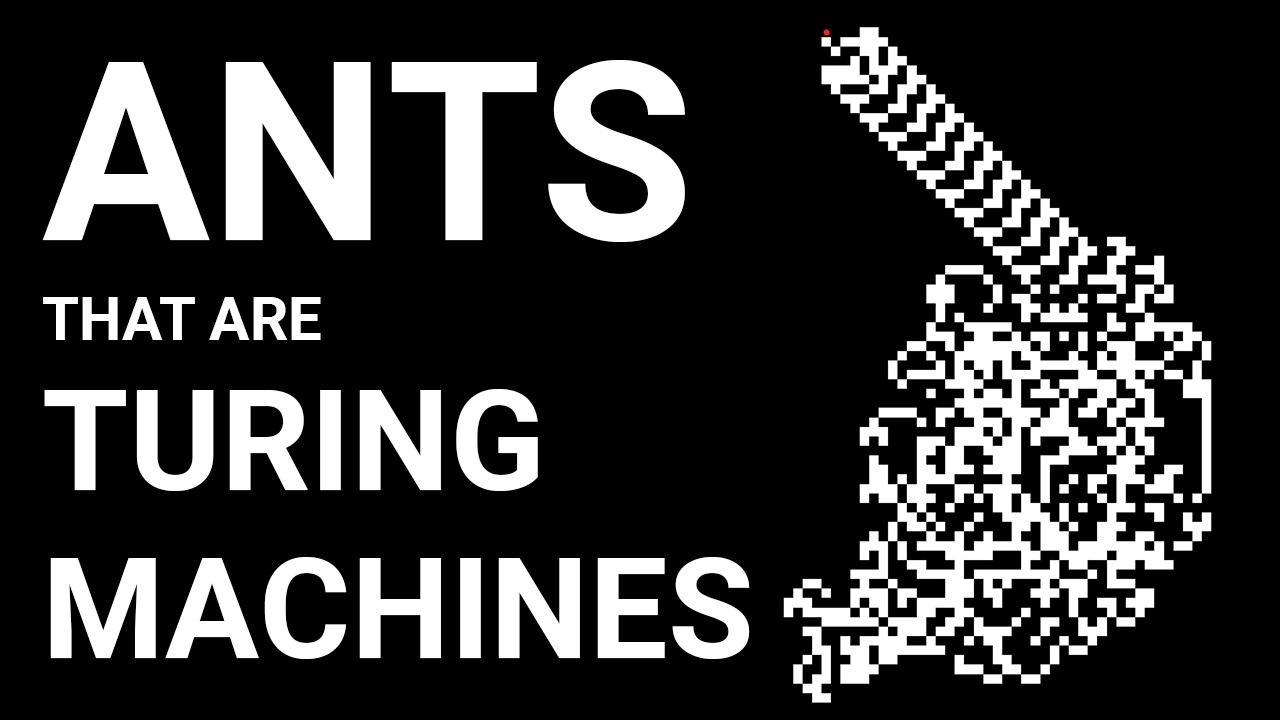
The video explores Langton’s Ant, a simple yet fascinating cellular automaton where an ant moves on a grid of black and white cells, changing their colors and turning based on specific rules. The ant’s behavior, governed by straightforward instructions—turn left on white, turn right on black, and flip the cell color—initially appears random but eventually produces complex patterns such as symmetrical shapes and highways. The simulation demonstrates how simple deterministic rules can lead to emergent order, chaos, and intricate structures over time, highlighting the surprising complexity that can arise from minimal initial conditions.
The creator extends the basic ant model by introducing multiple ants, which interact in unexpected ways, such as building borders, backtracking, or engaging in endless dances depending on their configurations. These behaviors are highly sensitive to initial arrangements, with even numbers of ants facing the same direction producing organized patterns, while odd numbers tend to create chaotic or stuck behaviors. The simulation allows for experimentation with different configurations, revealing that simple rules can generate a wide variety of emergent phenomena, from organized borders to chaotic noise.
A key innovation in the project is the use of AI to generate and analyze complex rules for ant behavior. The creator encodes ant logic as state machines or finite automata, which can read and write multiple colors and change states based on current conditions. This approach transforms the ant into a universal Turing machine, capable of performing any computable function given enough states and memory. By manipulating rule sets—adding different movement types, colors, and states—the simulation can produce highly intricate behaviors, effectively visualizing the execution of computer programs in a two-dimensional grid.
The video also discusses how restricting the ant’s movement and colors can simulate classical Turing machine concepts, such as the busy beaver problem, which seeks the longest halting program with a fixed number of states. Examples include three- and four-state busy beaver programs, with the latter running over 107 steps before halting. The creator notes the enormous complexity and computational limits involved in exploring higher-state busy beavers, hinting at the potential for future research and videos on this topic. The simulation thus serves as a bridge between simple cellular automata and the broader theory of computation.
Finally, the creator envisions expanding the simulation into an ecosystem-like model, where multiple ants with evolving rules interact and reproduce based on their behaviors. This could lead to emergent biological phenomena such as evolution, mutation, and population control within the ant community. The project combines elements of artificial life, AI, and computational theory, offering a platform for experimentation and discovery. The creator encourages viewers to share their creations and ideas on Discord, emphasizing the potential for future developments in understanding complex systems through simple rules and AI-assisted design.