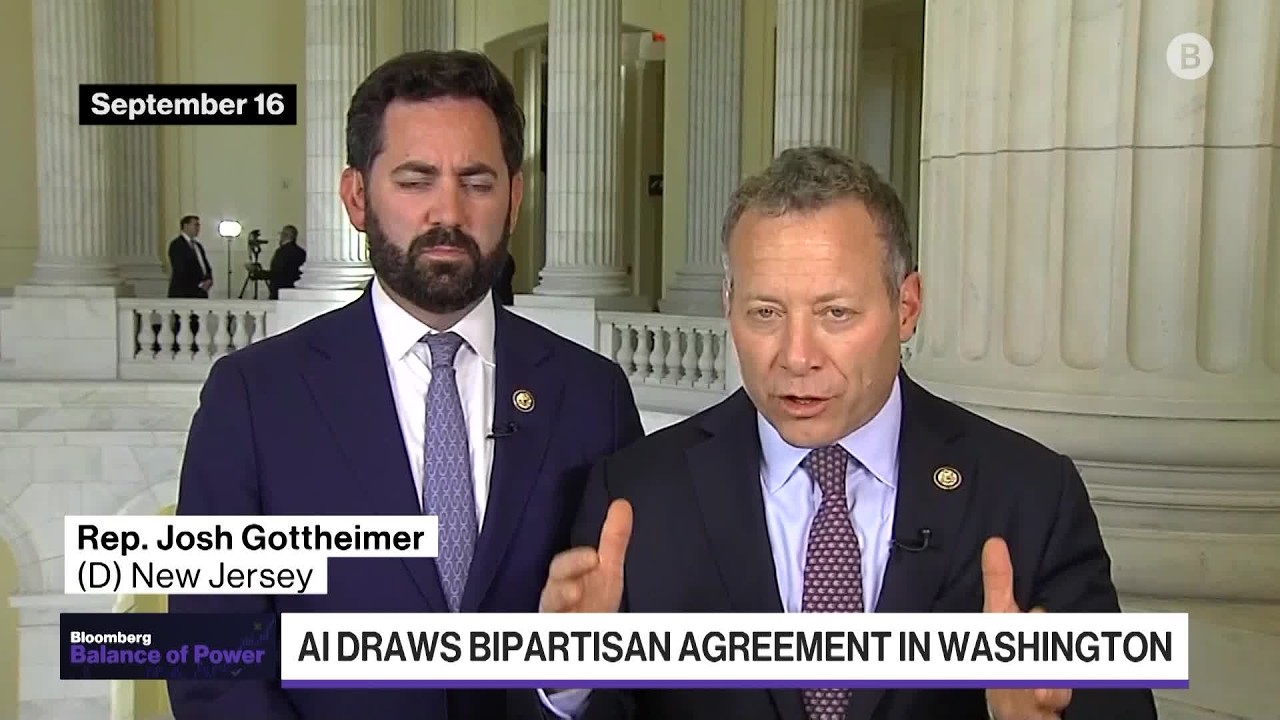
Artificial intelligence (AI) has become a rare point of bipartisan agreement among U.S. lawmakers, with figures from both the Republican and Democratic parties calling for more government oversight and guardrails. Lawmakers such as Mike Lawler, Troy Downing, Josh Gottheimer, and Raja Krishna Murthy emphasized the need for a coordinated federal approach to regulate AI, ensuring public safety while maintaining the country’s competitive edge. This consensus reflects growing concerns about AI’s rapid development and its potential societal impacts, signaling a shift in political priorities ahead of upcoming elections.
The bipartisan concern over AI is not limited to Congress; state leaders like Pennsylvania Governor Josh Shapiro, a potential 2028 presidential candidate, have also advocated for tougher AI regulations. Bloomberg’s Mario Parker highlighted how unusual it is to see such cross-party agreement in the current polarized political climate, underscoring the urgency and seriousness with which AI governance is now being approached. The discourse around AI has evolved from technical debates about data and economic issues to more existential and apocalyptic warnings from tech executives about the technology’s future risks.
Despite this growing caution, some politicians face a balancing act, especially those who have previously supported AI-related economic investments such as data centers in their states. For example, Maryland’s Westmoreland has welcomed data centers but now faces scrutiny over AI’s expansion. Many Democrats are publicly supporting AI regulation, with several presidential hopefuls, including Chris Murphy, Ron DeSantis, Mark Kelly, AOC, Ruben Gallego, Josh Shapiro, J.B. Pritzker, Gavin Newsom, and Kamala Harris, weighing in on the issue. This broad engagement suggests AI regulation will be a significant topic in the 2028 presidential race.
Former President Barack Obama recently emphasized the importance of having a clear stance on AI for any 2028 presidential candidate, criticizing his party for not taking a more proactive role. Governor Shapiro, in particular, has argued against the false dichotomy of either halting AI development entirely or pursuing it without restraint, advocating instead for a balanced approach. Some lawmakers, like Jon Ossoff, have even suggested international agreements akin to nuclear nonproliferation treaties to manage AI development globally, especially between the U.S. and China, which are seen as key competitors in this technological race.
Meanwhile, former President Donald Trump has pushed back against calls for stringent AI regulation, emphasizing the need for the U.S. to “win” the AI race. His stance reflects a broader tension between economic interests and regulatory caution, as AI and related technologies contribute significantly to the stock market and GDP. Tech executives initially hoped to influence the White House toward a more open approach to AI development, and the economic benefits of AI continue to be a strong argument against heavy-handed regulation. This dynamic sets the stage for ongoing debates about how best to balance innovation, economic growth, and public safety in the AI era.
Useful Links