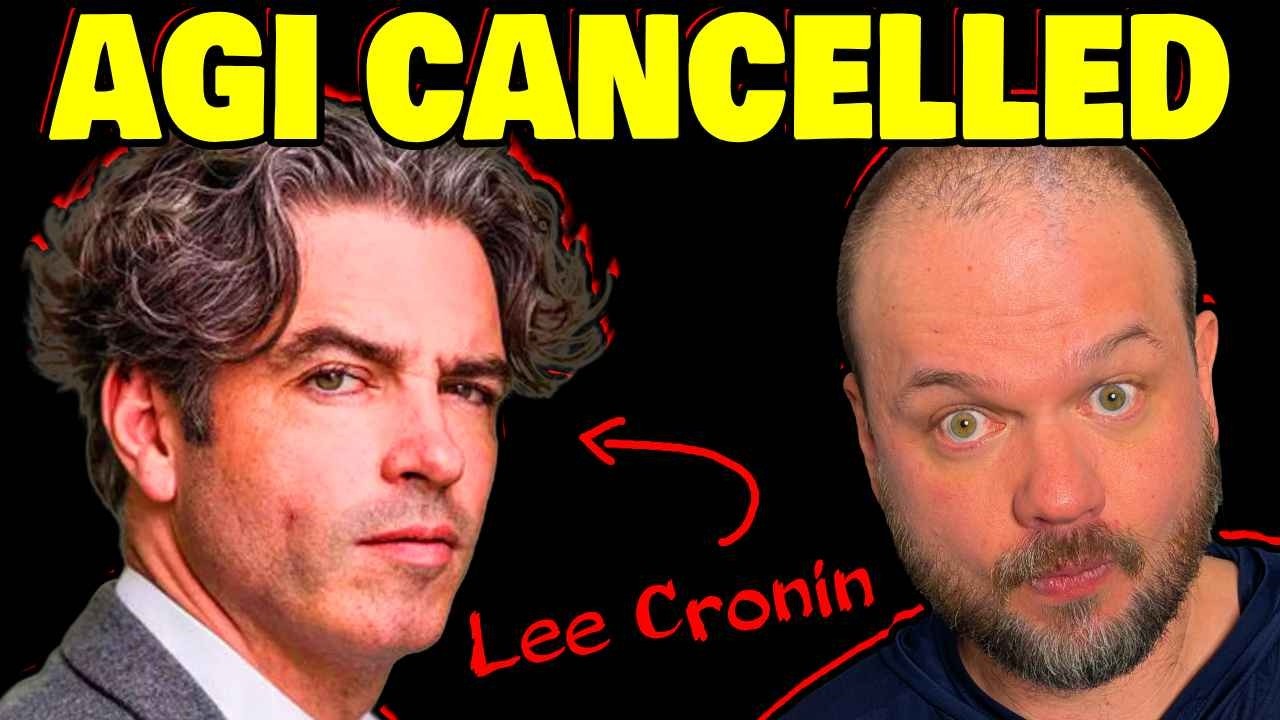
Lee Cronin, a professor of chemistry at the University of Glasgow, discusses his views on the nature of life, intelligence, and artificial intelligence (AI), challenging many mainstream narratives about AI risk and the potential for artificial general intelligence (AGI). He begins by critiquing the current discourse around AI, particularly the fears of AGI “doom.” Cronin argues that there is no plausible mechanism by which AGI could spontaneously develop agency, become superintelligent, and threaten humanity. He emphasizes that AI systems, no matter how advanced, lack the creativity, agency, and evolutionary grounding of living systems. According to Cronin, complex multicellular organisms possess agency, while AI does not and cannot under current architectures.
Cronin delves into the philosophical and scientific foundations of existence, causation, and evolution. He explains that the universe is fundamentally random and featureless, but chemistry introduces causation, which allows for the persistence and evolution of matter. This process, he argues, is the root of complexity and life. He introduces assembly theory, which provides a quantitative way to distinguish life from non-life by measuring the complexity and abundance of molecular structures. Life, in his view, is defined by the ability to produce complex objects at scale through recursive processes—something only evolution can achieve.
The conversation shifts to the origins of life and the role of selection before biology. Cronin posits that selection is a fundamental force in the universe, akin to gravity, and that it operated even before biological evolution began. This perspective reframes the emergence of life as a natural consequence of matter persisting against environmental attrition, rather than a miraculous leap. He uses examples like DNA and E. coli to illustrate how replicating systems can outlast even the most durable non-living materials, highlighting the unique persistence of life.
When discussing intelligence and consciousness, Cronin outlines a hierarchy: evolution leads to sensing, which leads to memory, consciousness, imagination, and finally free will. He argues that true intelligence requires agency, which in turn depends on this layered structure. AI systems, he contends, lack these qualities—they do not possess real memory, consciousness, or imagination, but merely encode and represent patterns from data. While AI can be powerful tools for searching and correlating information, they are fundamentally different from living, intelligent beings. Cronin is particularly critical of the anthropomorphizing of AI and the misleading terminology used by tech companies and media.
Finally, Cronin addresses the social and ethical implications of AI. He dismisses the “doomer” narrative as baseless fearmongering, pointing out that the real risks of AI lie in misuse—such as fake data, political manipulation, and mass hysteria—not in runaway superintelligence. He calls for more precise language and regulation, emphasizing that AI should be seen as a tool rather than a potential existential threat. Cronin advocates for curiosity-driven science, humility in the face of the unknown, and a focus on understanding the true nature of life and intelligence, rather than succumbing to hype or fear.