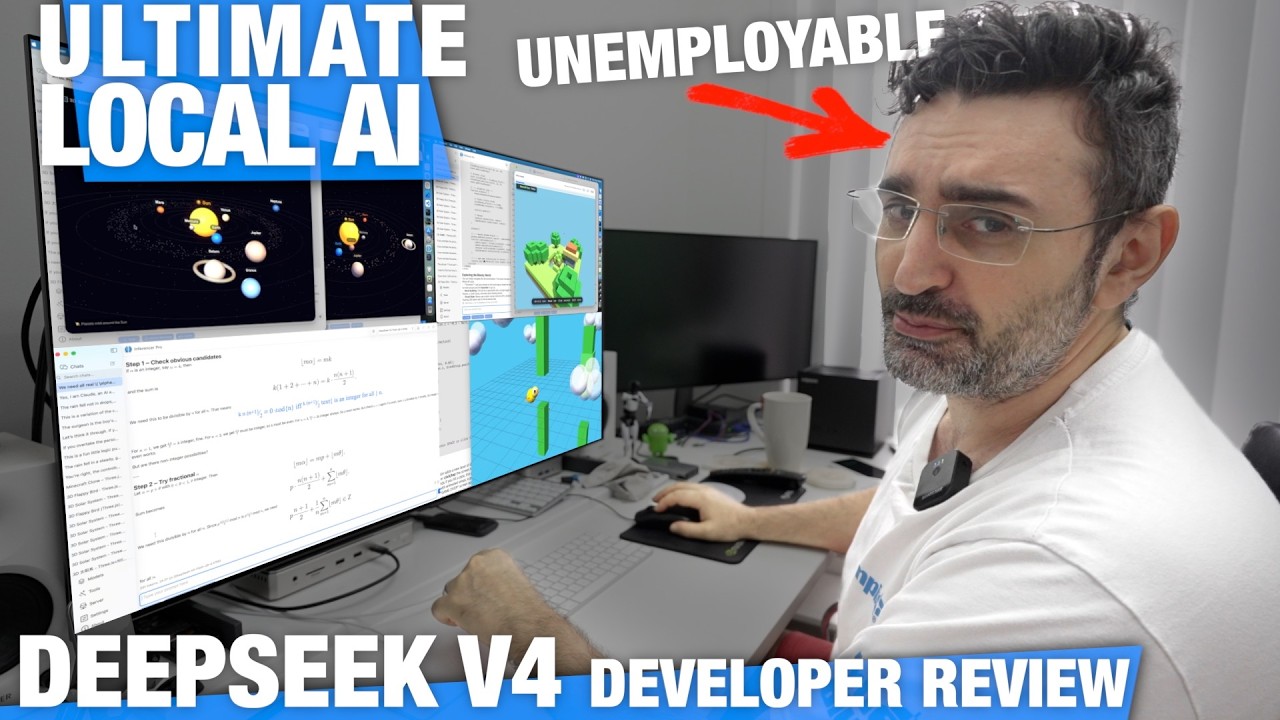
The video reviews Deep Seek V4’s Flash and Pro editions, highlighting the Flash edition’s impressive local performance on a Mac Studio with efficient quantized models that handle complex tasks like 3D scene generation, reasoning, and solving challenging math problems faster and with fewer resources than larger models. The presenter emphasizes Deep Seek’s advanced architecture, showcases its creativity and flexibility, and announces plans to share the Flash model publicly while exploring future enhancements for the Pro edition.
In this video, the presenter explores Deep Seek V4, focusing on its two editions: the massive Pro edition with 1.6 trillion parameters and the more accessible Flash edition. While the Pro edition requires substantial hardware resources and is still being worked on, the Flash edition runs locally on a Mac Studio with quantized models (4-bit and 9-bit). Deep Seek’s architecture is influential, inspiring other top models like Kimmy K2.6 and GLM 5.1, and it incorporates advanced features such as hybrid attention and manifold constrained hyper connections, making it a cutting-edge AI model.
The presenter runs various local tests comparing the two quantizations of Deep Seek V4 Flash and also contrasts them with cloud-based versions. The Flash edition performs impressively, generating complex 3D scenes like a solar system and a Flappy Birds game with detailed 3D models and lighting effects. The 4-bit repacked quantization uses significantly less memory (145 GB) compared to the 9-bit version (298 GB) while delivering comparable or slightly better visual quality. Cloud versions also produce good results, sometimes with better lighting or interactivity, but local runs demonstrate strong capabilities without runtime errors.
When testing more complex tasks like generating a Minecraft-style world, the model produces visually appealing results but struggles with interactive controls locally, whereas the cloud Pro edition offers better interactivity. The presenter also evaluates Deep Seek’s reasoning and logic abilities through riddles and ethical dilemmas, noting that while it can reason well, it sometimes flips answers depending on prompt formatting. The model shows creativity in story writing and can be influenced by parameters like temperature and seed to vary outputs, highlighting its flexibility.
A significant highlight is Deep Seek V4 Flash’s performance on a challenging International Math Olympiad problem. Despite its smaller memory footprint compared to other large models like Kimmy K2.6 and GLM 5.1, it correctly solves the problem with fewer steps and at a faster token generation rate. This breakthrough demonstrates the efficiency and power of the Flash edition, making it a promising option for local AI coding, math, and logic tasks without requiring enormous computational resources.
The video concludes with the presenter sharing plans to upload the experimental Flash model for public use and hints at future improvements, including running the Pro edition with distributed computing or better quantization. The presenter invites viewers to share their experiences with Deep Seek V4, especially the Pro edition, and expresses excitement about the model’s potential. The video ends with a playful challenge to the AI to write Python inference code for Deep Seek V4, showcasing the model’s advanced capabilities and the ongoing development in local AI solutions.