Michael Richmond, an engineering leader at Bitly, introduces the concept of FOMAT—Fear of Missing Agent Time—a term he coined to describe the anxiety developers feel when they cannot immediately interact with their coding agents. Unlike the familiar FOMO (Fear of Missing Out), FOMAT arises when an agent is working autonomously but requires user input at unpredictable times, causing delays and inefficiencies. Richmond highlights that as agent tasks grow longer, sometimes spanning hours or days, the challenge of timely interaction becomes more critical, especially when developers are away from their primary development environment.
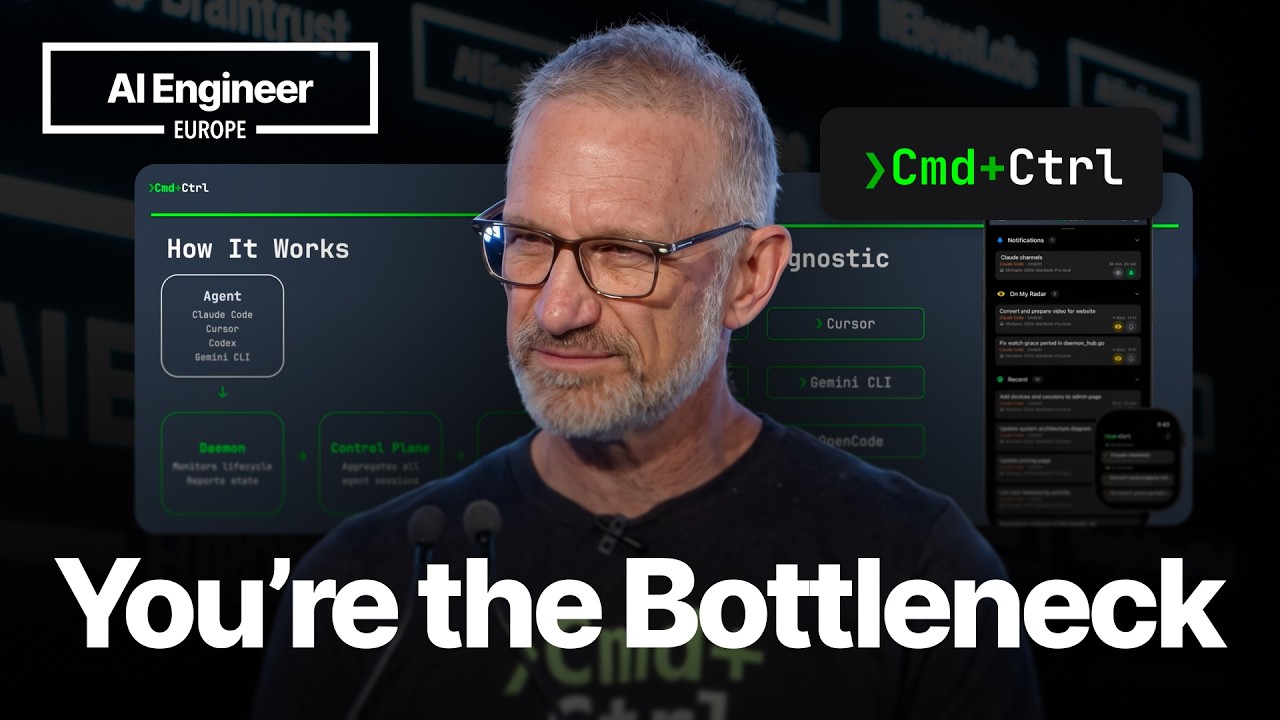
To address this problem, Richmond developed a system called Command and Control, designed to centralize and streamline the management of multiple coding agents across various platforms and devices. This tool allows developers to monitor, interact with, and launch agent sessions from anywhere—be it a mobile phone, web interface, or even a smartwatch. By consolidating sessions from different agents like Claude Code, Codex, Gemini, and Cursor into a single interface, Command and Control helps users keep track of numerous concurrent tasks, reducing the cognitive load and preventing sessions from stalling unnoticed.
Richmond demonstrates several features of Command and Control, including real-time notifications when agents require input or complete tasks, the ability to start new sessions remotely, and a dashboard that organizes sessions by priority and recency. These capabilities enable developers to maintain continuous engagement with their agents without being tethered to their development machines. The system’s architecture includes a daemon running alongside each agent platform that communicates with a centralized control plane, ensuring seamless integration and management regardless of where the agents are hosted.
Beyond the technical solution, Richmond reflects on the broader impact of agentic coding workflows on software development. He contrasts the traditional concept of “flow”—deep, uninterrupted focus on coding—with a new paradigm centered on “agent choreography,” where developers orchestrate multiple agents working in parallel. This shift demands new tools and approaches to manage complexity and maintain productivity, emphasizing the importance of balancing constant availability with necessary breaks to avoid cognitive overload.
In closing, Richmond invites the audience to explore Command and Control and share their experiences and challenges with agent workflows. He underscores the need for systems that support flexible, anytime-anywhere interaction with coding agents to truly overcome FOMAT. By enabling developers to stay connected with their agents during breaks and across devices, Command and Control aims to enhance both the efficiency and enjoyment of modern software development.