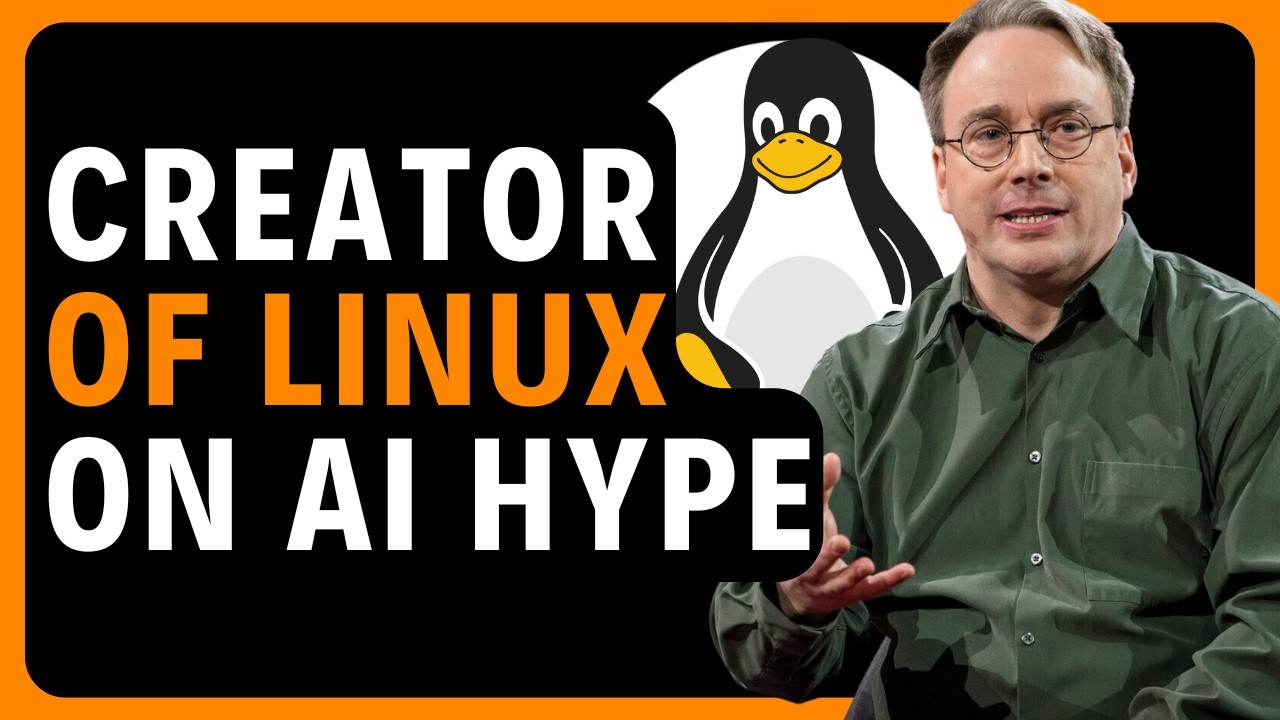
Certainly! Here’s a five-paragraph summary of the video featuring Linus Torvalds discussing AI hype and the future of Linux:
In a recent onstage conversation hosted by the Linux Foundation, Linus Torvalds sat down with Dirk, the head of open source efforts at Verizon, to discuss the current state and future of AI in Linux development. The conversation began with an exploration of whether AI tools could make Linus’s work easier, particularly in the areas of code review, bug detection, and conflict resolution. Linus acknowledged that the Linux development environment is already heavily reliant on tools, and that AI is becoming an increasingly important part of this toolkit.
Linus expressed a nuanced view of AI, stating that while he dislikes the overhyped nature of the term “AI,” he is a strong believer in its practical applications as a tool. He emphasized that AI’s most promising use in the Linux kernel is not in generating code, but in reviewing and maintaining it. Several internal projects are already underway, using AI to check patches and prevent bad code from being merged. Linus noted that some AI tools have recently demonstrated impressive results, sometimes even identifying issues that human experts missed, and he expects AI-assisted code review to become an integral part of the Linux workflow in the near future.
The discussion also touched on the potential for AI tools to help new contributors get started with kernel development. Linus pointed out that while the Linux kernel is a complex and challenging project, AI could lower the barrier to entry by helping newcomers navigate the extensive codebase and processes. However, he cautioned that beginners might want to start with smaller projects before tackling the kernel. He compared the impact of AI to that of compilers, which revolutionized programming by making it vastly more efficient, but stressed that AI is ultimately just another tool in the developer’s arsenal.
Linus further elaborated that while AI might offer a tenfold or even hundredfold productivity boost, compilers already provided a thousandfold improvement decades ago. He urged the audience not to view AI as a revolutionary change, but rather as a continuation of the evolution of programming tools. Linus also humorously noted that AI tools are more polite than compilers when they make mistakes, and shared anecdotes about AI models trained on kernel mailing lists needing to be taught not to curse.
In conclusion, Linus expressed optimism about the future integration of AI into Linux development, particularly in making code review and maintenance more efficient and accessible. He looks forward to the hype around AI subsiding, allowing the technology to be appreciated for its genuine contributions. The conversation wrapped up with thanks to the Linux Foundation and an invitation for viewers to share their thoughts on AI in kernel development, as well as a reminder to check out the full talk for more insights.