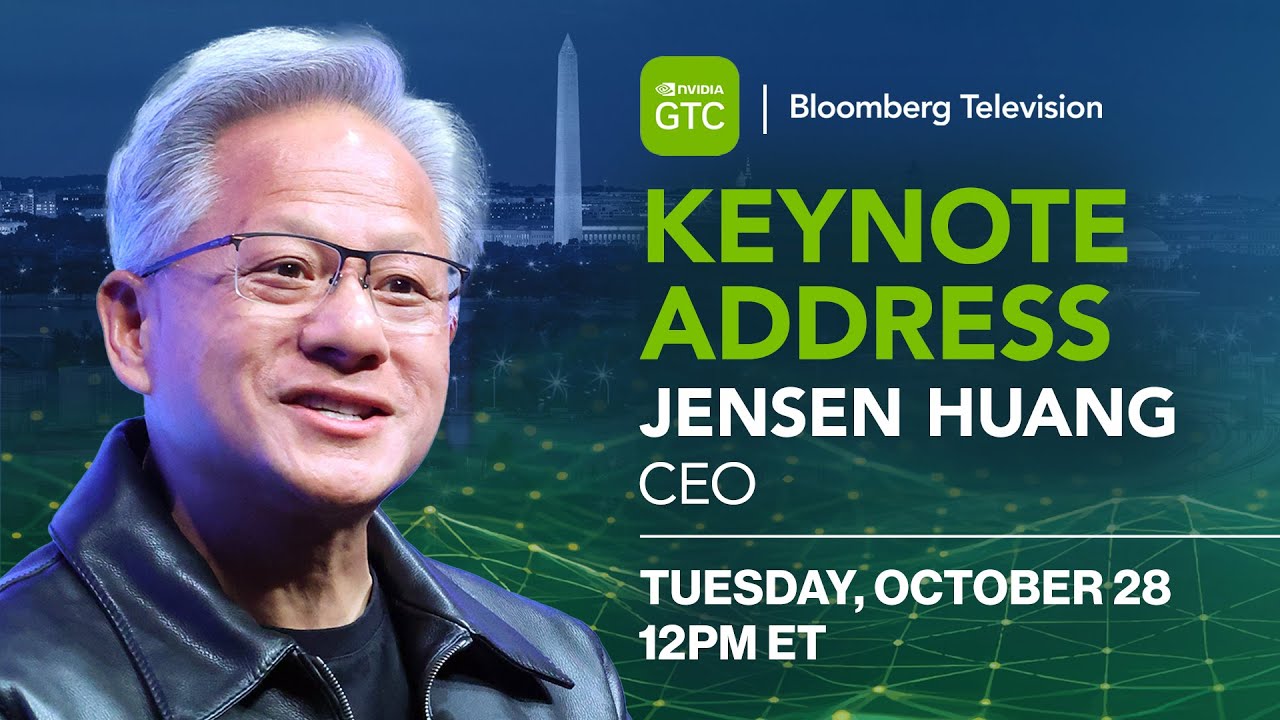
In his keynote address at GTC Washington DC, Nvidia CEO Jensen Huang outlined the transformative impact of accelerated computing and artificial intelligence (AI) on various industries and the future of technology. He emphasized that Nvidia has pioneered a new computing model, moving beyond the limitations of Moore’s Law and Dennard scaling, by integrating parallel computing with sequential CPU processing through GPUs and a robust programming model called CUDA. This innovation has enabled breakthroughs across domains such as computational lithography, AI training, medical imaging, genomics, and quantum computing, supported by a vast ecosystem of software libraries and partners.
Huang announced Nvidia’s strategic partnership with Nokia to develop Nvidia Arc, a revolutionary software-defined, programmable wireless communication platform designed for 6G networks. This platform combines Nvidia’s Grace CPU, Blackwell GPU, and ConnectX networking to enable AI-enhanced radio access networks (AI for RAN) and edge cloud computing (AI on RAN), aiming to improve spectral efficiency and power consumption in telecommunications. This collaboration marks a significant effort to bring American innovation back to the forefront of global wireless technology.
The keynote also highlighted Nvidia’s advances in quantum computing, introducing NVQLink, an interconnect architecture that links quantum processors with Nvidia GPUs to enable quantum error correction, AI calibration, and hybrid quantum-classical simulations. This scalable platform supports a wide range of quantum hardware and is backed by extensive industry and Department of Energy partnerships. Huang underscored the importance of integrating quantum computing with classical accelerated computing to push the boundaries of scientific research and innovation.
A major focus of the address was the concept of AI factories—specialized data centers designed exclusively to produce AI tokens efficiently and cost-effectively. Huang explained how AI has evolved from simple pre-training to complex post-training and real-time thinking, driving exponential growth in computational demand. Nvidia’s extreme co-design approach, exemplified by the Grace Blackwell and Reuben AI supercomputers, delivers unprecedented performance and cost-efficiency, enabling the rapid scaling of AI applications across industries. The company is also advancing AI infrastructure with digital twins and Omniverse DSX to optimize the design, operation, and management of these AI factories.
Finally, Huang discussed Nvidia’s broad AI ecosystem, including open-source models, enterprise collaborations, robotics, and autonomous vehicles. He highlighted partnerships with companies like CrowdStrike for cybersecurity AI, Palantir for data processing, and Uber for deploying Nvidia Drive Hyperion in robo-taxis. The integration of AI into physical systems such as robotic factories, surgical robots, and humanoid robots was showcased through digital twin simulations and real-world applications. Huang concluded by celebrating America’s resurgence in manufacturing and innovation, driven by Nvidia’s cutting-edge technologies and collaborations, positioning the country for leadership in the AI era.