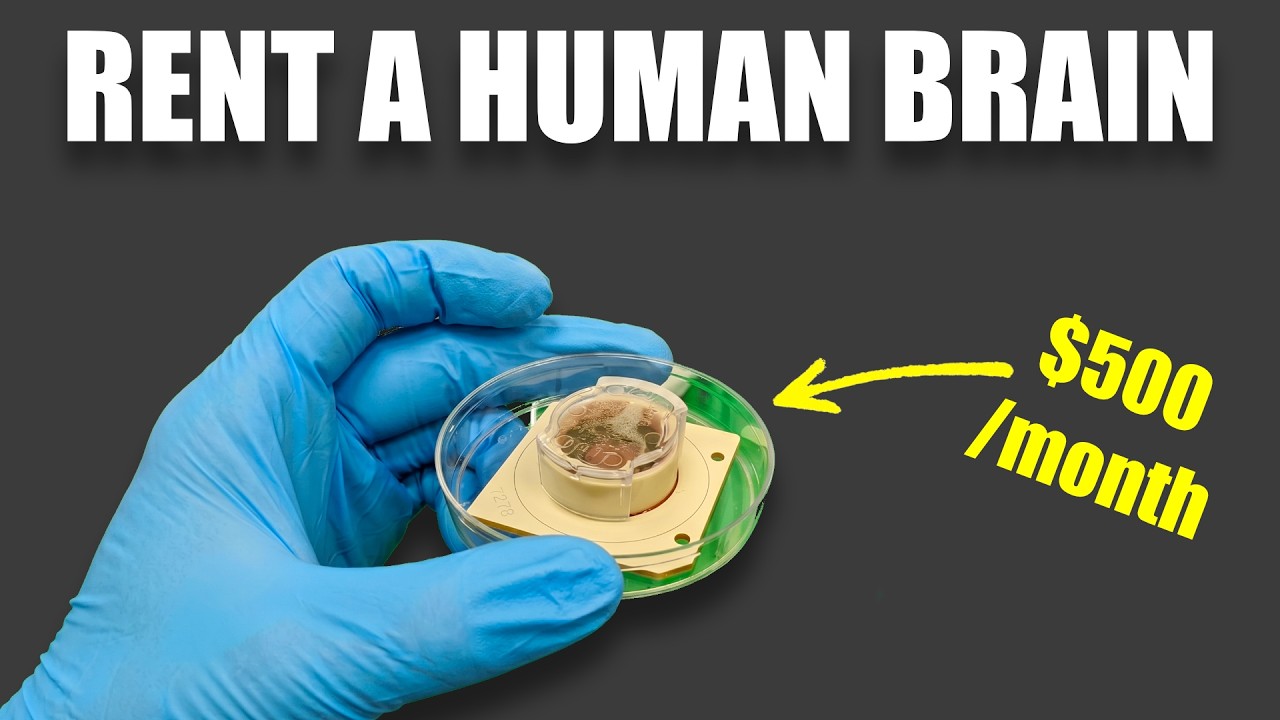
Final Spark has developed technology that uses living human brain organoids—grown from adult cells and maintained in lab conditions—as computational servers, enabling real-time code execution and learning via a Python interface, primarily for medical research on neurological diseases. However, this innovation raises significant ethical concerns due to the potential sentience of these brain tissues, the distress caused during their training, and the challenges of managing their limited lifespan and consciousness implications.
A company named Final Spark has pioneered a groundbreaking technology that allows people to rent living human brains—clusters of real human neurons grown from adult cells and maintained in lab conditions—as computational servers. These “wetware as a service” systems enable users to run code on actual brain cells remotely via a Python interface. The neurons learn and adapt in real time, but training them is a complex and ethically troubling process that involves subjecting the brain cells to discomfort or “torture” to encourage learning, based on the free energy principle where neurons seek to avoid unpredictable, chaotic stimuli.
The brains used in these systems are not harvested from donors but are grown from adult skin or blood samples that are chemically reverted to stem cells and then developed into neurons or organoids—tiny 3D clusters of brain tissue. These organoids require a specialized microfluidic chamber to supply nutrients and remove waste, mimicking a bloodstream, but they can only survive for a few months before deteriorating. Communication with these living brains is facilitated by multi-electrode arrays (MEAs) that translate digital signals into electrical impulses the neurons can sense and vice versa, allowing a two-way interaction between human users and the brain tissue.
The primary application of this technology is in medical research, particularly for studying brain diseases like Alzheimer’s, Parkinson’s, and epilepsy. Organoids grown from patients’ cells carry the exact disease pathology, enabling researchers to observe disease progression and test drugs directly on living human brain tissue without ethical concerns of experimenting on actual humans. This approach bypasses the limitations of animal models, which often fail to replicate human neurological diseases accurately, offering a faster and more precise platform for drug development.
Despite the technological advances, significant challenges remain. The living brains only last a few months, and all the learning and adaptations they acquire are lost when the tissue dies, necessitating a continuous cycle of growing new brains and retraining them from scratch. Moreover, studies have shown that even without external stimuli, these organoids exhibit brainwave patterns similar to those of premature infants, raising profound ethical questions about whether these tissues might possess some form of sentience or consciousness. Scientists acknowledge the difficulty in defining or testing consciousness, especially in such minimal brain structures.
The ethical implications of this technology are profound and largely unresolved. While researchers currently operate under the assumption that these organoids are not conscious beings but merely biological tissue, the possibility that they might experience suffering or awareness cannot be dismissed outright. This uncertainty poses a moral dilemma, especially given the training methods involve causing distress to the neurons. As the field rapidly advances, the question of how to ethically manage and regulate living brain computation remains a critical and uncomfortable issue that the scientific community has yet to fully address.