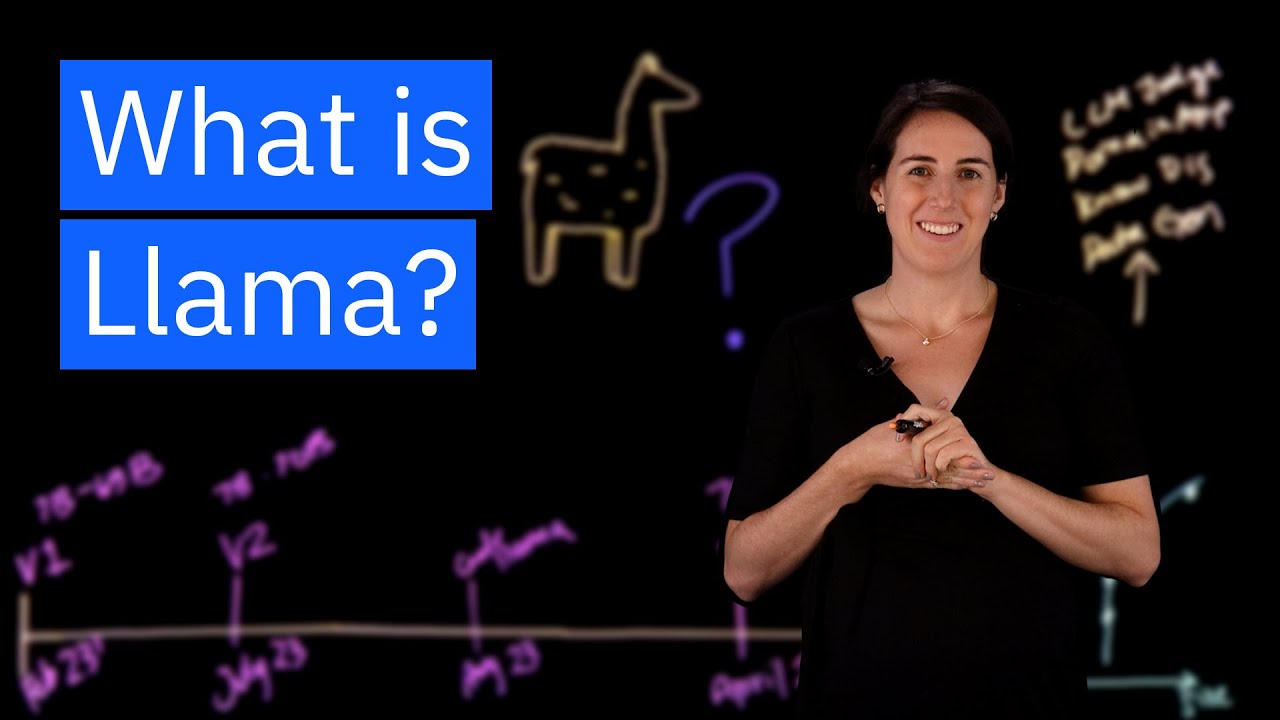
The video discusses Llama, an open-source AI model that is revolutionizing the way we think about artificial intelligence. Llama stands for “Large Language Model Meta AI” and is designed to be transparent, customizable, and accurate. Being open-source allows users to see how the model was built, understand its limitations, and tailor it to specific use cases. This flexibility leads to more efficient and cost-effective solutions compared to proprietary models, which are often larger and more expensive.
The history of Llama began with its first version released in February 2023, which included models ranging from 7 billion to 65 billion parameters. This initial release marked a significant entry into the small model market, focusing on word prediction. The second version, launched in July 2023, improved performance while maintaining a similar size range, showcasing Llama’s commitment to enhancing efficiency. Subsequent releases, including Code Llama in August 2023, introduced domain-specific models, particularly beneficial for developers working with programming languages like Python.
Llama 3, released in April 2024, continued the trend of increasing performance relative to size, with models ranging from 7 billion to 70 billion parameters. The most recent update, Llama 3.1, released in July 2024, introduced several exciting features, including multilingual capabilities, an expanded context window for generating more text, and enhanced security measures like Llama Guard to mitigate risks associated with prompt injection. Notably, Llama 3.1 also introduced a massive 405 billion parameter model, significantly larger than its predecessors.
The video highlights various applications of Llama 3.1, emphasizing its potential for data generation, which can drastically reduce the time needed for data scientists to access necessary data. The model’s ability to generate synthetic data in minutes represents a substantial productivity boost. Additionally, Llama can be utilized for knowledge distillation, allowing users to refine the model for specific domains, and as an evaluator for comparing different large language models to determine the best fit for particular use cases.
In conclusion, the video encapsulates the evolution of Llama, its current capabilities, and its practical applications. It invites viewers to consider the future of Llama and what enhancements they might anticipate in upcoming releases. The open-source nature of Llama not only democratizes access to advanced AI technology but also fosters innovation and customization, making it a significant player in the AI landscape.