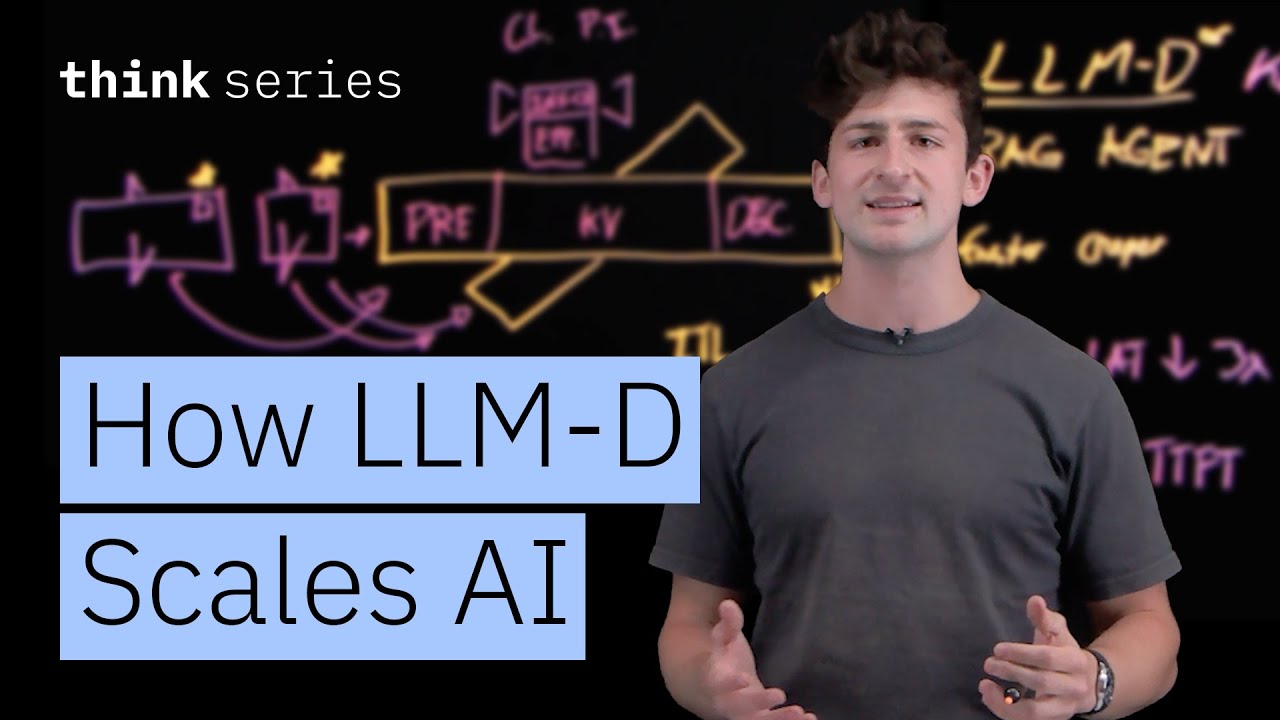
The video explains how LLM-D, an open-source project, uses intelligent routing—similar to air traffic control—to efficiently manage and distribute AI inference requests across Kubernetes clusters, improving speed and reducing costs for applications like RAG and coding assistants. By grouping similar requests, leveraging caching, and optimizing resource allocation, LLM-D significantly reduces latency and enhances performance for large language model deployments.
The video uses the analogy of an airport and air traffic control to explain how LLM-D, an open-source project, manages AI inference requests. Just as air traffic controllers route different types of planes to the correct runways, LLM-D intelligently routes various AI requests—ranging from small, simple ones to large, complex tasks—to the appropriate resources. This is particularly important for applications like Retrieval-Augmented Generation (RAG), coding assistants, and other AI agents that rely on large language models (LLMs).
LLM-D stands for “Large Language Model - Distributed,” and its main purpose is to make LLM inference both faster and more cost-effective by distributing workloads across a Kubernetes cluster. Traditional load balancing methods, such as round-robin, can lead to congestion and increased latency, especially when requests vary greatly in size and complexity. This results in higher inter-token latency, which is the delay users experience between sending a request and receiving a response.
A key feature of LLM-D is its ability to recognize and route similar requests together, leveraging caching and prefix routing to reduce redundant computations. By grouping similar tasks, the system can save on hardware acceleration costs and increase overall throughput. The main goal is to minimize the number of calculations required, thereby improving efficiency and reducing operational expenses.
LLM-D uses an inference gateway that evaluates incoming requests based on several metrics, such as current system load, predicted latency, and the likelihood that the data is already cached. The gateway employs an endpoint picker to process requests in two phases: prefill (evaluating the request) and decode (generating the response). These phases are distributed across different hardware resources—high-memory GPUs for prefill and scalable resources for decode—while sharing the same key-value cache for efficiency.
The implementation of LLM-D has led to significant performance improvements, such as a threefold reduction in P90 latency (the slowest 10% of requests) and a 57-fold increase in time to first token. These enhancements are crucial for meeting service-level objectives and quality of service agreements, especially for high-demand or mission-critical AI systems. The video concludes by emphasizing the importance of intelligent routing in AI inference and invites viewers to share their thoughts and suggestions for future topics.