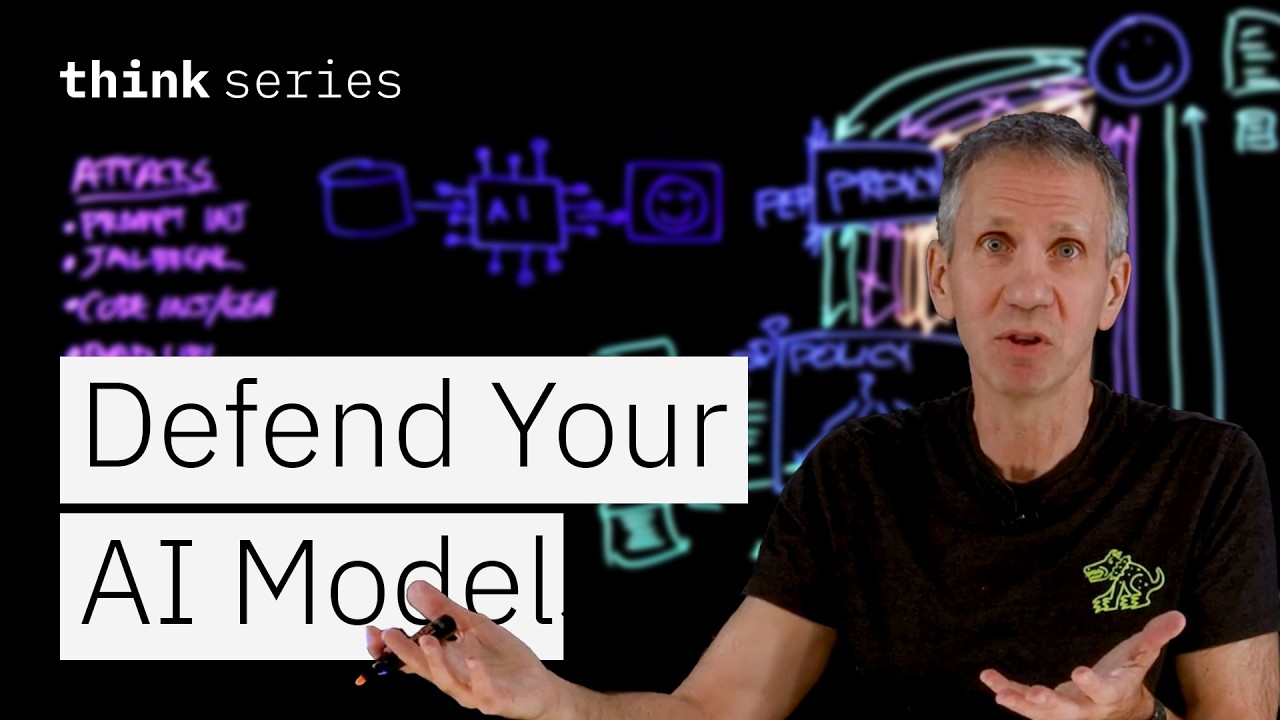
The video discusses the vulnerabilities of large language models (LLMs) to various usage-based attacks, particularly focusing on prompt injection. Prompt injection tricks the LLM into executing malicious instructions embedded within user input, potentially leading to harmful or manipulated outputs. A notable example is jailbreaking, where attackers bypass model restrictions by instructing the LLM to ignore previous safety guidelines, often resulting in the generation of unsafe content. Other risks include data exfiltration, where sensitive information might be leaked, and the generation of hate, abuse, or profanity (HAP), which can damage the reputation of organizations deploying these models.
To defend against these threats, the video proposes inserting a proxy component between the user and the LLM. This proxy acts as a policy enforcement point, inspecting both incoming requests and outgoing responses. It works alongside a policy engine, or policy decision point, which evaluates inputs and outputs to decide whether to allow, modify, warn about, or block certain interactions. For example, the proxy can block dangerous prompt injections before they reach the LLM, redact sensitive information from responses, or clean up offensive language, thereby maintaining control over the model’s behavior.
This proxy-policy engine approach offers several advantages over relying solely on training the LLM to resist attacks. Training multiple LLMs to be secure is labor-intensive and difficult to maintain, especially as new model versions are released. By centralizing security enforcement in a proxy, organizations can consistently apply policies across multiple models, simplifying management and ensuring uniform protection. Additionally, the policy engine can leverage other AI models, such as LlamaGuard or BERT, to detect complex attack patterns, effectively using AI to secure AI.
The video also highlights the benefits of consistent logging and reporting through this architecture. All decisions made by the policy engine are recorded, enabling organizations to monitor attack attempts, allowed and blocked requests, and overall system health via dashboards. This visibility helps in understanding the attack surface and improving defenses over time. The approach is adaptable to a wide range of threats beyond prompt injection, including code injection, malicious URLs, intellectual property leakage, and traditional web attacks like cross-site scripting and SQL injection.
In conclusion, while extensive model training is helpful, it is insufficient on its own to secure LLMs. The video advocates for a defense-in-depth strategy that layers protections, with a proxy and policy engine providing an essential additional layer. This method ensures that LLMs behave as intended, protecting sensitive data and maintaining safety and compliance across diverse use cases and evolving threats.