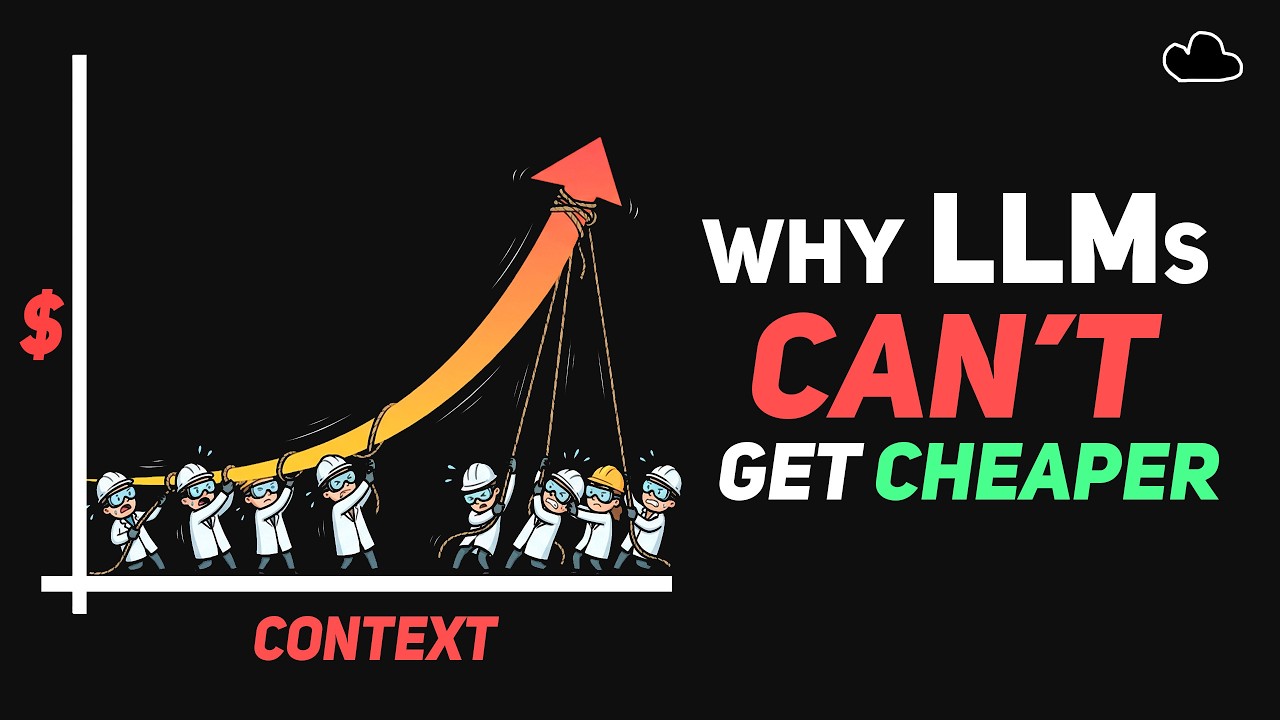
The video discusses the escalating costs and technical challenges associated with scaling large language models (LLMs), particularly as token consumption has surged due to the rise of advanced “thinking models” and AI agents. In 2024 and 2025, models began solving complex problems by generating thousands of tokens, and agent-based AI further increased token usage by requiring models to orchestrate complex processes and tool integrations. This has rendered previously large context windows, like 64k tokens, insufficient for practical use, especially in fields like software development. The quadratic growth in compute and memory costs due to standard attention mechanisms has become a significant bottleneck, making it clear that fundamental changes are needed to support context windows of 256k to 10 million tokens.
To address these challenges, the video introduces three main approaches to scaling attention efficiently: sparse attention, linear attention, and compressed attention. Sparse attention restricts which tokens can interact, reducing computational complexity from quadratic to linear, but risks forgetting important information. Linear attention changes how information is stored and retrieved, accumulating token information in a shared memory, which allows for linear scaling but can degrade performance. Compressed attention, as seen in DeepSeek’s Multi-Head Linear Attention (MLA), compresses tokens into smaller representations before comparison, making the process cheaper but still fundamentally quadratic in complexity.
The video reviews recent research and model releases that experiment with these attention mechanisms. For example, Minimax’s Minimax01 and M1 models explored custom linear attention, finding that pure linear attention performed poorly unless hybridized with standard attention. However, even with these hybrids, practical performance lagged behind standard attention models, leading Minimax to revert to standard attention in their M2 model. Other models, like Quinn 3 Next and Moonshot AI’s K-Linear, introduced state-space and feature-wise forgetting mechanisms to improve memory management and long-context performance, with varying degrees of success.
Despite these innovations, the video notes that no single approach has yet delivered both high performance and efficient scaling for extremely large context windows. Linear attention hybrids show promise but still face significant trade-offs in quality and reliability. Meanwhile, Google’s Gemini 3 Flash model appears to have made a breakthrough, achieving high performance at a fraction of the cost and outperforming competitors like Claude 4.5 Sonnet, suggesting that Google may have solved some of the fundamental challenges of efficient attention at scale. Similarly, the latest Claude 4.6 Opus model has demonstrated remarkable long-context retrieval performance, indicating ongoing architectural breakthroughs in the field.
The video concludes by emphasizing the rapid pace of research and the importance of staying informed about the latest developments. The presenter encourages viewers to subscribe to their newsletter for early access to research trends and thanks supporters and sponsors. The overall message is that while efficient attention mechanisms are advancing, the quest for scalable, high-performing LLMs is ongoing, with major players like Google and Anthropic leading the way in overcoming the billion-dollar problem of LLM scaling.