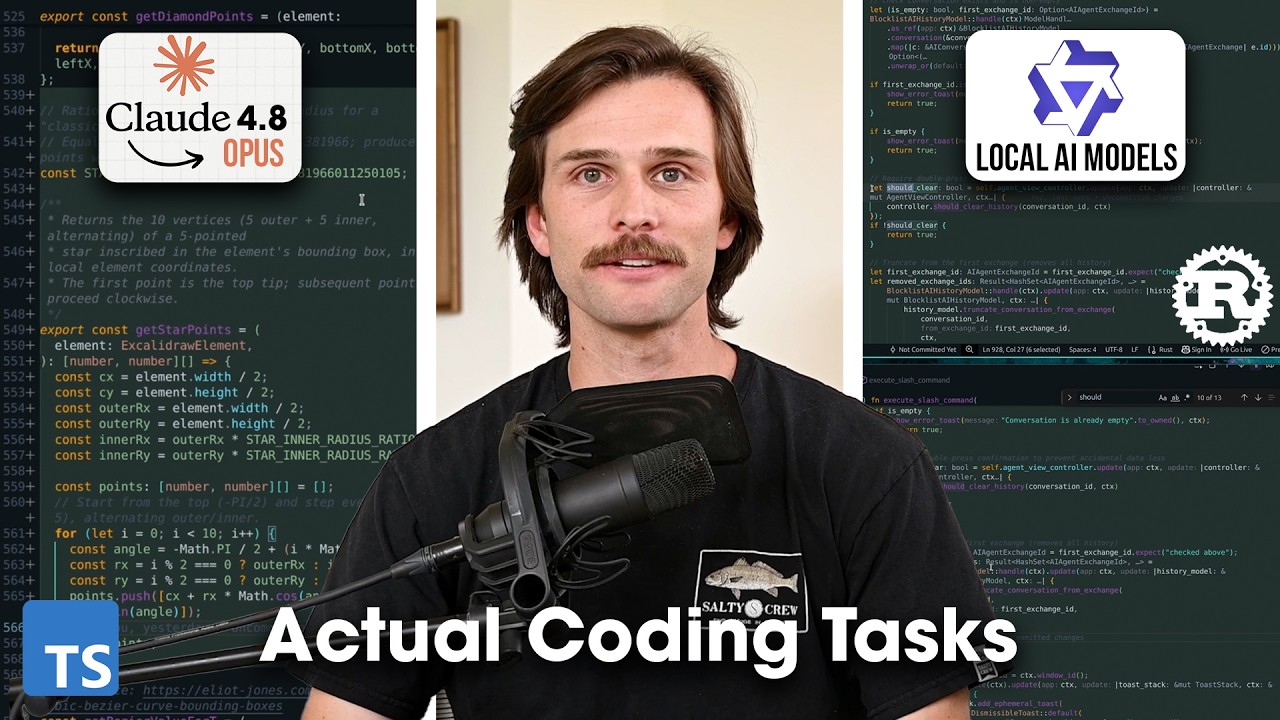
The video explores the recent advancements in local AI models for coding, highlighting that local AI has finally reached a level where it can effectively assist in real-world software development. The creator tests two local AI models, Qwen-3-72B and Qwen-3.6-27B, against a frontier cloud-based model, Opus 4.7, using real production codebases in TypeScript (Excalidraw) and Rust (Warp). The motivation behind focusing on local AI is the need for developers working with sensitive or regulated codebases—such as defense, healthcare, or finance—who cannot send their code to cloud services due to compliance and security restrictions.
The hardware setup used for running these local models is a high-end AMD Ryzen Threadripper 9980X system paired with an AMD Radeon AI Pro R9 700 GPU, optimized for AI workloads with 32 GB of VRAM and 128 GB of DDR5 RAM. The local models are run using quantized versions to fit the GPU memory, with CPU offloading employed for the larger model. The video emphasizes that while frontier models run on massive cloud infrastructure, the local models are tested on the best consumer-available hardware, showcasing what is currently possible for local AI coding assistance.
In the TypeScript codebase Excalidraw, both local and frontier models successfully implemented tasks such as adding a highlighter mode and creating a five-pointed star shape. However, the frontier model produced cleaner, more architecturally sound code, while the local models sometimes took shortcuts or introduced minor bugs that could affect maintainability over time. Despite these imperfections, the local models demonstrated a significant improvement compared to previous years, managing to understand and modify complex codebases with reasonable accuracy.
For the Rust codebase Warp, the models were tasked with adding a clear history command and implementing command bookmarks. Both models passed basic compilation checks for the simpler task, but the frontier model’s implementation was architecturally cleaner, even if it did not fully meet the intended functionality. The local model achieved the desired behavior but with a less polished user experience. For the more complex bookmarks feature, the frontier model implemented most of the functionality but missed some execution details, while the local model struggled with numerous compilation errors and ultimately failed to produce a working solution.
The video concludes that while frontier cloud models remain superior in speed, architectural quality, and overall performance, local AI models have matured enough to be genuinely useful for developers who must keep their code and data on-premises. The local models require more precise prompting and task breakdowns to perform well and are significantly slower, but they can still assist with mundane or repetitive coding tasks. This makes them a valuable tool for developers in regulated industries or anyone wanting full control over their codebase, marking a promising step forward in local AI-assisted software development.