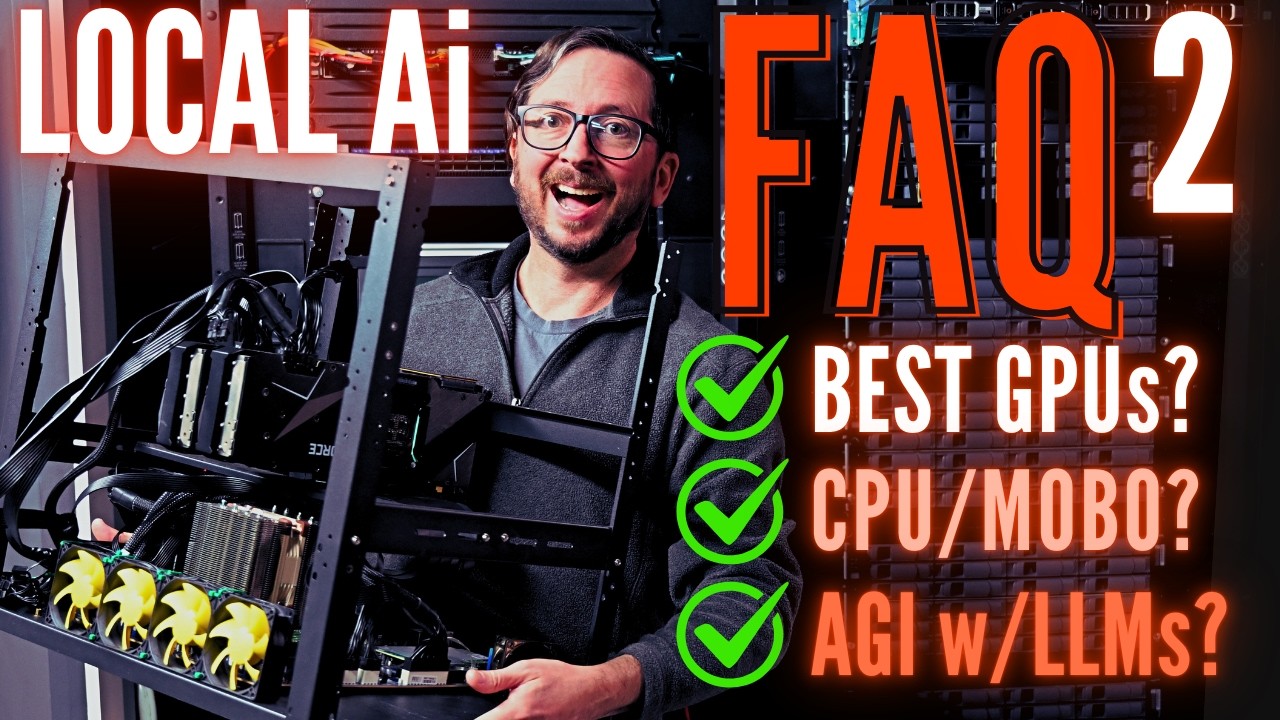
The video provides an in-depth overview of local AI hardware setups, emphasizing optimal CPU and GPU configurations, cooling solutions, and practical considerations for efficient AI inference and model training. It also discusses software interfaces, network limitations, market trends, and encourages viewers to engage with the broader local AI ecosystem beyond mainstream platforms.
The video begins by addressing a variety of questions related to local AI hardware setups, focusing heavily on CPU and GPU choices for AI inference and model training. The host discusses the AMD Epic 7F52 CPU, highlighting its strong single-thread performance and suitability for CPU-based inference tasks, especially when paired with adequate RAM and motherboard configurations to maximize bandwidth. He emphasizes the importance of single-thread speed for faster token propagation in AI models and explains how memory population affects system bandwidth, advising users to consider their DIMM slot usage carefully.
GPU configurations are a major topic, with recommendations on balancing lead GPUs like the RTX 4090 with follower GPUs such as the 5060 Ti. The host advises against having too many follower GPUs due to sharding complexities in software like VLM, suggesting a maximum of four GPUs for optimal performance and compatibility. He also touches on the challenges of GPU passthrough in Proxmox 9, noting that it remains straightforward with Nvidia GPUs, though specific driver choices like the MIT driver for the 5060 Ti are necessary. The discussion extends to eGPU setups, where the host explains that PCIe bandwidth limitations mainly affect model load times but not inference speed, making eGPUs viable for certain AI workloads.
The video also covers practical hardware considerations, including cooling solutions and chassis choices. Open mining rig frames are praised for their excellent airflow and cooling capabilities, despite potential noise concerns and the need for additional system fans to cool motherboard components. The host shares his experience fitting multiple GPUs into a rackmount setup, highlighting the challenges of cable management and the need for heavy-duty rail slides to support the weight of fully loaded rigs. He stresses the importance of keeping GPUs cool to maintain performance and hardware longevity.
On the software and AI model front, the host compares different local AI interfaces like Anything LLM and Open Web UI, noting that Anything LLM is faster but less versatile for multi-user or server setups. He discusses the limitations of network-based GPU sharing, explaining that even with high-speed 100 gigabit connections, the performance gains are modest and not the doubling some might expect. The host also critiques the current state of large language models, expressing skepticism about imminent AGI breakthroughs and emphasizing the need for open-source developments to advance the field.
Finally, the video addresses community questions about hardware longevity, market trends, and future-proofing. The host advises viewers to consider selling high-capacity DDR4 RAM soon due to changing market conditions and highlights the challenges expected in 2026 with inflation and hardware availability. He shares personal insights on energy costs and the importance of location when running power-intensive AI rigs. The video concludes with a call to action for viewers to educate others about the broader AI ecosystem beyond just OpenAI and ChatGPT, encouraging ongoing engagement with local AI technologies and promising more content on these topics in the future.