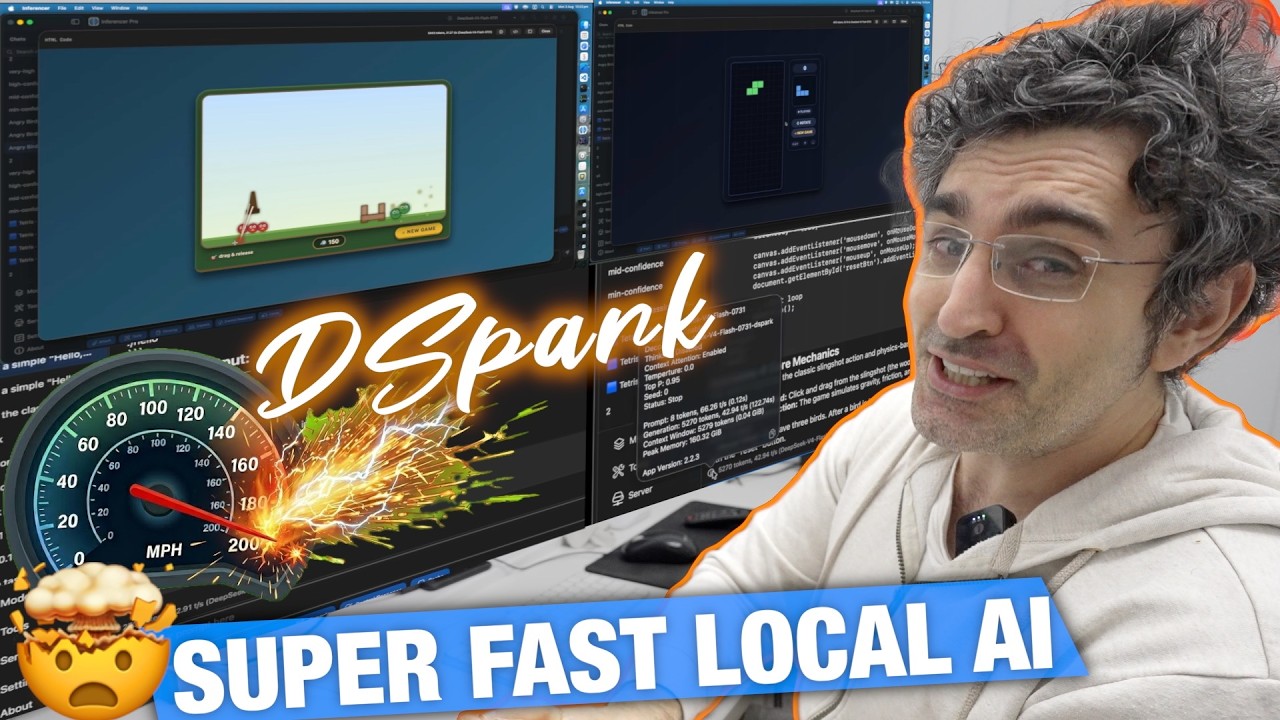
The video showcases how DeepSeek V4.07 combined with DSpark significantly accelerates token prediction speeds, especially in coding and syntax-heavy tasks, by predicting multiple tokens ahead while maintaining mathematically verified accuracy. Although DSpark demands more memory and may be less effective in creative writing compared to MTP, its optimized performance and speed gains make it a valuable upgrade for users prioritizing faster inference.
The video explores the performance enhancements of DeepSeek V4.07 when combined with a technology called DSpark, which aims to accelerate token prediction speeds significantly. The presenter compares the traditional MTP (Multi-Token Prediction) speculative decoder with the newer DSpark version, highlighting that DSpark predicts five tokens ahead instead of just a couple, which can lead to faster inference speeds, especially in syntax-heavy tasks like coding. Both methods guarantee mathematically accurate outputs since every predicted token is verified by the main model, ensuring reliability despite slight variations in results due to the stochastic nature of the model.
Initial tests show that the baseline DeepSeek V4 processes around 32 tokens per second, while enabling MTP boosts this to approximately 36 tokens per second. DSpark, after some optimizations, can push speeds even higher, reaching peaks of up to 80 tokens per second momentarily and averaging around 38 to 46 tokens per second depending on the task. The presenter notes that DSpark performs best with code-related prompts where token prediction confidence is high, allowing the model to guess subsequent tokens more accurately and quickly.
However, DSpark’s performance gains are less pronounced in creative writing or less syntax-heavy tasks. In such cases, MTP tends to maintain a slight edge in speed, with DSpark sometimes running slower due to the complexity of predicting multiple tokens ahead and the need to roll back when predictions fail. Despite this, the overall speed loss in creative tasks is minimal, making DSpark a viable option for general use, especially when speed is a priority.
The video also demonstrates large-scale generation tests, such as creating a Tetris game in HTML and an Angry Birds game, where DSpark consistently outperforms MTP and the baseline model in tokens per second. An optimization involving confidence thresholds for token acceptance further improves DSpark’s speed by reducing unnecessary rollbacks, balancing speed and accuracy effectively. The presenter emphasizes that while DSpark requires significantly more memory—about 10 GB more than MTP due to its three-layer architecture—the speed improvements can be substantial for users focused on coding and mathematical tasks.
In conclusion, DSpark offers a powerful upgrade for DeepSeek V4 users seeking faster inference speeds, particularly in coding scenarios. Although it demands more system resources and may not always outperform MTP in creative writing, its mathematically verified accuracy and potential for optimization make it a compelling choice. The presenter created the video to provide a realistic assessment of DSpark’s capabilities, addressing mixed feedback found online and helping users understand when and how to best utilize this technology.