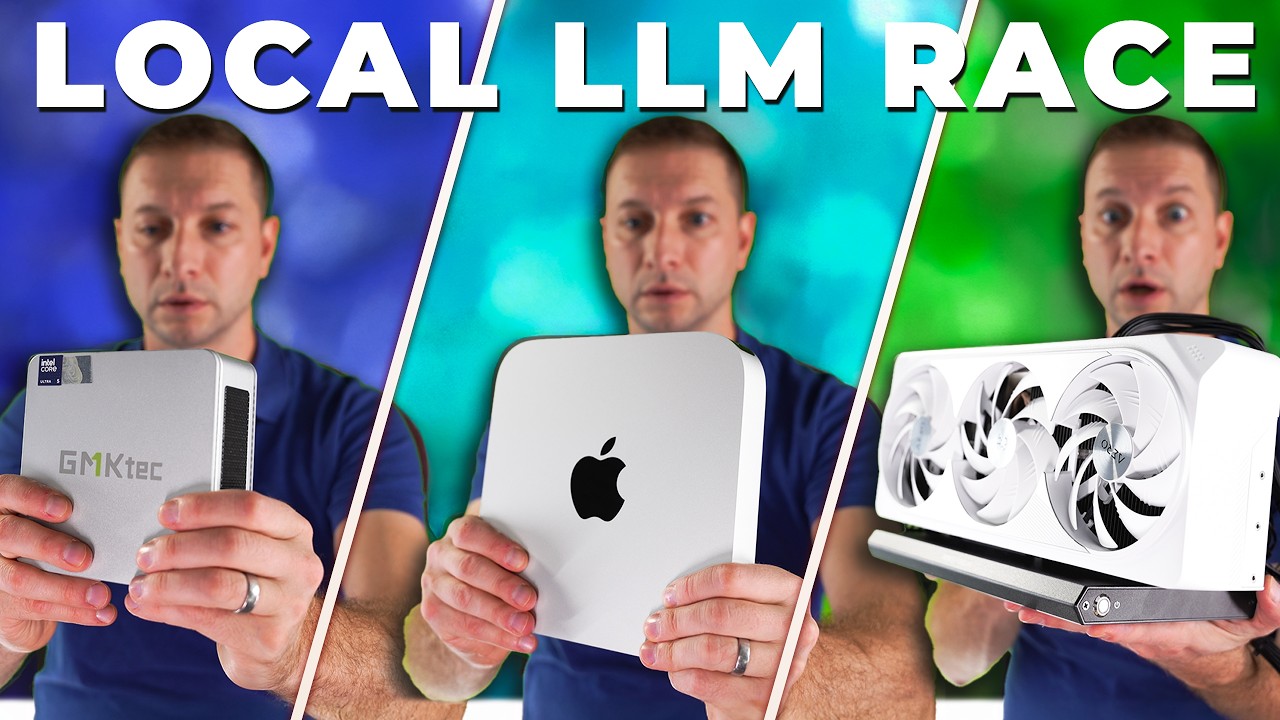
The video discusses the growing importance of running machine learning models locally, particularly to avoid ongoing cloud service costs. The presenter showcases a variety of consumer hardware setups, including an Intel NUC with a Core Ultra 5 processor, an M2 Pro Mac Mini, and a Mini PC with an RTX 490 GPU. The focus is on testing the performance of these systems using a 7 billion parameter model, comparing speed and efficiency across different configurations. The presenter emphasizes that while speed is crucial, efficiency also plays a significant role in determining the best setup for specific tasks.
As the video progresses, the presenter powers on the various machines and monitors their power consumption during idle and active states. Initial observations reveal that the Intel NUC and Mac Mini consume relatively low power, while the RTX 490 setup uses more energy. The presenter runs tests to generate a 1,000-word story using the models on each machine, noting that the RTX 490 is expected to perform the fastest due to its powerful GPU capabilities. However, the presenter also highlights the importance of model size and memory limitations, particularly with the RTX 490, which has a maximum of 24 GB of VRAM.
The presenter conducts multiple tests, switching between CPU and GPU processing on the Intel machine, and compares the results with the Mac Mini and RTX 490. The RTX 490 consistently outperforms the other machines in terms of speed, but the presenter notes that the initial data transfer from system RAM to VRAM can create a bottleneck. The Mac Mini, while slower than the RTX 490, demonstrates efficient performance with lower power consumption. The Intel machine, running on CPU, lags behind in speed but is tested for efficiency when using the Intel Arc integrated GPU.
After completing the tests, the presenter analyzes the results, focusing on tokens per second generated by each machine. The RTX 490 achieves significantly higher throughput compared to the Mac Mini and Intel NUC, especially for larger models. However, the presenter also considers factors such as time to first token and overall energy consumption, revealing that the Intel machine, despite its slower performance, consumes more energy over the course of the tests. The M2 Pro Mac Mini emerges as the most energy-efficient option, providing a balance of performance and lower operational costs.
In conclusion, the video emphasizes the trade-offs between speed, efficiency, and cost when selecting hardware for running local machine learning models. The presenter encourages viewers to consider their specific use cases, such as the need for fast responses in coding assistance or the importance of energy costs in different regions. Ultimately, while the RTX 490 offers the highest performance for long generation tasks, the M2 Pro Mac Mini stands out as the most cost-effective solution for everyday use. The presenter invites feedback and suggestions for future content, particularly regarding upcoming Intel hardware developments.