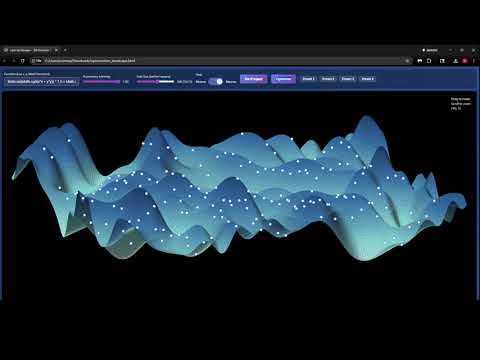
The video showcases an interactive open-source simulation that visualizes loss landscapes and demonstrates how optimization algorithms locate minima or maxima by iteratively refining search areas. It is part of the “Get Amplified” series aimed at accelerating AI learning, with the full project and additional educational resources available through the creator’s Patreon.
The video presents a visualization simulation of a loss landscape, which is a conceptual representation often used in training machine learning models or neural networks. The simulation displays a landscape with projected dots that represent points touching the surface. Users can interact with the simulation by selecting optimization targets such as minima or maxima. By clicking “optimize,” the simulation identifies the lowest or highest points on the landscape grid, demonstrating how optimization algorithms seek these critical points during training.
The simulation also allows users to define a search radius to refine the optimization process. When the radius is set, the simulation projects new dots within that area and refines the search iteratively. This process visually mimics how optimization algorithms progressively hone in on local minima or maxima. The video shows how, with each refinement, the points move closer to the bottom of a valley or the peak of a hill, effectively illustrating the concept of gradient descent or ascent in a tangible way.
Users can switch between searching for minima and maxima, and adjust parameters such as the projection grid size to increase the number of points considered during optimization. This flexibility helps demonstrate the behavior of optimization in different scenarios, including finding local maxima that may not be the highest overall peaks. The simulation thus provides an intuitive and interactive way to understand the dynamics of loss landscapes and optimization paths in machine learning.
The creator highlights that this simulation is part of a larger open-source project available for download on their Patreon page. It is introduced as part of the “Get Amplified” series, which includes 12 open-source projects aimed at accelerating creativity and learning in AI and programming. The series is designed to help users think and build faster, sharing insights gained from the creator’s extensive experience working with AI over the past three years.
Finally, the video encourages viewers to explore the simulation and consider supporting the creator by becoming a patron. Patrons gain access to this course, other educational content, weekly meetings, and consulting opportunities. The course is also available for purchase separately, but membership offers a more cost-effective option. The creator expresses pride in the series and invites viewers to engage with the content to enhance their understanding and skills in AI and optimization.