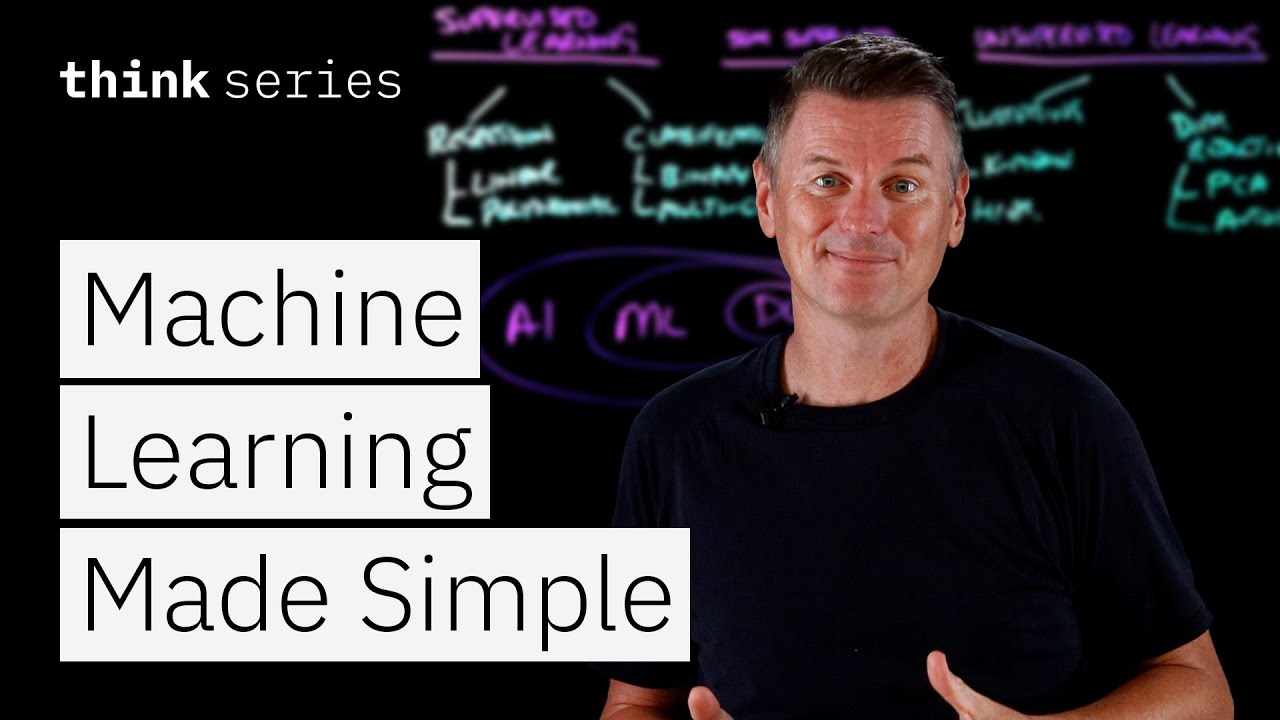
The video begins by explaining the concept of machine learning (ML) as a subset of artificial intelligence (AI) focused on algorithms that learn patterns from training data to make predictions or decisions without explicit programming. It clarifies the relationship between AI, ML, and deep learning (DL), noting that ML is a subset of AI, and DL is a further subset of ML that uses multi-layered neural networks to learn hierarchical data representations. The core idea of ML is model training, where a model is optimized on a dataset to perform well on similar real-world tasks, and once trained, the model can make predictions on new data during a phase called AI inference.
The video then outlines the three main learning paradigms in machine learning: supervised learning, unsupervised learning, and reinforcement learning. Supervised learning involves training models on labeled data to predict outputs, such as classifying emails as spam or not spam. Unsupervised learning works with unlabeled data to discover inherent structures, including clustering and dimensionality reduction. Reinforcement learning involves an agent interacting with an environment, learning to maximize rewards through trial and error by balancing exploration and exploitation.
Within supervised learning, the video highlights two primary types of models: regression and classification. Regression models predict continuous numerical values, such as prices or temperatures, with examples including linear and polynomial regression. Classification models predict discrete categories, such as binary classification (fraud or legit) or multi-class and multi-label classification. It also mentions ensemble methods, which combine multiple models to improve accuracy, and semi-supervised learning, which uses a small amount of labeled data alongside a larger pool of unlabeled data to enhance model performance while reducing labeling costs.
For unsupervised learning, the video discusses clustering and dimensionality reduction. Clustering groups similar items together, with methods like k-means clustering, which partitions data into k groups, and hierarchical clustering, which builds a tree of clusters that can be cut at different levels for varying granularity. Dimensionality reduction techniques, such as principal component analysis (PCA) and encoders, reduce the number of features in data while preserving meaningful information, aiding in data compression, visualization, and preprocessing.
Finally, the video touches on reinforcement learning, where an agent learns policies to maximize long-term rewards by interacting with an environment, receiving rewards or penalties based on its actions. An example is a self-driving car learning to navigate safely by balancing exploration and exploitation. The video concludes by noting that classic ML techniques like regression, classification, clustering, and reinforcement learning remain foundational in business applications today. It also highlights recent advances, such as large language models (LLMs) built on transformer architectures and reinforcement learning with human feedback (RLHF), which fine-tunes models based on human preferences, demonstrating how traditional ML concepts continue to evolve and scale in modern AI applications.